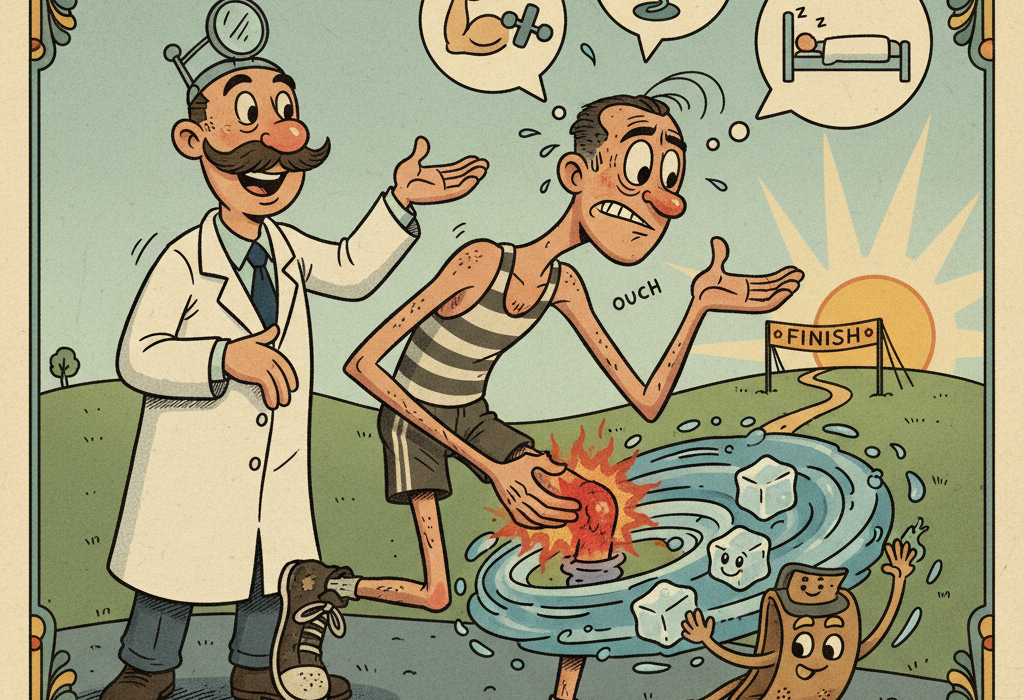
If you’ve ever felt a nagging ache around your kneecap after a long run, or a sharp burn on the outer side of your knee a few miles in, you’ve likely experienced what people casually call “runner’s knee.” But here’s the thing: “runner’s knee” isn’t actually one condition. It’s an umbrella term that covers at least two or three distinct knee problems, each with different causes and different treatments.
This matters because treating the wrong problem can waste months of recovery time. A 1980 article in The Physician and Sportsmedicine noted that up to 40% of all running injuries involve the knee, and a 1984 review found that 60% to 70% of regular runners get hurt badly enough to stop running temporarily. Decades later, knee pain remains the top reason runners seek medical help.
So what exactly is runner’s knee, what does the research say about treating it, and can you keep running through it? Let’s break it down.
What Is Runner’s Knee, Exactly?
The term “runner’s knee” most commonly refers to two conditions:
- Patellofemoral pain syndrome (PFP) (puh-TELL-oh-FEM-or-ul) – pain behind or around the kneecap. This is by far the most common type.
- Iliotibial band syndrome (ITBS) (ILL-ee-oh-TIB-ee-ul) – pain on the outer side of the knee, caused by irritation of a thick band of tissue that runs from your hip to your shin.
Sometimes the term also covers chondromalacia patellae (KON-droh-muh-LAY-shuh puh-TELL-ee), which refers to softening or damage of the cartilage on the underside of the kneecap. A 2021 review in Stem Cell Research & Therapy described chondromalacia patellae as an early-stage condition that may be reversible or may progress to osteoarthritis.
Each of these conditions feels different and responds to different treatments. That’s why getting the right diagnosis matters.
| Condition | Where It Hurts | Who Gets It Most | Main Triggers |
|---|---|---|---|
| Patellofemoral pain (PFP) | Behind/around kneecap | Young women, athletes, military recruits | Squatting, stairs, prolonged sitting, running |
| Iliotibial band syndrome (ITBS) | Outer side of knee | Runners, cyclists | Repetitive knee bending, downhill running |
| Chondromalacia patellae | Behind kneecap (deeper) | Young adults, especially women | Overuse, trauma, anatomical factors |
How Common Is Runner’s Knee?
Very common. A 2018 meta-analysis in PLoS ONE found that patellofemoral pain has an annual prevalence of about 22.7% in the general population and 28.9% in adolescents. Among novice female runners, the incidence was strikingly high at roughly 1,081 cases per 1,000 person-years. In female adolescent athletes, point prevalence was around 22.7%.
ITBS is somewhat less common but still significant. A 2012 systematic review in Sports Medicine estimated that ITBS accounts for 5% to 14% of all running-related injuries and is the most common cause of lateral (outer) knee pain in runners. A 2022 narrative review in Sports Medicine confirmed that ITBS remains one of the leading causes of lateral knee pain in the running population.
These numbers tell us something important: runner’s knee isn’t a rare fluke. If you run regularly, your odds of experiencing some form of it are substantial.
What Causes Each Type of Runner’s Knee?
Patellofemoral Pain
The causes of PFP are not fully understood, which is part of what makes it frustrating. A 2019 meta-analysis in the British Journal of Sports Medicine involving 4,818 participants found that many commonly blamed factors, including body weight, BMI, body fat percentage, age, and the Q angle of the knee, were not actually risk factors for developing PFP.
What did predict PFP? In military recruits, quadriceps weakness was a clear risk factor, especially when strength was measured relative to body mass. Interestingly, in adolescents, increased hip abduction strength predicted future PFP, possibly because stronger hips were a marker of higher activity levels rather than a direct cause.
A 2016 clinical review in the British Journal of Sports Medicine noted that other features associated with PFP include a shallower femoral groove (the track the kneecap glides in), altered lower limb movement patterns (more hip adduction and internal rotation), and weakness in the quadriceps and hip muscles.
Iliotibial Band Syndrome
ITBS was traditionally thought to be caused by friction of the IT band sliding back and forth over the bony bump on the outer side of the knee (the lateral femoral epicondyle). More recent research challenges this view. A 2022 review in Physical Therapy in Sport explained that cadaveric studies show the IT band is actually firmly attached to the epicondyle and doesn’t truly slide. Instead, the current leading theory is a compression model: excessive tension in the IT band compresses the fat pad and other sensitive tissues underneath it, causing inflammation and pain.
A 2005 review in Sports Medicine and a 2011 review in the Journal of the American Academy of Orthopaedic Surgeons both identified training errors as major contributors, including running too many miles too quickly, running downhill frequently, and always running in the same direction on a track. Hip abductor weakness has also been linked to ITBS, though the evidence is mixed.
A 2020 ultrasound study in the Journal of Ultrasound described typical imaging findings of ITBS: swelling or fluid collection between the IT band and the lateral femoral epicondyle, rather than damage to the band itself.
Does Running Itself Damage Your Knees?
This is one of the most common questions runners ask, and the research is reassuring. A 2023 systematic review in the Orthopaedic Journal of Sports Medicine analyzed 17 studies involving over 14,000 people (7,194 runners and 6,947 non-runners). The findings:
- Runners reported less knee pain than non-runners (28.2% vs. 41%, a statistically significant difference)
- Multiple studies found no significant differences in radiographic signs of knee osteoarthritis between runners and non-runners
- MRI studies showed no differences in cartilage thickness between the groups
- One study found non-runners were actually more likely to need a total knee replacement (4.6% vs. 2.6%)
The review concluded that running, in the short term, is not associated with worsening knee osteoarthritis and may actually be protective against generalized knee pain.
That said, these are observational studies, so they can’t prove running causes protection. It’s possible that people with healthier knees are simply more likely to become and remain runners (a form of selection bias). Still, the consistent pattern across multiple studies is reassuring: moderate running does not appear to destroy your knees.
Related: Intermittent Fasting: What the Latest Science Actually Says
What Treatments Work for Patellofemoral Pain?
PFP has the most treatment research behind it. A 2022 systematic review of randomized controlled trials in the British Journal of Sports Medicine evaluated prevention and management strategies for running-related knee injuries. Here’s what the evidence supports:
Exercise Therapy
Physiotherapist-led exercise is the backbone of PFP treatment. The 2016 clinical review reported that six weeks of quadriceps and hip strengthening exercises significantly reduced pain and improved function compared with watchful waiting, with a number needed to treat of 3.6 (meaning roughly 1 in 4 patients benefit specifically from exercise).
A 2019 review in Annals of Translational Medicine recommended a multimodal approach: strengthening the quadriceps and hip muscles, combined with movement retraining and, when appropriate, patellar taping or mobilization.
Running Technique Retraining
The 2022 British Journal of Sports Medicine review found low-certainty evidence that retraining runners to “land softer” reduced knee injury risk by roughly two-thirds (risk ratio 0.32) in one trial of 320 participants. For runners already experiencing PFP, technique retraining also reduced pain in the short term.
Foot Orthoses
Off-the-shelf shoe insoles with a medial arch support have shown modest benefit. The 2016 review cited a high-quality trial where prefabricated insoles outperformed flat sham insoles.
Osteopathic Manipulation
A 2020 randomized controlled trial in the Journal of Sport Rehabilitation compared osteopathic manipulative treatment (joint manipulation and myofascial release) with a structured exercise program in 82 runners with PFP. Both groups experienced significant pain reduction compared with a control group. The osteopathic group also showed improved flexibility and function.
What Doesn’t Work Well
Traditional physical agents used alone, such as ice, ultrasound therapy, electrical stimulation, and laser, have not been shown to meaningfully reduce PFP pain, according to the 2016 review. Patellar taping alone is also ineffective as a standalone treatment, though it can enhance an exercise program.
The Role of Fear and Psychology
An often-overlooked factor is kinesiophobia (kin-EE-zee-oh-FOH-bee-uh), the fear of movement or re-injury. A 2023 systematic review in Physical Therapy analyzed 41 studies involving 2,712 people with PFP and found that higher kinesiophobia was moderately associated with poorer function. Very low-certainty evidence suggested that interventions specifically targeting fear of movement (including education, psychobehavioral strategies, and self-managed exercise) may reduce kinesiophobia more effectively than standard physical therapy alone.
This is a reminder that knee pain isn’t purely mechanical. How you think about your pain can affect how well you recover.
What Treatments Work for IT Band Syndrome?
ITBS treatment has far less high-quality evidence behind it. A 2012 systematic review concluded that the methodological quality of ITBS research was poor and results were highly conflicting.
Here’s what the available evidence and expert recommendations suggest:
Acute Phase
The 2005 Sports Medicine review and the 2019 Annals of Translational Medicine review both recommend:
- Rest from aggravating activities (especially running)
- Ice or other anti-inflammatory modalities
- NSAIDs (such as ibuprofen) for pain and inflammation
- In severe cases, a corticosteroid injection guided by ultrasound can relieve symptoms. The 2020 ultrasound study confirmed that ultrasound-guided steroid injections are effective for symptom relief.
Rehabilitation Phase
The 2022 Physical Therapy in Sport review critically evaluated common rehabilitation strategies against a biomechanical model of ITBS:
- Hip strengthening: Commonly recommended, but potentially a double-edged sword. While stronger hip abductors may correct excessive hip adduction during running, they can also increase tension through the IT band. The review recommended focusing on muscular endurance rather than maximum strength, and following strengthening with measures to reduce muscle tone.
- Stretching: Unlikely to produce lasting changes in IT band length or stiffness based on evidence from other tendons. Short-term muscle relaxation effects disappear within about 30 minutes. Stretching may still help as part of a routine but should not be expected to fix the underlying problem.
- Soft tissue techniques (massage, foam rolling): Effective at temporarily reducing symptoms and muscle tone but effects are very short-lived (as little as 3 minutes in some studies). Best used as preparation for other treatments.
- Running retraining: The most promising but least studied approach. Two case reports showed significant improvements in pain and function. The review concluded that correcting individual running mechanics may address the root cause more effectively than strengthening alone.
The 2005 review offered a practical timeline: most patients fully recover within 6 weeks using a comprehensive approach. Interestingly, biomechanical studies show that faster-paced running is less likely to aggravate ITBS because the knee is flexed beyond the 30-degree “impingement zone” at foot strike. So when returning to running, faster strides may initially be better than slow jogging.
Surgery
Surgery for ITBS is rare and reserved for truly refractory cases. Options include releasing or lengthening the posterior portion of the IT band at the point of peak tension, according to the 2005 review and the 2011 JAAOS review.
Emerging Treatments: Stem Cell and Cell Therapies
For cases where cartilage damage is involved (as in chondromalacia patellae), researchers are exploring cell-based therapies. The 2021 Stem Cell Research & Therapy review summarized the current state:
- Mesenchymal stem cell (MSC) injections have shown safety and some benefit in small studies and case reports. One case series of 3 patients with chondromalacia who received adipose-derived stem cells (mixed with platelet-rich plasma and hyaluronic acid) reported 80-90% pain reduction and MRI evidence of cartilage restoration.
- Autologous chondrocyte implantation (growing a patient’s own cartilage cells and implanting them) has been used for larger cartilage defects, with FDA-approved products available.
However, these therapies are still early-stage for runner’s knee specifically. The MSC case studies lacked control groups, used combination treatments, and involved very few patients. These approaches are not yet standard care and require much more rigorous testing.
Who Should Be Cautious?
- People with a history of patellar dislocation or instability should get a thorough evaluation before starting a running program.
- Adolescents during growth spurts are particularly vulnerable to PFP. The 2016 review noted that patellofemoral pain is especially problematic during rapid growth periods.
- Runners over 40 with persistent pain may want imaging to check for early osteoarthritis. The 2016 review noted that approximately 70% of people over 40 with patellofemoral pain showed radiographic signs of osteoarthritis in community studies.
- Anyone with red flags like fever, significant swelling, warmth over the knee, or night pain should seek prompt medical evaluation, as these may indicate infection or other serious conditions.
Practical Guidance for Runners
Based on the research, here are evidence-informed steps for managing runner’s knee:
For patellofemoral pain:
1. Start with a physiotherapist-led exercise program focusing on quadriceps and hip strengthening
2. Consider off-the-shelf foot orthotics with arch support
3. Patellar taping may help as an add-on to exercise (not alone)
4. Ask about running technique retraining, particularly landing softer
5. Address any fear of movement with education and gradual exposure
6. Expect improvement within 6-12 weeks
For IT band syndrome:
1. Reduce or stop running temporarily in the acute phase
2. Use ice and anti-inflammatory medication for initial symptom relief
3. Focus hip exercises on endurance rather than maximum strength
4. Incorporate foam rolling and stretching, but don’t rely on them alone
5. Work with a professional on running mechanics (step width, cadence, hip drop)
6. When returning to running, try faster-paced strides on flat ground; avoid downhill running initially
For both conditions:
- Don’t increase weekly mileage by more than 10% per week
- Vary running surfaces and directions
- Maintain flexibility in the calves, hamstrings, and hip flexors
- Seek professional evaluation if pain persists beyond 2-3 weeks of self-management
Common Questions About Runner’s Knee
Can I run through runner’s knee?
It depends on severity. Mild PFP often allows continued running with modifications (reduced distance, softer surfaces). ITBS typically worsens with continued running and usually requires a period of rest. In both cases, pain that alters your running form is a signal to stop.
Will running give me arthritis?
Current evidence suggests recreational running does not increase the risk of knee osteoarthritis and may even be protective. A systematic review of over 14,000 participants found no increased rates of radiographic knee osteoarthritis in runners compared with non-runners.
Do I need an MRI?
Usually not. Runner’s knee is primarily diagnosed through history and physical examination. The 2016 clinical review noted that MRI has limited diagnostic accuracy for low-grade cartilage lesions and that cartilage damage on MRI correlates poorly with symptoms. Imaging is mainly useful for ruling out other conditions when symptoms don’t respond to treatment.
Is foam rolling the IT band helpful?
It may provide temporary relief, but the effects are very short-lived. The 2022 biomechanical review found that foam rolling-induced reductions in muscle tension can disappear within 3 minutes. It’s best used as a warm-up to other treatments rather than as a standalone fix.
The Bottom Line
Runner’s knee is an umbrella term that covers several distinct knee conditions, primarily patellofemoral pain and iliotibial band syndrome. These are among the most common injuries in runners, affecting a substantial percentage of the running population.
The best-supported treatment for patellofemoral pain is physiotherapist-guided exercise therapy targeting the quadriceps and hip muscles, often combined with foot orthoses or patellar taping. Running technique retraining, particularly learning to land more softly, shows promise for both prevention and treatment.
For IT band syndrome, current treatment recommendations are based more on biomechanical reasoning and expert opinion than on high-quality clinical trials. Rest, anti-inflammatory measures, hip endurance training, and running form correction form the core approach, but stronger research is needed.
Reassuringly, recreational running itself does not appear to damage healthy knees or accelerate osteoarthritis. Most cases of runner’s knee respond well to conservative treatment within 6 to 12 weeks. The key is identifying which specific condition you’re dealing with and targeting your treatment accordingly.
Quick Reference: Key Studies
| Study Focus | Key Finding | Source |
|---|---|---|
| Running and knee osteoarthritis (systematic review, 14,141 participants) | Running not associated with worsening knee OA; may protect against knee pain | PMID 36875337 |
| Patellofemoral pain prevalence (meta-analysis, 23 studies) | Annual prevalence ~22.7% in general population; ~28.9% in adolescents | PMID 29324820 |
| Risk factors for PFP (meta-analysis, 4,818 participants) | Quadriceps weakness predicts PFP in military; BMI, weight, age are not risk factors | PMID 30242107 |
| Prevention/management of knee injuries in runners (30 RCTs) | Running retraining to land softer reduced knee injury risk by ~two-thirds | PMID 36150753 |
| Kinesiophobia and PFP (41 studies, 2,712 participants) | Fear of movement moderately associated with poorer function in PFP | PMID 37354454 |
| Conservative treatment of ITBS (biomechanical review) | Hip strengthening may increase ITB tension; running retraining most promising | PMID 35007886 |
| Osteopathic manipulation vs. exercise for PFP (RCT, 82 runners) | Both OMT and exercise significantly reduced pain vs. control | PMID 33333491 |
| ITBS in runners (systematic review) | Poor evidence quality; hip/knee coordination and running style are key treatment factors | PMID 22994651 |
| IT band anatomy and function (narrative review) | ITB is uniquely human; compression model preferred over friction model for ITBS | PMID 35072941 |
| Chondromalacia patellae and cell therapies (review) | MSC injections show early promise but lack rigorous clinical evidence | PMID 34275494 |
| ITBS evaluation and management (clinical review) | Diagnosis based on history/exam; conservative treatment is mainstay | PMID 22134205 |
| ITBS ultrasound findings | Edema/fluid deep to ITB more typical than ITB thickening | PMID 32514741 |
| PFP clinical management (clinical review) | Exercise therapy NNT of 3.6; benefits expected 6-12 weeks | PMID 26834209 |
| ITBS treatment innovations (review) | Triplanar exercises and hip strengthening; most recover by 6 weeks | PMID 15896092 |
| Evidence-based treatment for common runner knee injuries | Multimodal approach recommended: exercise, manual therapy, neuromuscular re-education | PMID 31728373 |
Last updated: February 2026
This article synthesizes findings from peer-reviewed research. It is for educational purposes only and does not constitute medical advice. Consult a healthcare provider before starting any new regimen.


Leave a Reply