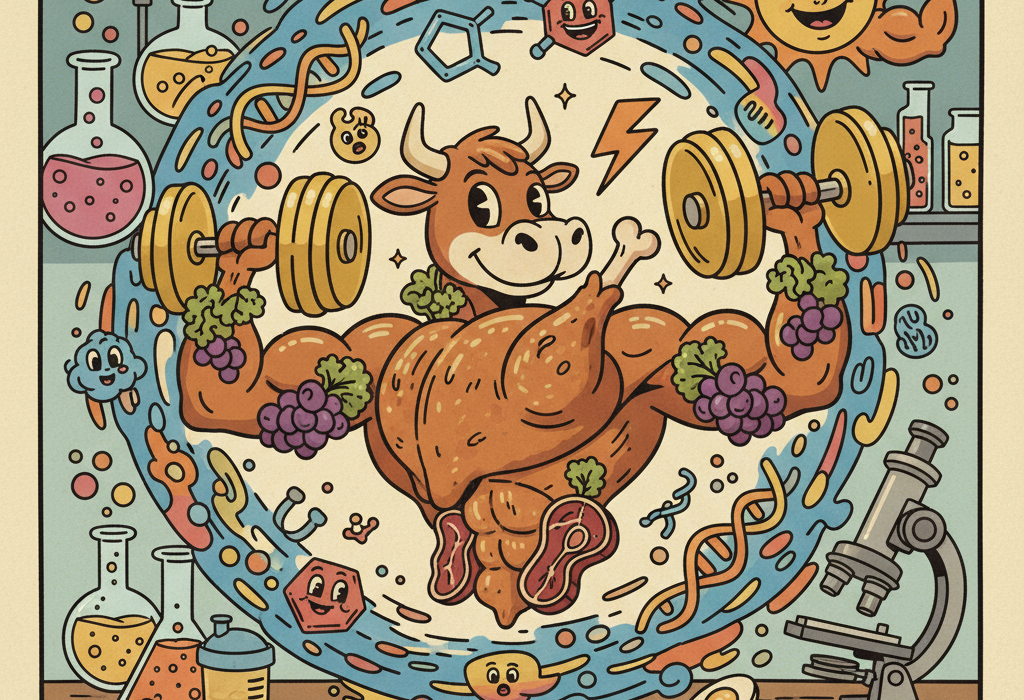
Think of Your Body Like a Construction Site
Imagine your body is a building under constant renovation. Every time you lift weights, you are essentially tearing down walls so they can be rebuilt stronger. But rebuilding takes supplies: bricks (protein), energy to power the crew (carbohydrates), water to mix the mortar (hydration), and downtime for the crew to rest (sleep and recovery).
Bodybuilders push this renovation process to the extreme. They spend months or years adding muscle, then diet down to very low body fat levels before a competition. Getting this right requires a careful nutrition plan. But what does the science actually say about how to eat for muscle? And do the strategies used by real-world bodybuilding coaches match up with the research?
Two recent studies help answer those questions. One is a 2025 review in the journal Life that updates a science-backed framework for post-exercise recovery nutrition called the “4Rs.” The other is a 2023 survey published in the Journal of Functional Morphology and Kinesiology that asked 33 experienced bodybuilding coaches about their actual nutrition, supplement, and training recommendations. Together, they paint a useful picture of what works, what might work, and what still needs more research.
What the Research Shows
The 4Rs Framework: A Science-Based Recovery Plan
The 2025 review in Life lays out an updated version of the “4Rs” of sports nutrition. This framework was originally developed in 2020 and organizes post-workout nutrition into four stages:
| The 4Rs | What It Means | Key Recommendation |
|---|---|---|
| Rehydrate | Replace fluids lost during exercise | Drink at least 150% of the body weight you lost during exercise, with sodium if faster replacement is needed |
| Refuel | Restore energy (glycogen) in muscles | About 1.2 g of carbohydrates per kg of body weight per hour, for up to 4 hours after exercise |
| Repair | Rebuild damaged muscle tissue | Eat high-quality protein after exercise; creatine monohydrate may also help |
| Recuperate | Allow systems to fully recover | Eat a slow-digesting protein (like casein) before sleep; prioritize quality sleep |
The idea is straightforward: your body needs different things at different times after a workout. Skip any of these steps, and you may slow down your progress or increase your risk of overtraining.
The review also introduces a concept called allostatic load (al-oh-STAT-ik load), which is basically the total amount of physical stress your body is carrying. Think of it like a stress meter. Every hard workout, every night of bad sleep, every skipped meal adds to that meter. If the meter gets too high for too long, your body starts breaking down instead of building up. The researchers propose that tracking certain blood markers and recovery signs can help athletes and coaches know when to push harder and when to pull back.
A key takeaway from this review: ketogenic diets (very low-carb, high-fat diets) generally have “neutral or negative effects on athletic performance compared to carbohydrate-rich diets.” For bodybuilders who need to train hard and recover fast, carbs appear to matter.
What Bodybuilding Coaches Actually Recommend
The 2023 coach survey took a different approach. Instead of reviewing lab studies, researchers surveyed 33 coaches who work with competitors in the IFBB Professional League and National Physique Committee (NPC), the largest bodybuilding organizations. These coaches work with athletes in the most muscular divisions for both men and women.
Here is what the coaches reported:
#### Protein Intake
Coaches recommended no less than 2 g of protein per kg of body weight per day, regardless of sex, division, or whether the athlete uses performance-enhancing drugs (PEDs). Some recommendations went as high as 4.84 g/kg/day for enhanced (PED-using) male competitors.
How does this compare to the science? Current research suggests that protein intakes of about 1.6 g/kg/day maximize muscle gains in most trained people. Some researchers suggest going up to 2.2 g/kg/day as a practical upper target. That means many coaches are recommending protein levels that are 1.5 to 2.5 times higher than what research has shown to be necessary.
However, and this is important, most protein studies have not been done on highly muscular, competitive bodybuilders. It is possible that people carrying significantly more muscle mass than the average gym-goer have higher protein needs. We just do not have enough research to confirm this yet.
| Population | Coach Recommendation (g/kg/day) | Research Recommendation (g/kg/day) |
|---|---|---|
| Natural athletes (off-season) | 2.0 to 3.3 | 1.6 to 2.2 |
| Enhanced females (off-season) | 2.0 to 3.85 | Limited data |
| Enhanced males (off-season) | 2.0 to 4.84 | Limited data |
#### Meal Frequency
Coaches recommended 3 to 7 meals per day, which aligns well with the scientific recommendation of 3 to 6 protein feedings per day. Recent research suggests that spreading protein intake roughly evenly across meals may help optimize muscle protein synthesis (MUS-ul PRO-teen SIN-thuh-sis), the process by which your body builds new muscle tissue. For younger men, about 0.40 g of protein per kg per meal appears to be a practical target per feeding.
#### Cardiovascular Exercise
About two-thirds of coaches recommended fasted cardio (doing cardiovascular exercise on an empty stomach). Their reasoning was mainly practical: athletes prefer to do cardio in the morning, and some coaches believe that certain fat-burning supplements or drugs work better in a fasted state.
However, a systematic review found that fasted cardio is not more effective for fat loss than fed cardio. The catch? None of those studies looked at competitive bodybuilders using specific PEDs alongside fasted exercise. So the jury is still out for that specific combination.
Coaches overwhelmingly preferred low-intensity steady state (LISS) and moderate-intensity steady state (MISS) cardio over high-intensity interval training (HIIT). This aligns with the evidence: research shows HIIT and MISS produce similar fat loss, but HIIT adds more recovery demand, which can interfere with weight training during a calorie deficit.
| Cardio Type | Coach Preference | What Research Says |
|---|---|---|
| LISS (walking, easy cycling) | Very common | Effective; less recovery cost |
| MISS (brisk walk, moderate effort) | Very common | Effective; similar fat loss to HIIT |
| HIIT (sprints, intervals) | Rarely recommended | Effective but adds fatigue; not ideal during dieting |
#### Supplements
The most commonly recommended supplements across all groups were:
1. Creatine monohydrate (KREE-uh-teen MON-oh-HY-drayt): A well-studied supplement that helps with strength and lean mass gains. It was ranked number one or two across nearly every category.
2. Fish oil / Omega-3 fatty acids: Recommended for general health and recovery. The 2025 review also notes omega-3s as a supplement that “deserves further clinical research” for recovery, though evidence for direct muscle-building effects is limited.
3. Caffeine: Commonly used during contest preparation to boost energy expenditure and workout performance.
4. Protein supplements: Used to help athletes hit their daily protein targets.
The 4Rs framework review specifically highlights creatine monohydrate as a supplement that “might help to enhance recovery.” It also mentions tart cherry extract, dietary nitrate (from foods like beets), and flavonoid-rich polyphenols as areas deserving more study.
Where Coaches and Science Agree (and Disagree)
| Topic | Coaches Say | Science Says | Alignment |
|---|---|---|---|
| Protein amount | At least 2 g/kg/day, often higher | 1.6 to 2.2 g/kg/day for most | Partial: coaches go higher than proven necessary |
| Meal frequency | 3 to 7 meals/day | 3 to 6 meals/day | Strong agreement |
| Carb importance | Not directly asked, but diet variety implied | Essential for recovery and performance | Supported by 4Rs framework |
| Fasted cardio | ~67% recommend it | No proven fat loss advantage | Coaches rely on anecdotal/practical reasons |
| Creatine | Top supplement recommendation | Strong evidence for effectiveness | Strong agreement |
| HIIT cardio | Rarely recommended | Effective but adds fatigue | Strong agreement |
| Pre-sleep protein | Not directly asked | Casein or slow-digesting protein before bed aids recovery | Supported by 4Rs framework |
Who This Applies To
These findings are most relevant to:
- Competitive bodybuilders preparing for shows, whether natural or enhanced
- Recreational lifters who want to optimize their nutrition for muscle building
- Coaches and trainers working with physique athletes
- Anyone doing intense resistance training who wants to recover better
Who Should Be Careful
- People with kidney conditions should talk to a doctor before adopting very high protein intakes. While high protein has not been shown to damage healthy kidneys, existing kidney issues are a different story.
- Anyone considering PEDs should understand that the health risks are serious. The coach survey documented that coaches recommend PED dosages for male bodybuilders ranging from 300 to 4,000 mg/week of total substances. The 4Rs review notes that PED abuse in recreational exercisers and amateur bodybuilders “is increasingly recognized as a serious public health concern.”
- People in prolonged calorie deficits should watch for signs of relative energy deficiency in sport (RED-S), a condition where you are not eating enough to support both your training and basic body functions. Symptoms can include hormonal disruption, weakened bones, and suppressed immunity. The 4Rs review emphasizes that energy availability should stay above 30 kcal per kg of fat-free mass per day.
How to Actually Use This Information
You do not need to be a competitive bodybuilder to benefit from these findings. Here is a practical breakdown based on the combined research:
Step 1: Prioritize Protein, But Do Not Go Overboard
Aim for about 1.6 to 2.2 g of protein per kg of body weight per day. For a 180-pound (82 kg) person, that is roughly 130 to 180 grams of protein daily. Spread it across 3 to 5 meals.
Step 2: Do Not Fear Carbs
Carbohydrates refuel your muscles after training. The 4Rs framework recommends about 1.2 g of carbs per kg of body weight per hour after intense exercise, for up to 4 hours. Even outside that window, adequate daily carb intake supports training quality and immune function.
Step 3: Hydrate After Training
Drink at least 150% of the weight you lost during your workout. If you lost 1 pound (about 0.5 kg), drink at least 24 ounces (about 700 mL) of fluid. Adding some sodium (a pinch of salt or an electrolyte drink) can speed rehydration.
Step 4: Consider Evidence-Based Supplements
- Creatine monohydrate: 3 to 5 grams per day. One of the most studied and consistently supported supplements for strength and muscle.
- Omega-3 fish oil: May support recovery and general health. Doses in studies typically range from 1 to 3 grams of combined EPA and DHA per day.
- Caffeine: 3 to 6 mg per kg of body weight before training can improve performance. Be mindful of timing so it does not disrupt sleep.
Step 5: Eat Protein Before Bed
The 4Rs framework recommends a slow-digesting protein source before sleep. About 25 to 40 grams of casein protein (found in cottage cheese, Greek yogurt, or casein powder) can support overnight muscle repair.
Step 6: Choose the Right Type of Cardio
If you are doing cardio alongside weight training, low to moderate intensity (walking, easy cycling, stair climbing) is a solid choice. It burns calories without adding excessive fatigue that could interfere with your lifting sessions.
Step 7: Listen to Your Body
If you are feeling constantly fatigued, getting sick more often, losing strength, or having trouble sleeping, your stress meter (allostatic load) may be running too high. Consider:
- Reducing training volume temporarily
- Increasing calorie intake, especially carbs
- Improving sleep habits
- Taking an extra rest day
What We Know and What We Don’t
What the evidence supports:
- Protein intake of at least 1.6 g/kg/day supports muscle growth in trained individuals
- Spreading protein across multiple meals per day is a reasonable strategy
- Carbohydrates are important for recovery, immune function, and training performance
- Creatine monohydrate is a safe, effective supplement for strength and muscle
- Pre-sleep protein (especially casein) can support overnight recovery
- Low to moderate intensity cardio is a practical choice during fat-loss phases
- Monitoring recovery markers can help prevent overtraining
What we still do not know:
- Whether highly muscular bodybuilders truly need more than 2.2 g/kg/day of protein
- Whether fasted cardio combined with specific drugs or supplements produces better fat loss
- The long-term health effects of the PED dosages commonly used in competitive bodybuilding
- Whether specific supplement combinations (like omega-3 plus bergamot) can meaningfully offset PED side effects
- How to best measure and use the allostatic load index in everyday training decisions (the concept is promising but still needs validation in athletic populations)
Both studies acknowledge their limitations. The coach survey relied on self-reported data from 33 coaches, which is a relatively small sample, and coaches were allowed to skip questions. The 4Rs review is a narrative review that proposes a new stress-monitoring index, but the authors clearly state it has not yet been fully validated in athletic populations. Both papers call for more research, especially in competitive bodybuilding populations who are currently understudied.
Quick Reference: Key Studies
| Study Focus | Key Finding | Source |
|---|---|---|
| 4Rs recovery framework update (Rehydrate, Refuel, Repair, Recuperate) | Carb-rich diets outperform keto for performance; pre-sleep protein aids recovery; creatine supports repair; allostatic load index proposed for athletes | PMID 40566521 |
| Survey of 33 bodybuilding coaches on nutrition and supplement practices | Coaches recommend protein at 2+ g/kg/day; creatine is the top supplement; LISS/MISS cardio preferred over HIIT; fasted cardio common but not evidence-based for fat loss | PMID 37367248 |
Last updated: July 2025
This article synthesizes findings from peer-reviewed research. It is for educational purposes only and does not constitute medical advice. Consult a healthcare provider before starting any new regimen.
Leave a Reply