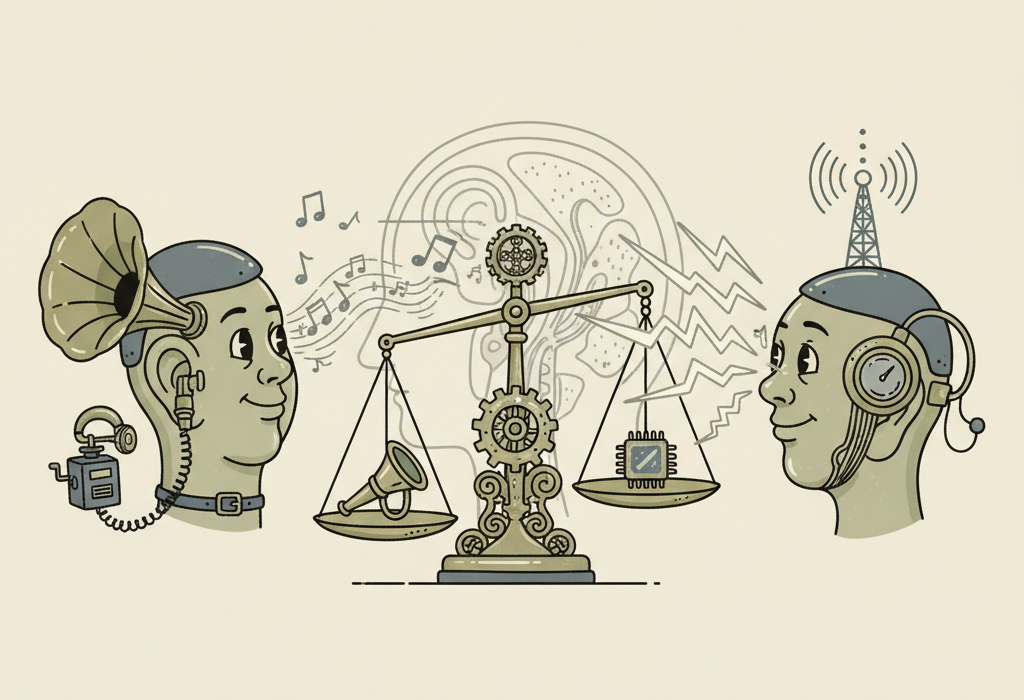
Imagine you are trying to listen to a radio station, but the volume is too low. Turning the volume dial up solves the problem. Now imagine the radio’s internal wiring is frayed. Turning the volume up will not help; you will just get louder static. You need to bypass the broken wires to hear the music clearly.
This analogy explains the core difference between the two main treatments for severe hearing loss. Hearing aids act like the volume dial, while cochlear implants act like a new wiring system.
For decades, scientists have studied how these devices compare, especially for people with sensorineural hearing loss (sen-sor-ee-NOOR-al HEER-ing los). This condition occurs when the tiny hair cells in the inner ear or the nerve pathways are damaged. Deciding between a hearing aid and a cochlear implant depends heavily on the severity of the damage, the age of the patient, and specific hearing goals.
Related: Hearing Loss at Every Age: What Science Actually Knows
This article reviews the latest peer-reviewed research to explain how these devices compare in real-world scenarios, from childhood development to adult speech comprehension and music perception.
How Hearing Aids and Cochlear Implants Work
To understand the research, it helps to understand how each device interacts with the body.
A conventional hearing aid is an acoustic device. It captures sound from the environment, amplifies it, and directs it into the ear canal. The sound still must travel through the middle ear and into the cochlea (KOKE-lee-uh), the spiral-shaped cavity of the inner ear. If the hair cells in the cochlea are severely damaged, simply making the sound louder will not make it clearer.
A cochlear implant is a surgically implanted electronic device. It bypasses the damaged hair cells entirely. An external microphone captures sound and sends it to a transmitter. The transmitter sends signals to an array of electrodes surgically threaded inside the cochlea. These electrodes directly stimulate the auditory nerve (AW-dih-tor-ee NURV), which carries the signals to the brain.
Comparison of Hearing Devices
| Feature | Hearing Aids | Cochlear Implants |
|---|---|---|
| Mechanism | Amplifies acoustic sound | Converts sound to electrical impulses |
| Target Area | Ear canal and middle ear | Directly stimulates the auditory nerve |
| Surgery Required? | No | Yes |
| Best For | Mild to severe hearing loss | Severe to profound hearing loss |
| Sound Quality | Natural, but can be distorted if damage is severe | Robotic or synthetic initially, requires brain adaptation |
What the Research Shows About Speech and Quality of Life
For adults who lose their hearing after learning to speak, the transition to severe hearing loss can be isolating. When hearing aids no longer provide enough clarity, cochlear implants are often the next step.
A 2012 study in the Brazilian Journal of Otorhinolaryngology evaluated patients with severe post-lingual deafness (deafness that occurs after learning a language). The researchers compared patients using hearing aids to those who transitioned to cochlear implants. They found that cochlear implant users experienced an average 90% improvement in speech perception tests, while hearing aid users only improved by 37% over the same period. The cochlear implant group also reported significantly lower rates of depression and anxiety.
However, cochlear implants do not instantly restore perfect hearing. The brain must learn to interpret the new electrical signals.
Single-Sided Deafness
Historically, cochlear implants were only given to people with severe hearing loss in both ears. Recently, researchers have studied their use in people with single-sided deafness (one normal ear and one deaf ear).
A 2026 meta-analysis in Otology & Neurotology reviewed 40 studies involving 667 participants with single-sided deafness. The research showed that cochlear implants significantly improved the ability to locate where sounds were coming from. Patients who received their implants early and wore their devices for more than 10 hours a day saw the best results.
Despite these benefits, a 2022 study in Cochlear Implants International noted that adults implanted for single-sided deafness often score lower on speech perception tests in their implanted ear compared to adults who are deaf in both ears. Researchers suspect this happens because people with one good ear naturally rely heavily on their normal hearing, which may reduce the amount of “practice” their brain gets at interpreting the implant’s signals.
Childhood Development: Intelligence and Social Skills
When children are born with hearing loss, early intervention is critical for brain development. Parents often worry about whether a hearing aid or a cochlear implant will better support their child’s cognitive and social growth.
Research suggests that as long as the device matches the severity of the hearing loss and is fitted early, children can thrive with either option.
A 2023 study in the journal Life compared the intelligence quotients (IQ) of children aged 6 to 8 years old. One group had profound deafness and used cochlear implants. The other group had moderate to severe hearing loss and used hearing aids. After one year of auditory rehabilitation, both groups showed similar improvements in their IQ scores. The researchers concluded that hearing aids can support normal cognitive development even in cases of severe hearing loss, provided the child’s hearing thresholds are closely monitored.
Social communication is another major focus. A 2010 study in the Journal of Deaf Studies and Deaf Education evaluated how well children with hearing loss navigate everyday conversations (pragmatic abilities). The researchers compared children using cochlear implants, children using hearing aids, and children with normal hearing.
The study found no significant difference in social communication skills between the hearing aid and cochlear implant groups. Both groups successfully used a variety of communication strategies. However, both groups experienced more conversational misunderstandings than their peers with normal hearing. This suggests that while both devices are highly effective, children with hearing loss still benefit from targeted speech therapy to help them navigate complex social interactions.
The Challenge of Music and Spatial Hearing
While cochlear implants are excellent at transmitting the frequencies needed to understand human speech, they struggle to convey the complex layers of music.
A 2025 meta-analysis in Otolaryngology, Head and Neck Surgery reviewed 29 studies on music perception in children. The data showed a significant gap between children with cochlear implants and children with normal hearing. For example, pitch recognition accuracy was roughly 50% for children with implants compared to 91% for children with normal hearing. Melody and timber (the unique tone of an instrument) are difficult to process through the limited number of electrodes in an implant.
However, structured rehabilitation can help. A 2025 review in Healthcare found that older adults who participated in targeted music therapy saw measurable improvements in sound quality and spatial detection.
Related: Music Therapy for Tinnitus: Can Listening Rewire the Ringing?
Cochlear implants also present challenges for tracking moving sounds. A 2019 study in The Journal of the Acoustical Society of America tested adults with bilateral cochlear implants (implants in both ears). The participants struggled to identify the direction and range of moving sounds compared to adults with normal hearing. The timing and volume cues that the brain uses to track motion are not perfectly replicated by current implant processors.
Bimodal Hearing: The Best of Both Worlds?
Because hearing aids are better at preserving the natural richness of low-frequency sounds (like bass in music), and cochlear implants are better at providing clarity for high-frequency sounds (like consonants in speech), doctors often recommend using both. This is called bimodal hearing (bye-MOH-dul).
If a patient has some usable hearing in one ear, a surgeon might place a cochlear implant in the completely deaf ear and fit a hearing aid on the better ear. A 2023 study in Acta Medica Okayama reviewed 74 adults and found that placing the implant in the poorer-hearing ear was a highly successful strategy. It allowed patients to maintain bimodal hearing, which resulted in better speech recognition and overall sound quality than using an implant alone.
Where The Science Is Evolving: Hearing Preservation Surgery
In the past, cochlear implant surgery almost always destroyed any natural, residual hearing the patient had left in that ear. Today, surgeons use “soft surgery” techniques to preserve as much natural hearing as possible.
This involves using thinner, more flexible electrode arrays and inserting them very slowly to avoid damaging the delicate structures of the inner ear.
A 2019 study in Otology & Neurotology looked at pediatric patients who underwent this modern surgical approach. The researchers found that 82% of the children maintained detectable natural hearing after surgery, and 65% maintained functional low-frequency hearing.
Similarly, a 2015 study in Acta Otorhinolaryngologica Italica reviewed 155 patients (both adults and children) and found that 39% preserved their residual hearing overall, with children showing slightly better preservation rates than adults. Preserving this natural low-frequency hearing allows patients to use a hybrid approach, combining acoustic amplification for low pitches with electrical stimulation for high pitches.
Who Benefits Most and Who Needs Caution
Based on current research, the medical community generally categorizes patients by their specific needs:
- Mild to Moderate Hearing Loss: Conventional hearing aids remain the standard of care. They are non-invasive and highly effective at these stages.
- Severe to Profound Hearing Loss: When hearing aids no longer clarify speech, cochlear implants are strongly recommended. Delaying implantation can result in the brain losing its ability to process auditory signals effectively.
- Patients with Neurofibromatosis Type 2 (NF2): This genetic condition causes tumors to grow on the auditory nerves. A 2017 study in Cochlear Implants International noted that if the nerve is intact, a cochlear implant can work well. However, if the tumor or surgery has severed the auditory nerve, a cochlear implant will not work. In those cases, an Auditory Brainstem Implant (ABI) is required.
Common Questions About Hearing Aids and Cochlear Implants
Do cochlear implants sound like normal hearing?
No. Initially, patients often describe the sound as robotic, synthetic, or like a cartoon character. Over time (usually months), the brain adapts and rewires itself, and the sound becomes much more natural to the user.
Can you switch back to a hearing aid if you do not like the cochlear implant?
Usually, no. Because cochlear implant surgery often removes or damages the residual natural hearing in the implanted ear, a conventional hearing aid will no longer work in that ear. This is why thorough testing is required before surgery.
Do I still need speech therapy if my child gets an implant early?
Yes. Research consistently shows that the device only provides access to sound. The brain still needs structured practice (auditory-verbal therapy) to learn how to turn those sounds into meaningful language.
The Bottom Line
Hearing aids and cochlear implants are both highly effective tools, but they serve different biological needs. Hearing aids are ideal for amplifying sound when the inner ear still functions reasonably well. Cochlear implants are necessary when the inner ear is too damaged to process sound, requiring a direct electrical connection to the brain.
Research clearly shows that for profound hearing loss, cochlear implants significantly outperform hearing aids in improving speech recognition and quality of life. For children, both devices support normal cognitive development when fitted early and paired with proper therapy.
While cochlear implants still struggle to perfectly replicate the richness of music and the spatial awareness of normal hearing, ongoing advancements in “soft surgery” and bimodal hearing (using an implant and a hearing aid together) are closing the gap.
Quick Reference: Key Studies
| Study Focus | Key Finding | Source |
|---|---|---|
| Post-Lingual Deafness | Cochlear implants improved speech perception by 90% compared to 37% for hearing aids in severe cases. | PMID 22499380 |
| Childhood IQ | Children with severe hearing loss using hearing aids showed similar IQ development to children using cochlear implants. | PMID 38276261 |
| Music Perception | Children with cochlear implants scored lower on pitch and melody recognition compared to normal hearing peers. | PMID 40407175 |
| Hearing Preservation | Modern “soft surgery” techniques preserved functional low-frequency hearing in 65% of pediatric patients. | PMID 30741907 |
| Single-Sided Deafness | Implants significantly improved sound localization, especially with early activation and consistent daily use. | PMID 41738997 |
| Bimodal Hearing | Implanting the poorer-hearing ear to maintain a hearing aid in the better ear is a highly successful strategy. | PMID 38145932 |
Last updated: March 2026
This article synthesizes findings from peer-reviewed research. It is for educational purposes only and does not constitute medical advice. Consult a healthcare provider before starting any new regimen.


Leave a Reply