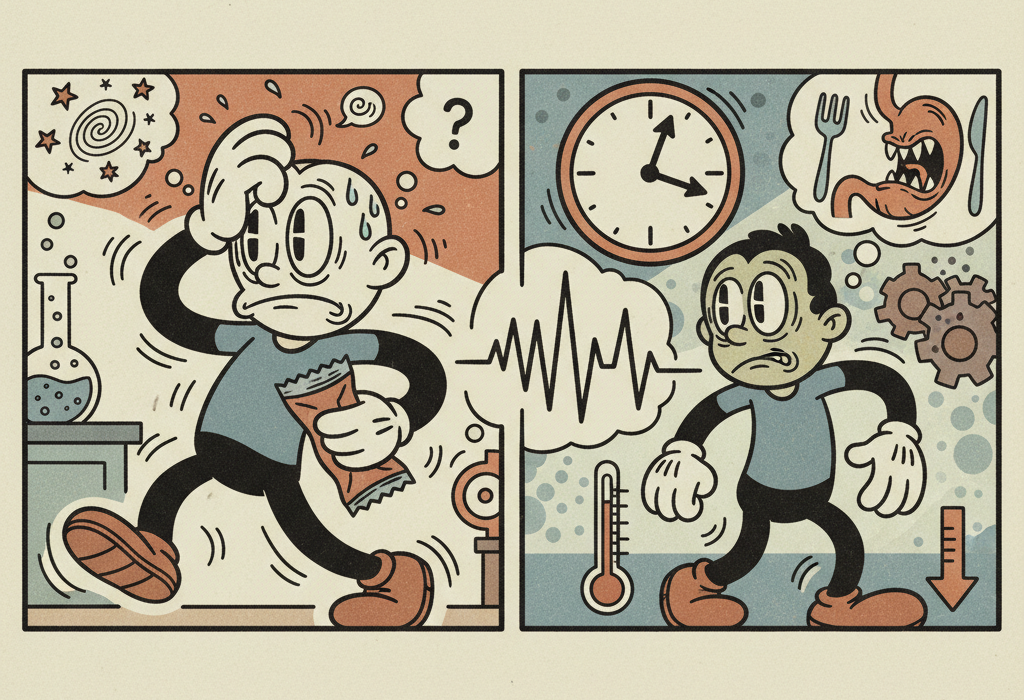
Many of us have experienced the sudden urge to eat, accompanied by a shaky, irritable feeling that people often call being “hangry.” It is common to blame these moments on low blood sugar. However, true clinical low blood sugar is a specific physiological state that goes far beyond simply needing a snack.
Low blood sugar, clinically known as hypoglycemia (hi-po-gly-SEE-mee-uh), occurs when the level of glucose in your blood drops below the amount your body needs to function properly. For most people, this is defined as a blood glucose reading below 70 milligrams per deciliter (mg/dL).
When blood sugar drops, the body triggers a cascade of alarms. A 2014 review in The American Journal of Medicine explains that hypoglycemia causes two distinct types of symptoms: early warning signs driven by adrenaline, and later, more severe signs caused by the brain running out of fuel.
This article breaks down exactly what happens in your body when blood sugar drops, how to recognize the symptoms, and why scientists say true hypoglycemia is often misunderstood.
What the Research Shows: The Two Stages of Symptoms
Glucose is the primary fuel for your body, and it is especially critical for your brain. Because the brain cannot store its own glucose, it relies on a steady supply from the bloodstream. When that supply drops, the body reacts in two distinct phases.
Phase 1: The Autonomic Alarm System
When blood sugar first begins to dip, your body attempts to fix the problem by releasing counterregulatory hormones, including adrenaline (epinephrine). This is the same hormone responsible for the “fight or flight” response.
A 1988 study in the Journal of Behavioral Medicine found that this adrenaline surge causes physical and emotional changes. These are known as autonomic (aw-toh-NOM-ik) symptoms, meaning they are controlled by the involuntary nervous system.
Common autonomic symptoms include:
- Sweating and clamminess
- Trembling or shakiness
- A pounding or racing heart (palpitations)
- Sudden, intense hunger
- Anxiety, nervousness, or irritability
- Pale skin
These symptoms act as an early warning system. They are uncomfortable by design, prompting you to find food before the situation becomes dangerous.
Phase 2: Brain Fuel Shortage
If blood sugar continues to fall, the brain begins to starve. This leads to a second set of symptoms known as neuroglycopenia (nur-oh-gly-koh-PEE-nee-uh), which literally translates to a shortage of glucose in the brain.
According to a 1992 review in Bailliere’s Clinical Endocrinology and Metabolism, neuroglycopenic symptoms are much more severe and can impair a person’s ability to help themselves.
These symptoms include:
- Confusion and difficulty concentrating
- Slurred speech
- Dizziness or lightheadedness
- Odd behavior or personality changes
- Poor coordination and clumsiness
- Extreme drowsiness or lethargy
- In severe cases, seizures or loss of consciousness
Comparing the Symptoms
To understand how these stages differ, here is a quick comparison based on clinical research:
| Symptom Type | What Causes It | Common Signs | Severity |
|---|---|---|---|
| Autonomic | Adrenaline release trying to raise blood sugar | Shaking, sweating, racing heart, anxiety, hunger | Mild to Moderate (Early Warning) |
| Neuroglycopenic | The brain lacking enough glucose to function | Confusion, slurred speech, dizziness, odd behavior | Severe (Medical Emergency) |
How This Might Work: The Body’s Defense System
To understand why these symptoms happen, it helps to look at how the body maintains balance. You can think of your blood sugar regulation like a thermostat in a house. When the temperature drops too low, the heater kicks on.
When your blood sugar drops, your pancreas stops releasing insulin (the hormone that lowers blood sugar). Instead, it releases a hormone called glucagon (GLOO-kuh-gon). Glucagon travels to your liver and signals it to release stored sugar into your bloodstream.
If glucagon alone is not enough, the body calls in backup. It releases adrenaline and cortisol (a stress hormone) to force more glucose into the blood. The physical symptoms of shaking and sweating are direct side effects of this adrenaline rush.
Common Misunderstandings: Do You Really Have Hypoglycemia?
One of the most fascinating findings in hypoglycemia research is that many people who believe they suffer from low blood sugar actually have normal glucose levels during their symptom episodes.
This condition is often self-diagnosed as “reactive hypoglycemia,” a term used to describe blood sugar dropping sharply a few hours after eating a heavy carbohydrate meal. However, a 1980 study in JAMA tested 192 patients who suspected they had reactive hypoglycemia. The researchers found that when the patients experienced symptoms like lightheadedness and shakiness, their blood sugar levels were actually normal. The study suggested that emotional stress and anxiety, which also release adrenaline, frequently mimic the exact symptoms of low blood sugar.
Furthermore, researchers have identified a phenomenon called the “transitional low blood-glucose state.” A 1975 review in Metabolism explains that it is entirely normal for blood sugar to temporarily dip below 50 mg/dL after a meal without causing any symptoms or harm.
To confirm true hypoglycemia, doctors use a strict medical standard called Whipple’s Triad, outlined in a 2020 diagnostic review. For a diagnosis, three things must happen at the exact same time:
1. The patient experiences symptoms of low blood sugar.
2. A blood test confirms the glucose level is genuinely low (usually below 70 mg/dL).
3. The symptoms go away immediately after the patient consumes sugar.
If all three criteria are not met, the symptoms are likely caused by something else.
Who Needs Caution: Vulnerable Populations
While anyone can experience a temporary dip in blood sugar, certain groups are at a much higher risk for severe clinical hypoglycemia.
People with Diabetes
For people with Type 1 diabetes, and those with Type 2 diabetes taking insulin or certain medications, hypoglycemia is a constant risk. Because their bodies cannot regulate insulin naturally, an accidental overdose of insulin, a skipped meal, or unexpected exercise can cause blood sugar to plummet.
Over time, some individuals with diabetes develop a dangerous condition called “hypoglycemia unawareness.” According to research in The American Journal of Medicine, repeated episodes of low blood sugar can dull the body’s adrenaline response. These patients stop experiencing the early warning signs like sweating and shaking. Instead, their first symptom might be severe confusion or a seizure, making this a highly dangerous condition.
Newborns and Children
Infants and young children process glucose differently than adults. A 2025 review in the Pediatric Clinics of North America notes that neonatal hypoglycemia is a common condition that requires careful screening, as a newborn’s brain needs a constant supply of glucose to develop properly.
In older infants and toddlers, a condition called ketotic hypoglycemia can occur. A 1983 study explains that young children have a higher brain-to-body mass ratio, meaning their brains demand more glucose. If they skip a meal or get sick and cannot eat, they deplete their sugar stores much faster than adults, leading to hypoglycemia.
People with Rare Medical Conditions
Although rare, certain non-diabetic conditions can cause severe low blood sugar. These include adrenal insufficiency, where the body fails to produce enough stress hormones to regulate glucose (detailed in a 2023 review in Frontiers in Endocrinology), and insulinomas, which are rare, usually benign tumors in the pancreas that overproduce insulin, leading to extreme drops in blood sugar (PMID 9735136).
Practical Guidance: How to Respond
If you or someone else experiences the symptoms of true hypoglycemia, fast action is required. Medical guidelines, including those for children with diabetes highlighted in the British Journal of Nursing, recommend the “Rule of 15s” for conscious individuals:
1. Consume 15 grams of fast-acting carbohydrates. This could be half a cup of fruit juice, a tablespoon of honey, or three to four glucose tablets. Avoid high-fat foods like chocolate or peanut butter, as fat slows down the absorption of sugar.
2. Wait 15 minutes.
3. Recheck blood sugar. If it is still below 70 mg/dL, consume another 15 grams of carbohydrates.
4. Eat a balanced snack. Once blood sugar returns to normal, eat a small snack containing protein and complex carbohydrates to prevent another drop.
For individuals with diabetes who are prone to sudden drops, wearable technology has provided new safety nets. Devices that track glucose levels 24/7 can sound an alarm before blood sugar drops too low. Related: Continuous Glucose Monitors: What the Latest Science Actually Says.
Common Questions About Low Blood Sugar
What is the official blood sugar alert level?
Most medical guidelines define hypoglycemia as a blood glucose reading below 70 mg/dL. This is considered an “alert value” that gives you enough time to consume carbohydrates before brain-related symptoms begin.
Can non-diabetics get hypoglycemia?
Yes, though it is quite rare. It can be caused by heavy alcohol consumption without food, severe liver disease, rare pancreatic tumors (insulinomas), or as a side effect of certain medications.
Can dogs really smell low blood sugar?
Interestingly, yes. A 2008 case report in the Irish Journal of Medical Science documented instances of dogs detecting hypoglycemia in their owners. While the exact mechanism is still being studied, scientists believe dogs can smell chemical changes in human sweat that occur during an adrenaline surge.
The Bottom Line
Low blood sugar symptoms are the body’s way of protecting the brain from a fuel shortage. The early signs, such as shaking, sweating, and a racing heart, are caused by an adrenaline rush designed to make you eat. If ignored, the brain begins to suffer, leading to confusion, slurred speech, and potentially dangerous medical emergencies.
While many people blame everyday fatigue or irritability on low blood sugar, research shows that true hypoglycemia is relatively rare in people without diabetes. Emotional stress and anxiety can easily mimic the exact same symptoms. If you frequently experience symptoms that you believe are tied to your blood sugar, it is important to consult a healthcare provider to find the true underlying cause.
Quick Reference: Key Studies
| Study Focus | Key Finding | Source |
|---|---|---|
| Symptom Classification | Hypoglycemia causes early autonomic symptoms (sweating, shaking) and late neuroglycopenic symptoms (confusion, drowsiness). | PMID 25282009 |
| Cognitive Impacts | Lowered blood sugar is directly associated with impaired cognitive performance, anxiety, and somatic symptoms. | PMID 3172195 |
| Symptom Misdiagnosis | Many patients who self-diagnose with reactive hypoglycemia have normal blood sugar during symptom episodes; symptoms often overlap with emotional distress. | PMID 7359666 |
| Diagnostic Criteria | True hypoglycemia must meet Whipple’s Triad: low blood sugar readings, physical symptoms, and relief upon eating sugar. | PMID 32942895 |
| Children & Diabetes | Recognizing the early warning signs of hypoglycemia is critical for children with Type 1 diabetes to prevent seizures and coma. | PMID 28345986 |
Last updated: March 2026
This article synthesizes findings from peer-reviewed research. It is for educational purposes only and does not constitute medical advice. Consult a healthcare provider before starting any new regimen or if you suspect you have a medical condition.
Leave a Reply