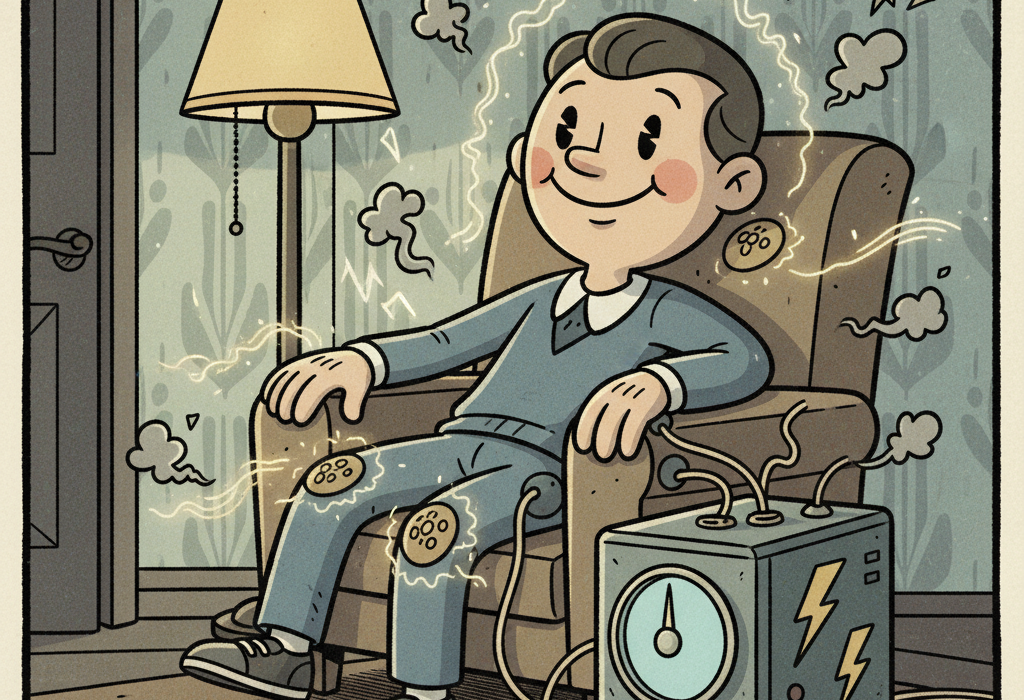
If you walk down the pain relief aisle of any major pharmacy, you will likely see small, battery-powered devices with wires and sticky pads. These are TENS units. They are marketed as a drug-free way to treat everything from sore backs to arthritis.
Transcutaneous electrical nerve stimulation (trans-kyoo-TAY-nee-us eh-LEK-trih-kuhl nerv stim-yoo-LAY-shun), or TENS, is a therapy that delivers mild electrical pulses through the skin to the nerves.
Many people swear by these devices, claiming they provide immediate relief. Others try them once, feel a mild buzzing sensation, and put the device in a drawer forever. This creates a core tension in the medical community. Why does TENS seem to work miracles for some people while doing absolutely nothing for others?
To answer this, researchers have spent decades studying how electrical stimulation affects the body. The science shows that TENS can be an effective tool for pain relief, but its success depends heavily on the type of pain you have and exactly how you use the device.
How This Might Work
To understand how TENS works, it helps to understand how your body processes pain. When you injure yourself, sensory nerves send an electrical signal up through your spinal cord and into your brain. Your brain translates that signal into the feeling of pain.
TENS units interrupt this process. Scientists believe this happens through two main biological mechanisms.
The Gate Control Theory
Think of your spinal cord as a highway with a toll booth. When you are in pain, the toll booth is wide open, allowing pain signals to rush up to your brain.
The electrical pulses from a TENS unit stimulate different, larger nerve fibers in your skin. These larger fibers transmit signals faster than the smaller pain fibers. When the signals from the TENS unit reach the spinal cord first, they essentially “close the gate” at the toll booth. The pain signals get stuck in traffic and never reach your brain. A 2017 review in Joint Bone Spine explains that this mechanism is primarily responsible for the immediate, short-term relief people feel while the device is turned on.
Endorphin Release
Your body has its own built-in painkiller system. When stimulated correctly, the brain and spinal cord release natural chemicals called endorphins.
Research shows that different settings on a TENS machine trigger different chemical responses. A 2003 review in The Journal of Pain explains that low-frequency TENS pulses cause the body to release one type of natural opioid, while high-frequency pulses release a different type. This chemical release helps explain why some people still feel pain relief for hours after they turn the TENS machine off.
What the Research Shows
Because TENS is inexpensive and safe, it has been tested on dozens of different medical conditions. The results vary depending on what is being treated.
The Big Picture on Pain Relief
To get a broad understanding of whether TENS works, scientists often look at meta-analyses. These are large studies that combine the results of many smaller studies.
A massive 2022 meta-analysis in BMJ Open looked at 381 clinical trials involving over 24,000 participants. The researchers found moderate-certainty evidence that pain intensity was significantly lower during or immediately after TENS treatment compared to a placebo (a fake TENS treatment where no actual electricity is delivered).
This study confirmed that TENS provides genuine, measurable pain relief in the moment. However, the relief is often temporary, acting more like a pain-relief window than a permanent cure.
Joint Pain and Surgery Recovery
Movement is a critical part of recovering from joint pain or surgery, but pain often makes movement difficult. TENS appears to be highly useful in these situations.
A 2022 review in Clinical Rehabilitation focused on people with knee osteoarthritis. The researchers concluded that TENS significantly relieved pain, decreased physical dysfunction, and improved walking ability, though it did not help with joint stiffness.
Similarly, a 2019 study in Clinical Interventions in Aging tested TENS on elderly patients recovering from hip fracture surgery. The patients who received active TENS treatment experienced significantly less pain during walking compared to the placebo group. Because they had less pain, they were able to walk further and improve their mobility faster.
Nerve Pain
Neuropathic pain (noor-oh-PATH-ik payn) occurs when nerves themselves are damaged or malfunctioning. This type of pain is notoriously difficult to treat with standard medications. Related: Treating Neuropathic Pain: What the Latest Science Says
A 2020 review in Current Pain and Headache Reports examined how TENS affects various types of nerve pain. The researchers found that TENS is effective for peripheral nerve pain, such as diabetic neuropathy (nerve damage caused by diabetes) and postherpetic neuralgia (lingering nerve pain after a shingles outbreak).
Animal studies help explain why this works. A 2024 study in Neurotherapeutics found that applying high-frequency TENS to rats with nerve injuries actually reduced the production of pain-related proteins in the nervous system without causing any additional nerve damage.
Women’s Health and Labor
TENS is frequently used in women’s health, particularly for menstrual cramps and labor pain.
Primary dysmenorrhea (dis-men-oh-REE-uh) is the medical term for severe, recurring menstrual cramps. A 2020 meta-analysis in Explore reviewed multiple studies and found that TENS was statistically more effective than a placebo at reducing menstrual pain.
For pregnant women, a 2022 scoping review in Revista Brasileira de Ginecologia e Obstetricia found that using TENS during labor provided positive pain relief. While it does not eliminate the pain of childbirth, it serves as a safe, drug-free strategy to help manage discomfort during contractions.
Where The Science Is Still Uncertain
While TENS works well for many conditions, the science is surprisingly mixed when it comes to back pain.
A 2018 meta-analysis in Regional Anesthesia and Pain Medicine looked at TENS for chronic back pain. The researchers found no significant difference in pain relief between patients who received TENS and those who received a placebo. However, they did note that TENS helped improve functional disability in the short term (under six weeks).
Similarly, a 2019 review in the Scandinavian Journal of Pain looked at acute low back pain. They found insufficient evidence to broadly support or dismiss TENS. They did note one study showing that a 30-minute TENS session provided worthwhile pain relief during emergency ambulance transport, but regular clinical use showed inconclusive results.
For back pain, TENS may be worth trying due to its safety, but science does not guarantee it will work. Related: Yoga vs. Physical Therapy for Back Pain: What Science Actually Says
Evidence is also mixed regarding cancer-related pain. A 2020 clinical trial in Supportive Care in Cancer tested TENS on patients with advanced cancer pain. While 85% of patients in the active TENS group reported at least a slight improvement, there was no statistically significant difference in average pain reduction compared to the placebo group.
Practical Guidance
If you decide to try TENS, research clearly shows that how you use it matters just as much as if you use it. Many clinical trials have failed simply because the researchers did not use the device correctly.
According to a detailed 2014 review in Pain Management, there are two major factors that determine whether TENS will work for you:
1. Intensity: The electrical stimulation must be turned up to a level that is “strong but comfortable.” If you only feel a faint tingling, the signal is not strong enough to close the pain gates in your spinal cord or trigger endorphin release. You should feel a robust buzzing sensation, but it should never be painful or cause your muscles to involuntarily twitch.
2. Tolerance: If you use the exact same frequency and intensity every single day, your nervous system will eventually get used to it. Just like you stop noticing a smell after being in a room for a while, your nerves stop responding to the electrical pulse. To prevent this, you should regularly change the settings on your device, switching between high-frequency (a fast buzz) and low-frequency (a slower tapping sensation).
Who Benefits Or Needs Caution
Who benefits most:
- People with localized joint pain, such as knee osteoarthritis.
- Individuals recovering from orthopedic surgeries who need pain relief to complete physical therapy exercises.
- Women experiencing severe menstrual cramps.
- People with peripheral nerve pain, such as diabetic neuropathy.
Who should use caution:
- People with pacemakers or other implanted electrical devices should never use TENS without medical supervision, as the electrical currents can interfere with the implant.
- TENS should not be placed over the front of the neck, eyes, or directly over a pregnant abdomen.
- People with epilepsy or a history of seizures should consult a doctor before use.
- Individuals with skin conditions or severe numbness (where they cannot feel if the machine is turned up too high) should be careful to avoid skin irritation.
The Bottom Line
The scientific consensus is that TENS is a safe, non-invasive, and drug-free option for managing many types of pain. While it is not a cure for the underlying cause of your pain, it can act as an effective shield, temporarily blocking pain signals so you can move, sleep, or participate in physical therapy.
The evidence is strongest for joint pain, nerve pain, and menstrual cramps, while the data for chronic back pain remains mixed. If you choose to use a TENS unit, remember that the intensity must be set to a “strong but comfortable” level to be effective, and you should vary the settings to prevent your body from building a tolerance to the therapy.
Quick Reference: Key Studies
| Study Focus | Key Finding | Source |
|---|---|---|
| Overall Effectiveness | Meta-analysis of 381 studies found TENS significantly lowers pain intensity compared to placebo during and immediately after use. | PMID 35144946 |
| Menstrual Pain | Meta-analysis showed TENS is a safe and well-tolerated method that effectively relieves pain in primary dysmenorrhea. | PMID 32917532 |
| Post-Surgery Mobility | Patients recovering from hip fracture surgery had significantly less pain during walking when using active TENS compared to a placebo. | PMID 31754300 |
| Neuropathic Pain | Review of literature confirmed TENS is an effective non-pharmacological treatment for peripheral nerve pain. | PMID 32072323 |
| Proper Usage | Clinical review emphasized that TENS is most effective when applied at a “strong but comfortable” intensity and when frequencies are varied to prevent tolerance. | PMID 24953072 |
Last updated: March 2026
This article synthesizes findings from peer-reviewed research. It is for educational purposes only and does not constitute medical advice. Consult a healthcare provider before starting any new regimen.



Leave a Reply