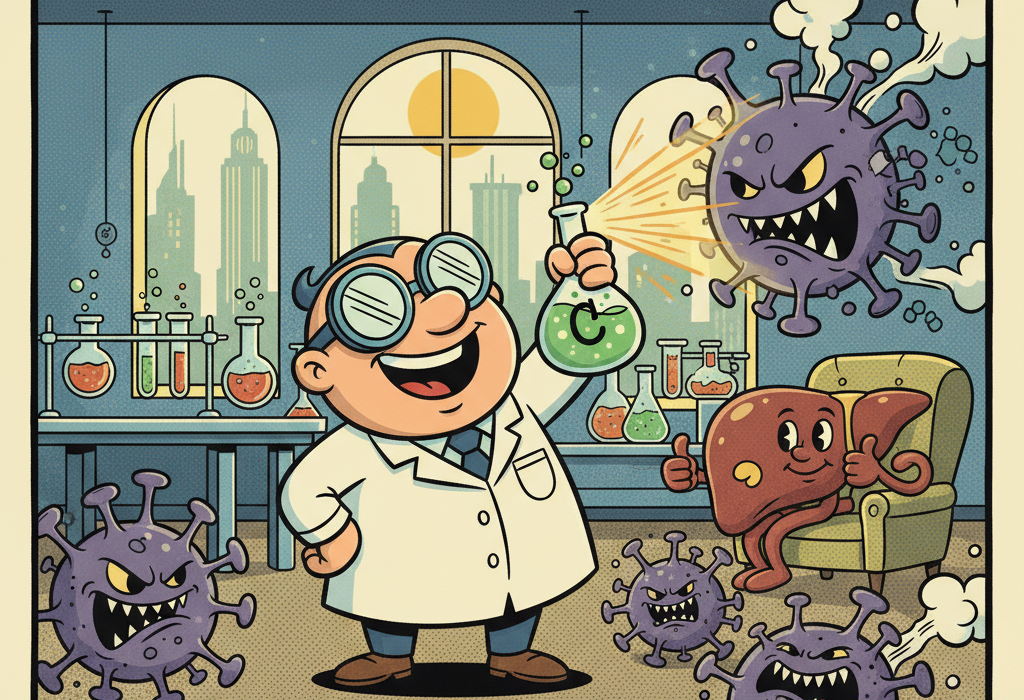
Imagine having a leaky pipe inside your walls. For years, the only way to address the problem was to flood the entire house with harsh chemicals to stop the leak, hoping the house survived the process better than the leak did. That was essentially the reality of treating Hepatitis C for decades.
Doctors relied on medications that stimulated the body’s entire immune system, which caused severe side effects and only cured the infection about half the time. Today, scientists have developed highly specific tools that fix the leak directly without flooding the house.
Modern research shows that a newer class of medications can cure the vast majority of people infected with Hepatitis C in just a few months. This article synthesizes the latest scientific research to explain how these treatments work, how successful they are, and what patients need to know.
Common Questions About Hepatitis C Treatment
Can Hepatitis C be completely cured?
Yes. When medical research refers to a cure for this virus, they use the term “sustained virologic response.” This means the virus remains completely undetectable in the blood months after treatment ends.
Do I still need interferon injections?
For the vast majority of patients, no. Modern treatments rely almost entirely on oral pills taken daily for 8 to 24 weeks, depending on the specific strain of the virus and the health of the liver.
Does the treatment work for everyone?
While success depends on the specific viral strain and the amount of existing liver damage, modern clinical trials consistently show cure rates above 90% for most patient groups.
How This Might Work: Stopping the Viral Factory
To understand how the treatment works, it helps to understand the virus itself. Hepatitis C virus (HEP-uh-TIE-tis C VY-rus), or HCV, is a bloodborne virus that specifically targets and infects liver cells. Once inside a liver cell, the virus turns the cell into a tiny factory designed to print thousands of copies of itself.
For many years, the standard treatment relied on two drugs: Interferon (in-ter-FEER-on) and Ribavirin (rye-buh-VY-rin). Interferon is a synthetic version of a protein your body naturally makes to fight infections. It acts like a blaring fire alarm, putting the entire immune system on high alert. While this sometimes helped clear the virus, the constant “fire alarm” state caused severe side effects like profound fatigue, depression, and anemia. A 2014 review in EMBO Molecular Medicine notes that this combination only cured about 40% to 50% of patients with the most common strain of the virus.
In recent years, scientists developed Direct-acting antivirals (dih-REKT ACT-ing an-tee-VY-ruls), or DAAs. Instead of sounding a general alarm, DAAs act like highly trained mechanics who walk into the viral factory and dismantle the specific machines the virus uses to copy itself.
DAAs target three main viral machines:
- NS3/4A Protease: The virus produces its parts in one long, continuous string. The protease acts as a pair of scissors, cutting the string into usable pieces. Drugs that block this are called protease inhibitors.
- NS5B Polymerase: This is the photocopy machine the virus uses to replicate its genetic code. Drugs like sofosbuvir jam this machine so it cannot print new copies.
- NS5A Protein: This is the scaffolding the virus needs to assemble new viral particles. NS5A inhibitors break down this scaffolding.
By combining two or more of these targeted drugs, doctors can shut down the viral factory completely, leading to the death of the virus.
What the Research Shows: The Shift to Targeted Therapy
The medical definition of a Hepatitis C cure is a Sustained virologic response (sus-TAYND vy-ro-LAH-jik ree-SPONS), or SVR. A patient achieves SVR when blood tests show no detectable virus 12 or 24 weeks after they take their last pill.
The transition to DAAs has drastically improved SVR rates. A 2014 systematic review in JAMA analyzed 41 studies involving over 19,000 patients. The researchers found that newer regimens utilizing DAAs achieved SVR rates of 89% to 90% in patients who had never been treated before.
Early DAA treatments in 2011, such as boceprevir and telaprevir, were added to interferon injections. While they improved cure rates to around 70%, they also increased toxic side effects. A 2016 review in the World Journal of Gastroenterology explains that the real breakthrough came in 2013 with the introduction of newer DAAs that allowed doctors to drop interferon entirely. These newer, interferon-free regimens are shorter, less toxic, and routinely achieve cure rates approaching 100% in certain populations.
How Treatment Adapts to Different Viral Strains
Hepatitis C is not a single identical virus. It exists in several genetic variations called a Genotype (JEE-no-type). There are six main genotypes globally, numbered 1 through 6.
A 2015 study in the American Journal of Health-System Pharmacy outlines how treatment must be tailored to these strains:
- Genotype 1: This is the most common strain in the United States, accounting for about 75% of cases. Historically, it was the hardest to treat. Today, combining an NS5B inhibitor (like sofosbuvir) with an NS5A inhibitor (like ledipasvir) cures over 90% of Genotype 1 patients in just 8 to 12 weeks.
- Genotypes 2 and 3: These strains account for roughly 20% of US cases. A 2014 review in Current Opinion in Infectious Diseases highlights that Genotype 3 can be slightly more stubborn because it alters how the liver processes fats, sometimes requiring a longer treatment duration of up to 24 weeks.
- Genotypes 4, 5, and 6: These strains are less common in North America but prevalent in parts of Africa and Asia. Research shows that modern pan-genomic DAAs (drugs designed to work across all strains) are highly effective against these variations as well.
Who Benefits Or Needs Caution
While modern treatments are highly effective, medical research identifies specific groups that require tailored approaches.
Older Adults
Historically, many older adults were excluded from Hepatitis C treatment because their bodies could not handle the severe side effects of interferon. A 2015 review in the World Journal of Gastroenterology notes that the aging population of Hepatitis C patients benefits immensely from interferon-free DAA regimens. However, doctors must carefully manage these patients because older adults often take multiple medications for other conditions, increasing the risk of drug interactions.
Patients with Advanced Liver Disease
Patients who have already developed severe liver scarring (cirrhosis) can still be cured of the virus. However, a 2016 guideline from the Journal of Hepatology emphasizes that eliminating the virus does not instantly repair existing severe liver damage. Patients with advanced cirrhosis still face a reduced, but present, risk of liver complications and require ongoing monitoring for liver cancer even after achieving a cure. Related: Can Supplements Slow Down Your Liver’s Aging Clock?
Patients Taking Specific Medications
DAAs can interact with other common drugs. For example, the 2016 EASL guidelines strictly warn against combining sofosbuvir with amiodarone, a medication used for heart rhythm problems. Taking these together can cause dangerously slow heart rates. Patients must disclose all medications and supplements to their doctor before starting Hepatitis C therapy.
Patients with HIV Co-infection
Because both HIV and HCV are transmitted through blood, some patients carry both viruses. A 2014 review in Seminars in Liver Disease shows that DAA regimens are just as effective in patients with HIV as they are in patients with only Hepatitis C. The main challenge is managing interactions between HIV antiviral drugs and Hepatitis C antiviral drugs.
Practical Guidance: Maximizing Treatment Success
Research indicates that achieving a cure relies heavily on patient adherence. A 2014 study in JAMA highlights that taking the medication exactly as prescribed every day is critical. Because DAAs work by keeping constant pressure on the viral factory, missing doses gives the virus a chance to mutate and develop resistance to the medication.
Additionally, patients are strongly advised to protect their liver from other sources of damage during and after treatment. Because alcohol accelerates liver scarring and can make the liver more vulnerable to the virus, abstinence is highly recommended. Related: What Science Actually Says About Treating Alcohol Use Disorder
Where The Science Is Still Uncertain
While the current generation of oral medications successfully cures the vast majority of patients, science continues to look for alternatives for the small percentage of people who do not respond to standard DAAs.
Additionally, researchers are exploring entirely different biological mechanisms. A 2022 study in Transplant Immunology explored the experimental use of stem cells acting as carriers for gene therapy to treat liver disorders, including Hepatitis C. While this approach is still in the early phases of laboratory research and not available to patients, it represents how scientists are continually looking for novel ways to repair liver tissue and manage viral infections.
Another ongoing challenge is global accessibility. A 2015 review in Current Opinion in Infectious Diseases points out that the high manufacturing and retail costs of modern DAAs limit their availability in lower-income countries. Because of this, older, less effective treatments are sometimes still utilized where newer drugs are financially out of reach.
The Bottom Line / Takeaways
- Hepatitis C is curable: For most patients, achieving a Sustained Virologic Response (SVR) means the virus is permanently eradicated from the body.
- Treatment is easier than ever: The grueling days of interferon injections are largely over. Modern treatment usually consists of taking targeted antiviral pills daily for 8 to 12 weeks.
- Success rates are extremely high: Research consistently shows that direct-acting antivirals cure between 90% and 100% of patients, depending on their specific viral strain and liver health.
- Monitoring is still required: Curing the virus stops further damage, but patients with existing severe liver scarring (cirrhosis) must continue working with their doctors to monitor their long-term liver health.
Quick Reference: Key Studies
| Study Focus | Key Finding | Source |
|---|---|---|
| Systematic Review of HCV Treatments | Sofosbuvir-based regimens achieve 89-90% cure rates in Genotype 1 patients, replacing older interferon therapies. | PMID 25117132 |
| EASL Treatment Guidelines | The primary goal of therapy is a Sustained Virologic Response (SVR), which cures the infection and reduces liver cancer risk. | PMID 27667367 |
| Treatment in the Elderly | Interferon-free DAA regimens allow older patients, who previously could not tolerate treatment, to be safely cured. | PMID 26139987 |
| Genotypes 2-6 Treatment | Genotype 3 interacts differently with liver metabolism and can be more resistant, sometimes requiring up to 24 weeks of therapy. | PMID 25313502 |
| Simeprevir and Sofosbuvir | Using specific combinations of DAAs prevents the virus from mutating, though certain genetic markers (like Q80K) can reduce drug effectiveness. | PMID 26294237 |
Last updated: March 2026
This article synthesizes findings from peer-reviewed research. It is for educational purposes only and does not constitute medical advice. Consult a healthcare provider before starting any new regimen.


Leave a Reply