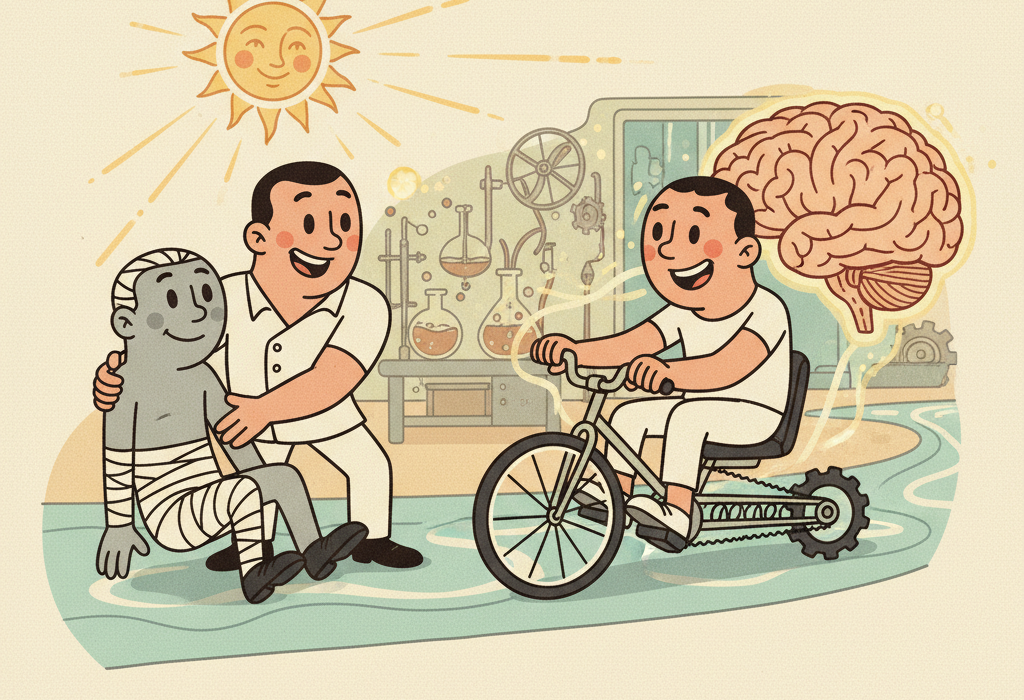
Imagine your brain is like a bustling city map. A stroke acts like a major roadblock on one of the main highways, stopping the flow of traffic. Suddenly, signals cannot reach the muscles, leading to weakness or loss of movement. Physical rehabilitation is the process of building new detours. By practicing specific movements repeatedly, the brain can actually draw new maps and reroute signals to healthy areas.
If you or a loved one are navigating life after a stroke, you might wonder how physical therapy actually works and what the latest science recommends. Does robotic assistance help? Can electrical stimulation wake up weak muscles? Research shows that physical rehabilitation is highly effective, but the timeline and methods depend heavily on the individual.
This article breaks down what peer-reviewed research says about regaining movement, managing pain, and improving independence after a stroke.
How This Might Work: Rewiring the Brain
To understand stroke rehabilitation, we first need to understand two key concepts:
- Hemiparesis (hem-ee-puh-REE-sis) – weakness on one side of the body caused by brain damage.
- Neuroplasticity (noo-roh-plas-TISS-ih-tee) – the brain’s ability to reorganize itself by forming new neural connections.
A 2017 review in Der Nervenarzt explains that a stroke does not just damage one isolated area of the brain. It disrupts an entire network of connections. Rehabilitation works by utilizing neuroplasticity to repair or bypass this damaged network. When a patient repeats a movement, such as lifting a cup or taking a step, they are actively training healthy parts of the brain to take over the job of the damaged areas.
What the Research Shows About Regaining Leg Strength and Walking
One of the primary goals of stroke rehabilitation is restoring the ability to walk. Scientists measure walking recovery using tools like the Functional Ambulation Category, which a 2007 study in the Archives of Physical Medicine and Rehabilitation confirmed is a highly reliable way to predict if a patient will eventually be able to walk independently in their community.
Strength Training and Muscle Control
Muscle weakness is a major hurdle. A 2016 meta-analysis in the Annals of Physical and Rehabilitation Medicine found that progressive resistance training significantly improves leg strength.
More specifically, researchers have looked at eccentric training. This involves lengthening a muscle while it is under tension, like slowly lowering yourself into a chair. A 2021 study in NeuroRehabilitation showed that eccentric training of the lower limbs significantly improved both muscle strength and walking speed in patients with chronic stroke.
Robotic-Assisted Gait Training
Technology is increasingly being used to help patients practice walking safely.
A 2023 pilot trial in Medicine studied patients who received 30 minutes of robot-assisted gait training combined with standard physical therapy. The robot helped move their feet and pelvis in a natural walking pattern. These patients showed greater improvements in walking ability compared to those who only received standard physical therapy.
Similarly, a 2024 study in the Journal of Clinical Neuroscience compared two different robotic systems: a wearable exoskeleton (ExoAthlet) and a stationary treadmill robot (Lokomat). The study found that both systems were equally effective at improving physical capacity and functional independence when added to conventional therapy.
Electrical Stimulation
Sometimes, muscles need a jumpstart. Neuromuscular electrical stimulation involves sending mild electrical impulses to the nerves to cause muscle contractions.
A 2018 systematic review in the Archives of Physical Medicine and Rehabilitation analyzed 21 trials and found that electrical stimulation significantly improved lower limb motor function, walking speed, and balance. Related: Does TENS Therapy Actually Relieve Pain? What the Latest Science Says
What the Research Shows About Restoring Arm and Hand Function
Regaining the use of an arm or hand is often more difficult than regaining the ability to walk. Fine motor skills, like grasping a pen or buttoning a shirt, require highly complex brain signals.
Task-Oriented Training and Robotics
Practicing specific, everyday tasks is crucial. A 2017 case report in BMJ Case Reports highlighted how intensive, task-oriented training in the first three months after a stroke led to significant improvements in hand function and handwriting.
To boost these results, researchers are combining task practice with robotics. A 2024 randomized controlled trial in the Journal of Neuroengineering and Rehabilitation tested a “force feedback” robotic glove. When patients tried to grasp an object, sensors in the glove detected their intent and provided the exact amount of extra force needed to complete the grip. Patients using this glove showed much better recovery of grip strength and hand function than those doing traditional therapy alone.
Sensory Retraining
Movement is only half the equation. Many stroke survivors lose their sense of touch, making it hard to hold objects without looking at them.
A 2011 randomized controlled trial in Neurorehabilitation and Neural Repair tested a program called SENSe. This program trained patients to recognize textures, joint positions, and objects by touch alone. The training proved highly effective, helping patients regain functional sensory capacity that they maintained even six months later.
Managing Shoulder Pain and Joint Issues
Many patients develop pain in their affected shoulder. This often happens because the weakened muscles can no longer hold the arm bone securely in the shoulder socket, leading to a condition called subluxation (sub-luck-SAY-shun), which is a partial dislocation.
- Kinesiology Taping: A 2024 study in Medical Science Monitor found that applying elastic kinesiology tape to the shoulder significantly reduced pain and subluxation while improving range of motion compared to a placebo tape.
- Medical Interventions: When standard therapy is not enough, a 2022 systematic review in the Annals of Physical and Rehabilitation Medicine found that adding treatments like botulinum toxin injections, nerve blocks, or dry needling significantly reduced hemiplegic shoulder pain.
It is important to note that the type of pain matters. A 2024 study in Physical Therapy clustered patients based on their pain symptoms. They found that deep, squeezing muscle pain generally improved with standard exercise rehabilitation. However, patients experiencing cold-evoked pain or tingling did not see the same relief, suggesting they may need different, specialized treatments.
Common Questions About Stroke Rehabilitation
Does mental practice or imagining movements help?
Motor imagery involves mentally rehearsing a movement without actually doing it. A 2020 Cochrane review found only very low-certainty evidence that motor imagery improves walking speed. While it is safe and has no adverse effects, the evidence suggests it should not replace physical practice.
Are wearable sensors useful for home therapy?
Devices that provide real-time feedback can be helpful, but they require motivation. A 2023 study in Disability and Rehabilitation: Assistive Technology tested “Stappy,” a shoe sensor that gives audio feedback on walking patterns. While patients liked the idea, actual usage varied widely. The study noted that patients were much more likely to use the technology if they had strong support from family members or caregivers.
Does overall physical activity affect arm recovery?
Yes. A 2020 observational study in Physiotherapy Research International tracked stroke patients and found a clear correlation: patients who engaged in more general physical activity throughout the day also used their affected arm more frequently. While this is a correlation and we cannot be certain which causes which, it suggests that staying generally active supports overall recovery.
Who Benefits Or Needs Caution
Older Adults: Stroke disproportionately affects older individuals. A 2012 review in Maturitas emphasizes that older adults benefit greatly from high-intensity therapy and cardiorespiratory fitness training. However, rehabilitation plans must be carefully adjusted to account for other age-related health conditions. Related: What Science Actually Says About Frailty in Older Adults
Community-Based Care: Transitioning from a hospital to home can stall progress. A 2023 meta-analysis in Disability and Rehabilitation found that community-based rehabilitation programs significantly improve physical functioning and activities of daily living for stroke survivors, highlighting the importance of continued care outside the clinic.
The Role of Orthotists: Specialists who design braces and splints (orthotists) are crucial for gait recovery. However, a 2024 UK survey in Prosthetics and Orthotics International revealed that orthotists are often brought into the rehabilitation process too late, suggesting patients might benefit from earlier bracing interventions.
The Bottom Line / Takeaways
- Repetition is key: Recovering movement after a stroke relies on neuroplasticity, which requires highly repetitive, task-specific practice.
- Technology adds value: Robotic exoskeletons, force-feedback gloves, and electrical stimulation consistently show added benefits when combined with traditional physical therapy.
- Shoulder pain is manageable: Treatments like kinesiology taping, dry needling, and targeted injections can significantly reduce shoulder pain and keep rehabilitation on track.
- Sensory training matters: Recovering the sense of touch is possible with targeted discrimination training, which improves overall hand function.
- Support systems are vital: Whether it is using a new home-therapy gadget or participating in a community exercise program, social and caregiver support heavily influences a patient’s long-term success.
While the science is clear that these interventions help, the timeline for recovery is highly individual. Always consult with a neurologist and a licensed physical therapist to create a rehabilitation plan tailored to specific needs.
Quick Reference: Key Studies
| Study Focus | Key Finding | Source |
|---|---|---|
| Hand Rehabilitation Robot | Force feedback robots improved grip strength and grasping better than conventional therapy alone. | PMID 38745227 |
| Kinesiology Taping | Taping reduced shoulder subluxation and pain while improving range of motion. | PMID 38820090 |
| Orthotist Involvement | Orthotists are vital for early gait rehab but are often involved too late in the process. | PMID 38896542 |
| Robot-Assisted Gait Training | End-effector robots combined with physical therapy improved walking ability more than therapy alone. | PMID 37861512 |
| Motor Imagery | Very low-certainty evidence that mentally rehearsing movements improves short-term walking speed. | PMID 32970328 |
| Task-Oriented Training | Intensive task-oriented training improved proximal and distal arm skills, including handwriting. | PMID 28314812 |
| Sensor-Feedback Technology | Patients liked wearable gait sensors, but consistent use required strong social support. | PMID 34263711 |
| Community-Based Rehab | Community rehabilitation significantly improved physical functioning and daily living activities. | PMID 35200068 |
| Eccentric Training | Eccentric muscle training improved lower limb strength and walking speed. | PMID 33967063 |
| Upper Extremity Strengthening | Isokinetic strengthening was evaluated in a randomized controlled trial context. | PMID 33765633 |
| Physical Activity & Arm Use | Higher general physical activity levels correlated with increased use of the affected arm. | PMID 31680404 |
| Electrical Stimulation | NMES improved motor function, gait speed, balance, and range of motion in chronic stroke. | PMID 29357280 |
| Neuronal Networks | Stroke affects entire brain networks; understanding this helps predict and tailor rehabilitation. | PMID 28656344 |
| Muscle Strengthening | Progressive resistance training is highly effective for improving lower limb strength. | PMID 26969343 |
| Rehab in Older People | High-intensity therapy and cardiovascular fitness are crucial for older stroke survivors. | PMID 22221654 |
| Sensory Retraining (SENSe) | Specific sensory discrimination training significantly improved the sense of touch in the hand. | PMID 21350049 |
| Functional Ambulation Category | The FAC is a highly reliable tool for predicting if a patient will achieve community walking. | PMID 17908575 |
| Pain Prognosis | Deep muscle pain improved with exercise, but cold-evoked pain and tingling lingered longer. | PMID 38567849 |
| Robotic Gait Training Types | Both wearable exoskeletons and stationary robots improved physical capacity and independence. | PMID 38241771 |
| Hemiplegic Shoulder Pain | Botox, nerve blocks, and dry needling significantly reduced shoulder pain when added to rehab. | PMID 34757009 |
Last updated: March 2026
This article synthesizes findings from peer-reviewed research. It is for educational purposes only and does not constitute medical advice. Consult a healthcare provider before starting any new regimen.
Leave a Reply