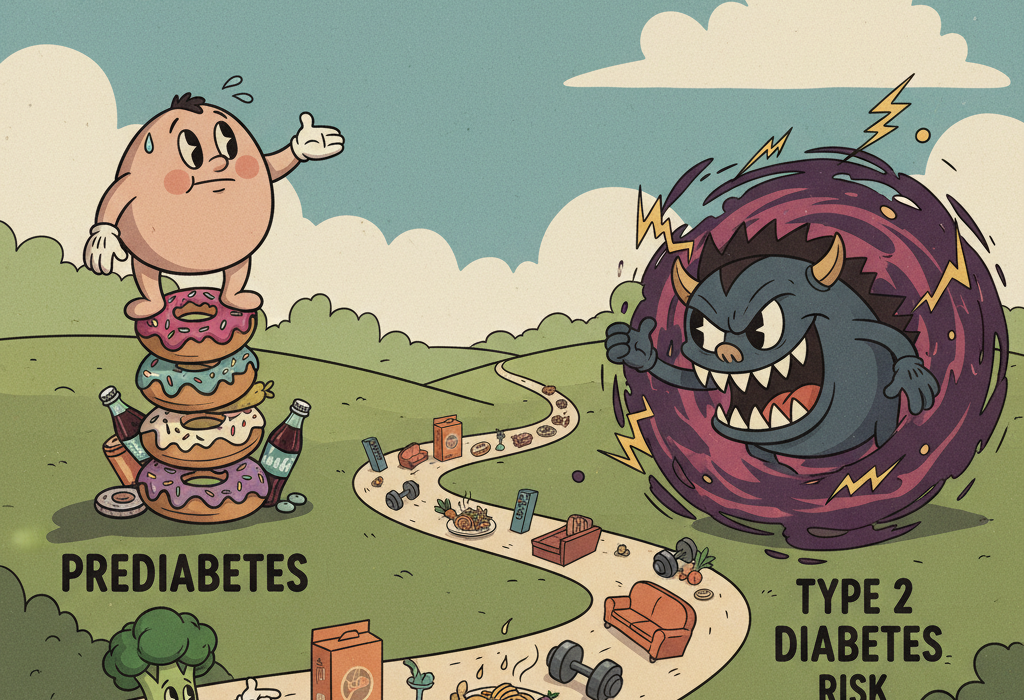
The Silent Warning Sign in Your Blood
Imagine your body is a busy factory. The food you eat is delivered as sugar to provide energy for the workers. Insulin (IN-suh-lin) is the manager who opens the factory doors so the sugar can get inside. When the factory gets overwhelmed, the manager has to shout louder and louder to get the doors open. Eventually, the doors stop opening easily. This is called insulin resistance (IN-suh-lin ree-ZIS-tuhns), which is when your body stops responding well to insulin.
Because the doors will not open, sugar piles up outside in your bloodstream. When blood sugar levels stay higher than normal but are not quite high enough to be classified as diabetes, doctors call it prediabetes.
For a long time, prediabetes was treated simply as a warning sign. It was viewed as a waiting room where nothing bad was happening yet. However, recent scientific research paints a very different picture. Prediabetes is an active condition that can begin changing your blood vessels, nerves, and organs years before full diabetes develops.
This article explores what the latest peer-reviewed studies actually say about prediabetes, how it progresses to type 2 diabetes, and what evidence-based steps can help manage the risk.
What the Research Shows About Prediabetes
When we look at large groups of people over many years, the data shows that prediabetes carries a significant health burden all on its own.
A 2022 study in Scientific Reports examined over 3,400 people to understand the physical toll of different blood sugar levels. The researchers found that individuals with prediabetes experienced a health burden comparable to 14 years of extra aging compared to people with normal blood sugar. This burden included a higher rate of joint issues, frequent infections, and early signs of heart disease.
High blood sugar also affects the nervous system early on. A 2021 review in Muscle & Nerve found that prediabetes and metabolic syndrome are strongly linked to small-fiber neuropathy. This is a condition where the tiny nerve endings in the skin become damaged, leading to tingling, numbness, or pain in the feet and hands. The research suggests that this nerve damage can begin long before a person crosses the threshold into type 2 diabetes.
The Progression to Type 2 Diabetes
If left unmanaged, prediabetes frequently progresses to type 2 diabetes. A comprehensive 2020 meta-analysis in the Journal of Advanced Nursing looked at 59 studies involving nearly 300,000 people. The researchers found that individuals with prediabetes were nearly six times more likely to develop type 2 diabetes compared to those with normal blood sugar.
However, the risk is not the same for everyone. A 2025 study in The Journal of Clinical Endocrinology and Metabolism analyzed data from the Diabetes Prevention Program. The researchers discovered that prediabetes is not a single identical condition in everyone. They identified two main subgroups of people with prediabetes, and these groups responded differently to treatments.
| Prediabetes Subgroup | Characteristics | Response to Treatment |
|---|---|---|
| Group 1 (31% of people) | Severe insulin resistance and severe obesity. | Responded very well to both intense lifestyle changes and the medication metformin. |
| Group 2 (69% of people) | Moderate insulin resistance and overweight/obesity. | Responded very well to lifestyle changes, but metformin provided much less benefit. |
This research highlights that while lifestyle changes like diet and exercise help almost everyone, medications like metformin may be most beneficial for specific subgroups with severe insulin resistance.
Related: How GLP-1 Drugs Actually Treat Type 2 Diabetes: What the Science Shows
How High Blood Sugar Changes Your Body Chemistry
To understand why prediabetes causes physical changes, we have to look at what extra sugar does inside the blood vessels.
A 2017 review in BioMed Research International explains the biological mechanisms. When blood sugar and insulin levels remain high, the body produces more Reactive oxygen species (ree-AK-tiv OX-ee-jen SPEE-sheez). These are unstable molecules that can damage cells.
This cellular damage reduces the availability of nitric oxide, a chemical that normally keeps blood vessels relaxed and flexible. Without enough nitric oxide, blood vessels become stiff. At the same time, the unstable molecules trigger inflammation. This combination of stiff blood vessels and inflammation accelerates atherosclerosis, which is the buildup of plaque in the arteries. This is why people with prediabetes have a higher risk of heart attacks and strokes.
The Role of Blood Lipids
Blood sugar is only one part of the equation. Blood fats, or lipids, also play a massive role in diabetes risk.
Scientists often measure the Atherogenic Index of Plasma, which is a mathematical ratio comparing Triglycerides (try-GLIS-er-ides) to HDL (good) cholesterol. A 2024 study in Frontiers in Endocrinology looked at over 12,000 Chinese adults. They found a non-linear but strong relationship: as this lipid ratio increased, the risk of prediabetes and type 2 diabetes skyrocketed.
A similar 2022 study in Cardiovascular Diabetology confirmed that high triglycerides combined with low HDL cholesterol is one of the strongest predictors of progressing to type 2 diabetes, even more so than standard cholesterol measurements.
Who Is at the Highest Risk?
Research clearly identifies certain populations that face a higher risk of developing prediabetes or progressing rapidly to type 2 diabetes.
Asian Populations
Multiple studies show that people of Asian descent develop prediabetes and type 2 diabetes at lower body weights than people of European descent. A 2019 review in Medicina noted that Asians tend to carry more visceral fat (fat around the organs) even when their overall Body Mass Index is considered normal. The 2020 meta-analysis mentioned earlier also confirmed that Asian populations with prediabetes had a significantly higher relative risk of progressing to full diabetes compared to Caucasian populations.
Adolescents and Youth
Type 2 diabetes was once considered an illness of older adults, but it is increasingly common in young people. A 2022 study in Pediatric Obesity looked at youth with overweight or obesity. They found that 37.6% of these young people already had dysglycemia (abnormal blood sugar). The risk increased drastically if the adolescent had additional factors like a family history of diabetes, a mother who had gestational diabetes during pregnancy, or abnormal blood lipids.
A 2020 systematic review in the Journal of Pediatric Nursing echoed these findings, noting that undiagnosed prediabetes in adolescents is a growing global issue. The review emphasized that early screening for youth with a family history of diabetes or high blood pressure is critical.
Surprising Risk Factors: Sleep and Vitamin D
Beyond diet and exercise, scientists are discovering other biological factors that heavily influence blood sugar control.
Sleep Apnea: Obstructive sleep apnea is a condition where breathing repeatedly stops and starts during sleep. A 2022 review in Nutrients highlighted a bidirectional relationship between sleep apnea and diabetes. Sleep apnea causes intermittent drops in oxygen, which triggers stress hormones like cortisol. These stress hormones directly increase insulin resistance. The review found that treating sleep apnea is a vital part of managing prediabetes and preventing cardiovascular disease.
Vitamin D Deficiency: Vitamin D is not just for bones; it plays a role in how the body processes sugar. A 2025 review in Endokrynologia Polska analyzed the link between Vitamin D and metabolic health. The researchers concluded that Vitamin D deficiency should be considered a clear risk factor for prediabetes. They noted that supplementing Vitamin D in deficient individuals can have a beneficial effect on body weight and carbohydrate metabolism.
Practical Guidance: What Science Says Works
The good news is that prediabetes is often reversible. A 2025 review in Trends in Endocrinology and Metabolism stresses that achieving remission from prediabetes is one of the most effective ways to reduce the global burden of type 2 diabetes.
So, what actually works?
The Mediterranean Diet: A 2021 review in Nutrients evaluated decades of data on the Mediterranean diet. This eating pattern focuses on whole grains, legumes, vegetables, nuts, and olive oil, while limiting processed meats and sugars. The review found that the Mediterranean diet significantly reduces Hemoglobin A1c (HEE-muh-glow-bin A-one-C), which is a long-term measure of blood sugar. It also lowers triglycerides and promotes weight loss, effectively addressing the root causes of insulin resistance.
Physical Activity: Muscles are the largest consumers of sugar in the body. The 2019 review in Medicina noted that replacing just 30 minutes of sedentary time with moderate physical activity can improve insulin sensitivity by 15%. When muscles contract during exercise, they can take in sugar from the blood even if insulin is not working perfectly.
Related: What Science Actually Says About Blood Sugar After Meals
Why Prevention Matters
Stopping the progression of prediabetes is crucial because full type 2 diabetes carries severe long-term consequences.
A massive 2025 study in Nature Reviews Disease Primers analyzed data from over 820,000 people. They found that having diabetes is associated with a much higher risk of death from vascular diseases, kidney disease, and even certain cancers. On average, a 50-year-old with diabetes died about 6 years earlier than someone without the condition. Preventing the transition from prediabetes to diabetes is the most effective way to avoid these outcomes.
The Bottom Line
Prediabetes is not just a warning; it is a state of metabolic stress that can begin damaging blood vessels and nerves immediately. The research clearly shows that elevated blood sugar, combined with poor lipid ratios and factors like sleep apnea, creates a high-risk environment for developing type 2 diabetes.
However, the evidence also shows that this process is not inevitable. Through targeted lifestyle changes like the Mediterranean diet, regular physical activity, and addressing hidden issues like sleep apnea or Vitamin D deficiency, many people can improve their insulin sensitivity and return their blood sugar to normal levels.
Quick Reference: Key Studies
| Study Focus | Key Finding | Source |
|---|---|---|
| Health Burden | Prediabetes carries a health burden comparable to 14 years of aging, increasing the risk of joint, immune, and vascular issues. | PMID 35513556 |
| Progression Risk | People with prediabetes are roughly 5.88 times more likely to develop type 2 diabetes than those with normal blood sugar. | PMID 33009836 |
| Subgroups | Prediabetes has distinct subgroups. Those with severe insulin resistance respond well to metformin, while others benefit mostly from lifestyle changes. | PMID 40497454 |
| Dietary Impact | The Mediterranean diet effectively lowers long-term blood sugar (HbA1c), reduces body weight, and improves lipid profiles. | PMID 33920947 |
| Sleep Apnea | Obstructive sleep apnea increases stress hormones and insulin resistance, accelerating the progression of metabolic disease. | PMID 36501019 |
| Mortality | Progressing to full diabetes reduces life expectancy by an average of 6 years for a 50-year-old, increasing risks for vascular and non-vascular diseases. | PMID 40676018 |
Last updated: March 2026
This article synthesizes findings from peer-reviewed research. It is for educational purposes only and does not constitute medical advice. Consult a healthcare provider before starting any new regimen.



Leave a Reply