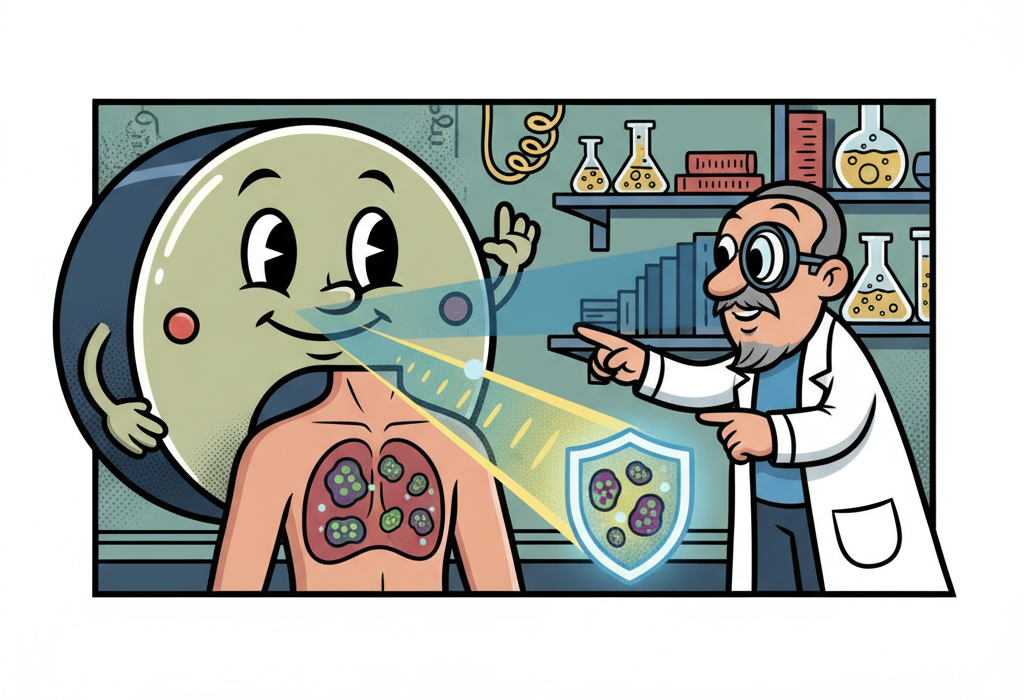
A Window Into the Body
Imagine trying to find a small crack inside a wall. You could tear the whole wall open to look, or you could use a special camera that sees through the surface without making a single hole. That is roughly what an MRI (em-are-EYE), or magnetic resonance imaging, does for the human body. It uses strong magnets and radio waves to create detailed pictures of organs and tissues, all without surgery or radiation.
MRI has become one of the most important tools doctors use to find, measure, and track cancer. But the technology keeps evolving. Researchers are now asking: Can we make MRI scans shorter and simpler without losing accuracy? Can MRI help us avoid unnecessary surgeries? And how does MRI compare to other imaging tools when it comes to spotting cancer that has spread?
Three recent studies shed light on these questions, covering prostate cancer, thyroid cancer, and rectal cancer. Together, they paint a picture of how imaging technology is being fine-tuned to give patients better outcomes with less burden.
What the Research Shows
Prostate Cancer: A Simpler MRI Works Just as Well
When doctors suspect prostate cancer, they often order a multiparametric MRI (mul-tee-pair-uh-MET-rik), or mpMRI. This is a detailed scan that combines several types of images, including one that requires injecting a contrast dye (called gadolinium) into the patient’s bloodstream. The dye helps highlight areas where blood flow is abnormal, which can signal a tumor.
But what if you could skip the dye and still get a reliable answer?
A biparametric MRI (by-pair-uh-MET-rik), or bpMRI, uses only two of those image types and does not require contrast dye. It is faster, cheaper, and more comfortable for the patient. The big question has been whether it is accurate enough.
A 2025 clinical trial published in JAMA set out to answer this. The PRIME trial was a prospective, multicenter study, meaning it followed patients forward in time across multiple hospitals. It is considered a “level-1” study, which is the highest quality of diagnostic evidence. The researchers enrolled 490 men who had never had a prostate biopsy before. Each man received both types of MRI scan, and the results were compared within the same patient.
The key finding: biparametric MRI was noninferior to multiparametric MRI for detecting clinically significant prostate cancer (defined as Gleason Grade Group 2 or higher). The difference between the two was just 0.4 percentage points. In plain language, the simpler scan found the same cancers as the more complex one.
This is a notable result because it suggests that, when image quality is good enough, doctors could use the shorter, dye-free scan as the standard first step in diagnosing prostate cancer.
| Feature | Biparametric MRI (bpMRI) | Multiparametric MRI (mpMRI) |
|---|---|---|
| Contrast dye needed? | No | Yes |
| Scan time | Shorter | Longer |
| Detects significant cancer? | Yes | Yes |
| Difference in detection | Only 0.4 percentage points apart | |
| Study quality | Level-1 prospective trial |
Important caveat: The researchers noted that adequate image quality is essential. A poorly done biparametric MRI would not be a reliable substitute. The scan must be performed by trained radiologists using proper equipment and protocols.
Thyroid Cancer: Comparing MRI to Other Imaging Tools
Medullary thyroid cancer (MED-yoo-lair-ee), or MTC, is a rare form of thyroid cancer. When surgeons plan an operation to remove MTC, they need to know whether the cancer has spread to nearby lymph nodes (LIMF nohdz), which are small, bean-shaped structures that filter fluid and fight infection throughout the body. If cancer reaches the lymph nodes in the neck, the surgery becomes more extensive.
A 2025 study in Cancer Imaging looked at 175 MTC patients from two major hospitals in the Netherlands over a 20-year period (2000 to 2020). The researchers compared how well different imaging tools detected lymph node spread before surgery.
The tools compared included:
- Ultrasound (the standard first-line tool)
- MRI
- CT scan (computed tomography)
- PET/CT (positron emission tomography combined with CT), using two different tracers: 18F-FDG and 18F-DOPA
Here is how each tool performed at finding cancer in the central neck lymph nodes (closest to the thyroid) and the lateral neck lymph nodes (on the sides of the neck):
| Imaging Tool | Sensitivity: Central Neck | Sensitivity: Lateral Neck | Specificity: Central Neck | Specificity: Lateral Neck |
|---|---|---|---|---|
| 18F-FDG PET/CT | 72% | 89% | 80% | 100% |
| 18F-DOPA PET/CT | 39% | 81% | 100% | 100% |
| Ultrasound | 6% | 77% | 100% | 75% |
| MRI | 42% | 76% | 71% | 78% |
| CT | 93% | 75% | 100% | 50% |
A quick note on what those terms mean:
- Sensitivity (sen-sih-TIV-ih-tee): How good the test is at finding cancer that is actually there. Higher is better.
- Specificity (speh-sih-FIS-ih-tee): How good the test is at correctly identifying areas that are cancer-free. Higher means fewer false alarms.
A few things stand out from this data:
1. MRI had moderate performance overall. It detected about 42% of central neck spread and 76% of lateral neck spread. It was not the best or worst tool in either category.
2. CT was the best tool for the central neck (93% sensitivity), likely because CT gives sharper anatomical detail close to the thyroid.
3. PET/CT scans were the best at finding lateral neck spread and had near-perfect specificity, meaning when they said cancer was there, it almost always was.
4. Ultrasound struggled with central neck lymph nodes (only 6% sensitivity), probably because those nodes sit deep beneath the surface where ultrasound has trouble reaching.
The researchers concluded that no single imaging tool was perfect for every situation. Instead, combining tools may give the most complete picture. For instance, pairing PET/CT with a diagnostic CT could cover both the central and lateral neck effectively.
This was a retrospective study (looking back at medical records), which means it has inherent limitations. Not every patient received every type of scan, so the comparisons are not perfectly apples-to-apples. Still, with 175 patients for a rare cancer, it provides useful real-world data.
Rectal Cancer: MRI as a Treatment Guide
MRI does not only find cancer. It also helps doctors track how a tumor responds to treatment. This is especially relevant in locally advanced rectal cancer (LARC), where tumors have grown into nearby tissue or spread to nearby lymph nodes.
Traditionally, patients with LARC received radiation and chemotherapy before surgery to remove the tumor. But a newer approach called total neoadjuvant therapy (TOH-tul nee-oh-AD-joo-vant), or TNT, delivers all the chemotherapy and radiation before surgery. Some patients respond so well that the tumor disappears completely, a state called clinical complete response (cCR). When that happens, doctors may offer a “watch and wait” approach instead of surgery, preserving the organ and avoiding major complications.
A 2024 protocol paper in BMC Cancer describes the Janus Rectal Cancer Trial, a large ongoing clinical trial across the United States. This study is enrolling up to 760 patients with stage II or III rectal cancer. All patients receive radiation plus chemotherapy, followed by either a two-drug (“doublet”) or three-drug (“triplet”) chemotherapy regimen.
Here is where MRI comes in: every patient in the trial undergoes a pelvic MRI with a dedicated rectal protocol at baseline and again after treatment. This MRI is one of the key tools used to determine whether the cancer has achieved a clinical complete response. If the MRI (along with a physical exam and endoscopy) shows no remaining tumor, the patient may be able to skip surgery entirely.
The trial had enrolled 330 patients as of May 2024 and is still actively recruiting. It does not yet have final results, so we cannot say which chemotherapy approach works better. However, the trial design highlights how central MRI has become to modern cancer care. It is not just a diagnostic tool anymore. It is a decision-making tool that directly influences whether a patient needs surgery.
Who Benefits Most
The research covered here applies to different groups of people, so it helps to break it down.
Men Being Screened for Prostate Cancer
The PRIME trial’s findings are most relevant to men who have never had a prostate biopsy and are being evaluated for the first time. For these men, a biparametric MRI could mean:
- A shorter scan (often under 15 minutes vs. 30+ minutes)
- No contrast dye injection, which matters for people with kidney problems or dye allergies
- Potentially lower cost
This does not apply to men who have already been diagnosed or who are being monitored after treatment. Those situations may still require the full multiparametric scan.
Patients With Medullary Thyroid Cancer
The imaging comparison study is most relevant to patients newly diagnosed with MTC who are planning surgery. Knowing where the cancer has spread helps surgeons decide how extensive the operation should be. Better imaging upfront could mean fewer surprise findings during surgery and fewer repeat operations later.
Patients With Locally Advanced Rectal Cancer
The Janus Trial is relevant to patients with stage II or III rectal cancer who are candidates for total neoadjuvant therapy. The possibility of achieving a complete response and avoiding surgery could significantly improve quality of life. MRI is one of the tools that makes this “watch and wait” approach possible.
Who Should Be Careful
| Group | Consideration |
|---|---|
| People with metal implants | Some implants are not MRI-safe; always inform your doctor |
| People with severe kidney disease | Contrast-enhanced MRI uses gadolinium, which can be risky; the bpMRI approach avoids this |
| People with claustrophobia | MRI machines are enclosed; sedation or open MRI may be options |
| Anyone self-diagnosing | These are clinical tools used by trained professionals, not consumer products |
How This Applies in Practice
You cannot order your own MRI or decide which type of scan you need. These are decisions made by your medical team. But understanding the landscape can help you have better conversations with your doctor.
If You Are Being Evaluated for Prostate Cancer
- Ask your urologist whether a biparametric MRI is an option for your initial evaluation.
- If your doctor recommends the full multiparametric scan, it may be because your case is more complex or because their facility has not yet adopted the shorter protocol.
- Either way, MRI before biopsy is now considered standard practice in many guidelines. If a doctor suggests going straight to biopsy without any MRI, it is reasonable to ask why.
If You Have Been Diagnosed With Thyroid Cancer
- Your surgical team will decide which imaging you need based on your specific cancer type and stage.
- If you have medullary thyroid cancer, ask whether PET/CT imaging might help plan your surgery, especially if there is concern about lymph node spread.
- Remember that ultrasound remains a first-line tool, but it has known limitations for deeper lymph nodes.
If You Have Rectal Cancer
- A dedicated rectal MRI is now a standard part of staging and treatment planning.
- If your oncologist discusses total neoadjuvant therapy, MRI will play a role in assessing your response.
- Ask about clinical trials like the Janus Trial if you are interested in approaches that may increase your chance of organ preservation.
What We Know and What We Do Not
Here is an honest summary of where the evidence stands.
What we know:
- Biparametric MRI performs as well as multiparametric MRI for detecting clinically significant prostate cancer in men having their first evaluation. This comes from a high-quality prospective trial.
- Different imaging tools have different strengths when it comes to thyroid cancer staging. No single tool catches everything. MRI is useful but not dominant in this setting.
- MRI is now a core part of rectal cancer treatment planning, helping doctors decide whether surgery is needed after chemotherapy and radiation.
What we do not know:
- Whether biparametric MRI performs equally well in men who have had prior biopsies or who are on active surveillance.
- The ideal combination of imaging tools for thyroid cancer staging. The thyroid cancer study was retrospective and relatively small, so its findings need confirmation in larger, prospective studies.
- Whether triplet chemotherapy leads to more complete responses than doublet chemotherapy in rectal cancer. The Janus Trial is still enrolling patients and has not reported results yet.
Correlation vs. causation note: The thyroid cancer study found that patients who received PET/CT scans had worse survival than those who did not. However, this was not because the scan caused harm. Patients with more advanced disease were more likely to be given PET/CT scans in the first place. When the researchers removed patients with distant spread from the analysis, the survival difference disappeared. This is a good reminder that correlation (two things happening together) is not the same as causation (one thing causing the other).
Quick Reference: Key Studies
| Study Focus | Type | Key Finding | Source |
|---|---|---|---|
| Biparametric vs. multiparametric MRI for prostate cancer | Prospective clinical trial (490 men) | bpMRI was noninferior to mpMRI for detecting clinically significant prostate cancer (0.4 percentage point difference) | PMID 40928788 |
| Imaging tools for medullary thyroid cancer staging | Retrospective observational study (175 patients) | PET/CT had the highest sensitivity for lateral neck lymph node spread (89%); CT was best for central neck (93%); MRI had moderate performance | PMID 40140941 |
| MRI in rectal cancer treatment monitoring (Janus Trial) | Ongoing phase II/III randomized trial (up to 760 patients) | MRI is a core tool for assessing tumor response after neoadjuvant therapy; trial comparing triplet vs. doublet chemotherapy is still enrolling | PMID 39060961 |
Last updated: July 2025
This article synthesizes findings from peer-reviewed research. It is for educational purposes only and does not constitute medical advice. Consult a healthcare provider before starting any new regimen.


Leave a Reply