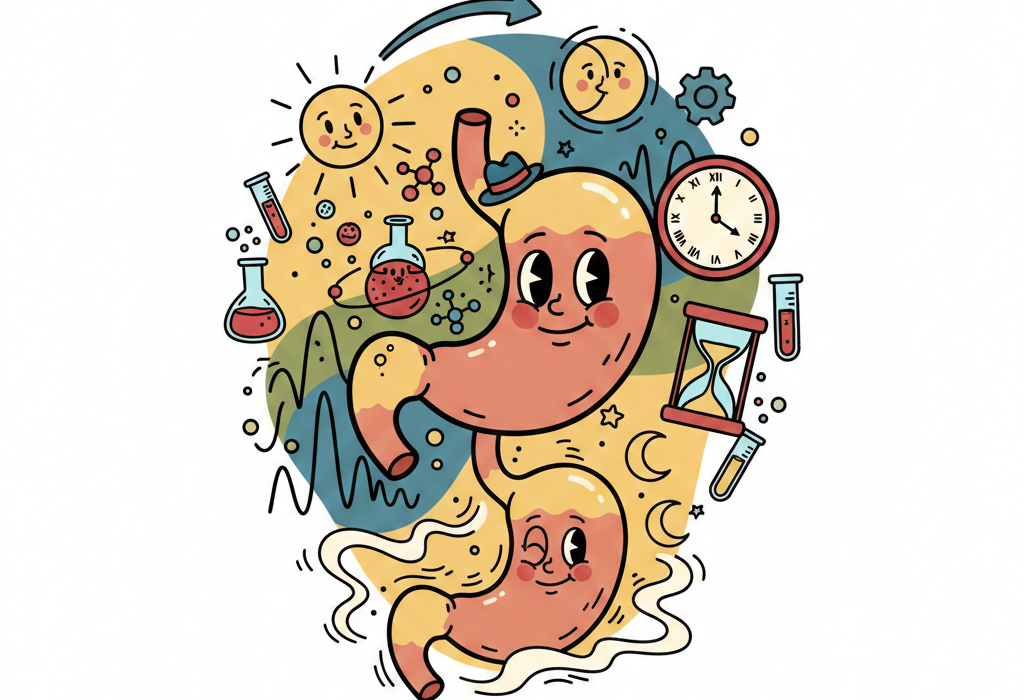
Your body has a built-in reset button. Here’s what happens when you press it.
Section 1: What Is Intermittent Fasting, Really?
Imagine your body is like a house. Most of the time, it’s busy receiving deliveries (that’s the food you eat), unpacking boxes, and storing things away. But what happens when the deliveries stop for a while? Your body finally gets a chance to clean up, take out the trash, and reorganize. That’s essentially what intermittent fasting does—it gives your body scheduled breaks from eating so it can do some housekeeping.
Intermittent fasting (IF) isn’t about what you eat, but when you eat. Instead of eating whenever you’re hungry throughout the day, you squeeze all your meals into specific time windows. The most popular approaches are the 16:8 method (eating only during an 8-hour window, like 10am to 6pm) and the 5:2 method (eating normally five days a week, then eating very little—around 500 calories—on two non-consecutive days). A 2025 review in The Journal of Nutrition analyzed 81 studies and found both approaches can improve how your body handles sugar, burns fat, and fights inflammation.
Here’s the cool part: your body has different “modes.” When you’re eating regularly, it’s in storage mode—taking the energy from food and tucking it away. But after about 12 hours without food, something shifts. Your body switches to a cleanup mode called autophagy (pronounced aw-TOFF-uh-gee), which literally means “self-eating” in Greek. Don’t worry—it’s a good thing! During autophagy, your cells break down old, damaged parts and recycle them into fresh building materials. Think of it like your body’s Marie Kondo moment, keeping what sparks joy and tossing the rest.
Scientists have also discovered that IF affects something called your circadian rhythm—your body’s internal 24-hour clock that tells you when to sleep, wake up, and eat. A Russian study on chrononutrition found that IF works best when you align your eating window with your natural body clock. Morning people might do better eating earlier in the day, while night owls might prefer a later eating window. The key is consistency—your body loves routine.
Section 2: What the Research Shows (The Good Stuff)
Let’s look at what scientists have actually found when they put intermittent fasting to the test. Spoiler alert: the results are pretty encouraging, especially for people dealing with weight issues or blood sugar problems.
Weight Loss and Body Composition
When researchers in Egypt studied 99 people with type 2 diabetes over three months, they found something interesting. One group just cut calories. The other group cut calories and used a 12-hour fasting window. The fasting group lost more weight (6.5% vs 4.4% of body weight) and—here’s the important part—they lost more body fat (9.4% vs 5.3%). That matters because you want to lose fat, not muscle.
Even more impressive was a Chinese study that compared the 5:2 method against two popular diabetes medications (metformin and empagliflozin). After 16 weeks, the fasting group beat both medication groups in nearly every measurement—losing more belly fat, more overall weight, and showing better body composition changes.
| Measurement | 5:2 Fasting | Metformin | Empagliflozin |
|---|---|---|---|
| BMI Change | -3.41 kg/m² | Lower | Lower |
| Waist Reduction | -8.83 cm | Lower | Lower |
| Body Fat Loss | -4.84% | Lower | Lower |
| Belly Fat Area | -66.05 cm² | Lower | Lower |
Source: PMID 41485450 – Clinical Nutrition, Feb 2026
Blood Sugar Control
For people with type 2 diabetes (a condition where your body struggles to manage blood sugar), IF shows real promise. A Dutch study found that people following time-restricted eating had zero dropouts over three months, compared to 19% who quit the traditional calorie-cutting diet. Why? Because many people find it easier to limit when they eat rather than obsessing over every calorie. The fasting group also maintained their metabolic rate (how many calories your body burns at rest), while the traditional dieters’ metabolisms slowed down—a common problem that makes weight regain more likely.
The Gut-Brain Connection
Here’s where it gets fascinating. Your gut contains trillions of bacteria that influence everything from your mood to your immune system—scientists call this your gut microbiome (micro-BY-ome). A review in Nutrients found that IF increases levels of beneficial bacteria like Akkermansia and Faecalibacterium, which help keep your gut lining healthy and produce short-chain fatty acids—tiny molecules that reduce inflammation throughout your body.
This gut connection even affects your brain. A mouse study found that IF before surgery protected elderly mice from post-operative confusion (delirium) by keeping their gut bacteria balanced. While we can’t assume mouse results apply directly to humans, it suggests IF might help protect brain function as we age—something a comprehensive review on neurodegenerative diseases also supports.
Section 3: Who Benefits Most (And Who Should Be Careful)
Intermittent fasting isn’t one-size-fits-all. Like a medicine, it works better for some people than others—and for certain groups, it might not be appropriate at all.
Great Candidates for IF
Based on the research, IF shows the most promise for:
People with type 2 diabetes or prediabetes: Multiple studies show IF can improve insulin sensitivity (how well your cells respond to insulin, the hormone that manages blood sugar) and lower HbA1c (a measure of your average blood sugar over 2-3 months). The Egyptian trial found IF + calorie restriction reduced HbA1c to 6.51%, compared to 6.86% with calorie restriction alone.
Women with PCOS: Polycystic ovary syndrome affects 6-21% of women of reproductive age. A nursing review found IF can help address three key PCOS problems: insulin resistance, high insulin levels, and excess male hormones (androgens). This makes IF a potential drug-free option for managing this frustrating condition.
People who struggle with traditional diets: If counting every calorie makes you crazy, IF might be your jam. You’re only making one decision: “Is it time to eat yet?” The Japanese web-based program achieved 79% adherence—remarkably high for any diet study.
Proceed with Caution
People with eating disorder history: A psychological review analyzing 87 studies found that while healthy adults generally do fine, people with past eating disorders face heightened risks of relapse and food preoccupation. The structure of IF can sometimes trigger unhealthy restriction patterns.
Those prone to anxiety or mood disorders: The same review noted that in vulnerable individuals, fasting can cause mood destabilization, increased anxiety, and in rare cases, more serious psychiatric symptoms. If you have a mental health condition, talk to your doctor before trying IF.
Pregnant or breastfeeding women: A rat study found that caloric restriction during lactation led to metabolic problems in offspring. While animal studies don’t always translate to humans, this is a time when consistent nutrition is critical.
| Population | IF Recommendation | Notes |
|---|---|---|
| Type 2 Diabetes | Generally beneficial | Monitor blood sugar closely; may need medication adjustments |
| PCOS | Promising option | May help with insulin and hormone balance |
| Healthy adults seeking weight loss | Good fit if sustainable | Watch for muscle loss; add exercise |
| Eating disorder history | Not recommended | Risk of triggering unhealthy patterns |
| Anxiety/mood disorders | Consult doctor first | May worsen symptoms in some people |
| Pregnant/breastfeeding | Avoid | Consistent nutrition needed for baby |
| Elderly/frail | Insufficient evidence | Most studies in healthy adults |
Section 4: The Practical Stuff—How to Actually Do This
So you’ve decided to try intermittent fasting. Great! But there are some important details that can make the difference between success and frustration.
Choosing Your Method
The two most-studied approaches are:
16:8 (Time-Restricted Eating): You eat all your meals within an 8-hour window and fast for 16 hours. Most people skip breakfast and eat from noon to 8pm, but you can shift this window to match your schedule. A 12-month Italian study found the 16:8 method produced fast initial metabolic improvements, though a ketogenic diet showed greater long-term weight loss.
5:2 (Modified Fasting): You eat normally five days per week and restrict to about 500-600 calories on two non-consecutive days. The Chinese diabetes study using this method showed impressive results for belly fat reduction.
Neither is objectively “better”—the best method is the one you can actually stick with. The Dutch study showed time-restricted eating had dramatically better adherence (100% completion) compared to traditional calorie restriction (81% completion).
Timing Matters
Remember chrononutrition—eating in sync with your body clock? A comprehensive review found that eating earlier in the day, aligned with natural circadian rhythms, produced better blood sugar outcomes than eating later. If you’re a morning person, consider a 7am-3pm eating window rather than noon-8pm. Your body processes food more efficiently when it expects to receive it.
Watch for Muscle Loss
Here’s a potential downside the studies flag: some research shows IF can lead to muscle loss along with fat loss. The Japanese pilot study specifically noted “muscle mass reduction was implied” and recommended adding exercise guidance. The solution? Combine IF with resistance training (lifting weights, bodyweight exercises, resistance bands) and make sure you’re eating enough protein during your eating window.
Don’t Expect Miracles
A review on chrononutrition concluded that IF offers “no advantages over traditional low-calorie diets” unless it helps you actually stick to eating less overall. The magic isn’t in some metabolic trick—it’s in finding an approach that works for your life and psychology. For many people, having clear “eating” and “not eating” times is easier than constant calorie monitoring.
Section 5: The Bottom Line—What We Know and Don’t Know
After reviewing 18 recent studies on intermittent fasting, here’s where the science stands in 2026.
What the Evidence Strongly Supports
IF can help with weight loss, especially fat loss around the belly. It can improve blood sugar control in people with type 2 diabetes or prediabetes. It appears to have anti-inflammatory effects and may support gut health. Many people find it easier to follow than traditional diets, leading to better long-term adherence. A comprehensive narrative review described fasting as a “low-cost, multidimensional biopsychospiritual health intervention” affecting metabolic, cardiovascular, immune, and cognitive systems.
What We’re Still Learning
Most IF studies are short-term (3-6 months) with relatively small groups of participants. As the immune aging review noted, “most evidence comes from short- to medium-term studies in selected, relatively healthy populations.” We need more research on:
- Long-term effects (5+ years)
- Effects in elderly and frail populations
- Optimal protocols for different health conditions
- How to prevent muscle loss during IF
- Potential risks in vulnerable populations
The ELI5 Summary
Your body is like a phone that sometimes needs to restart to work better. Intermittent fasting is like scheduling regular restarts. During the “off” time, your body cleans up damaged cells, burns stored fat for energy, and resets various systems. For many people—especially those with blood sugar issues or who struggle with traditional diets—this can be a helpful tool.
But just like you wouldn’t restart your phone during an important call, there are times when fasting isn’t appropriate. If you’re pregnant, have an eating disorder history, or have certain mental health conditions, IF probably isn’t for you. For everyone else, it’s a legitimate option worth discussing with your doctor—not a miracle cure, but a potentially useful tool in your health toolkit.
Quick Reference: Key Studies
| Study Focus | Key Finding | Source |
|---|---|---|
| IF vs. Calorie Restriction in Diabetes | IF group lost more weight (6.5% vs 4.4%) and more fat (9.4% vs 5.3%) | PMID 41501473 |
| 5:2 IF vs. Diabetes Medications | IF outperformed metformin and empagliflozin for body composition | PMID 41485450 |
| Adherence Comparison | 100% completion for IF vs. 81% for traditional diet | PMID 41587663 |
| Gut Microbiome Effects | IF increases beneficial bacteria and short-chain fatty acids | PMID 41515236 |
| Psychological Risks | Mood destabilization possible in vulnerable individuals | PMID 41515178 |
| PCOS Management | IF addresses insulin resistance and hormone imbalance | PMID 41617175 |
| Liver Disease (Animal) | IF reduced liver enzymes ALT by 47%, AST by 45% | PMID 41634219 |
| 12-Month Comparison | 16:8 showed fastest initial gains; keto showed most weight loss | PMID 41599851 |
Last updated: February 2026
This article synthesizes findings from peer-reviewed research published in PubMed. It is for educational purposes only and does not constitute medical advice. Please consult with a healthcare provider before starting any new dietary regimen.
About eli5health.com/: We break down complex health research into plain English so you can make informed decisions about your wellbeing. Because understanding your health shouldn’t require a medical degree.

Leave a Reply