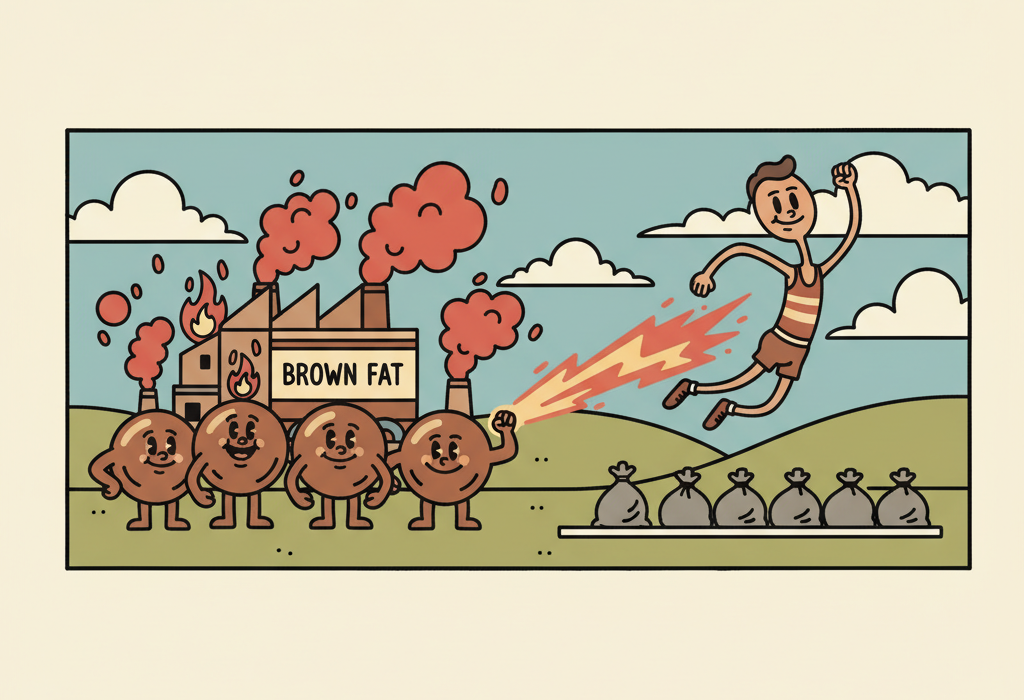
Most of us think of body fat as a storage locker, carefully holding onto excess calories for a time when food might be scarce. But the human body actually has a completely different type of fat that acts more like a furnace.
This tissue is called brown adipose tissue (BROWN ad-uh-pohs TISH-oo), or simply brown fat. Instead of storing energy, brown fat burns calories to generate heat. Because of this unique ability, scientists have spent years trying to figure out if activating brown fat could be a safe and effective way to help people lose weight.
The short answer is that brown fat does increase the amount of energy your body uses. However, relying on it alone for major weight loss might not be as effective as many hope. Here is what the latest scientific research actually says about brown fat, metabolism, and weight management.
Common Misunderstandings About Fat Loss
Before understanding how brown fat works, it helps to understand how weight loss actually happens. A common myth is that when you lose weight, fat is simply converted into pure energy or heat.
A 2014 analysis in the BMJ explains that this violates the laws of physics. Mass cannot just disappear into nothing. When your body breaks down fat molecules, the fat is actually converted into carbon dioxide and water. The water leaves your body through urine, sweat, and tears. The carbon dioxide leaves your body when you exhale.
In fact, the lungs are the primary excretory organ for weight loss. You literally breathe out the vast majority of the fat you lose. Brown fat simply speeds up the chemical reactions that lead to this breakdown.
How Brown Fat Might Work
To understand why brown fat is different, it helps to look at it under a microscope.
Standard white fat cells contain a single, large droplet of stored lipid (fat). Brown fat cells are packed with many smaller lipid droplets and contain a high number of mitochondria. Mitochondria are the microscopic power plants of the cell. They contain a specific protein called uncoupling protein 1 (uhn-KUHP-ling PRO-teen wuhn), or UCP1.
Normally, mitochondria process nutrients to create chemical energy for the cell to use. UCP1 disrupts this process. Instead of making usable chemical energy, the mitochondria release the energy as heat. This process is called thermogenesis (ther-moh-JEN-uh-sis).
Humans are born with a lot of brown fat to help keep us warm as infants. While we lose a lot of it as we age, adults still retain small pockets of brown fat around the neck, collarbones, and spine.
Interestingly, white fat can sometimes take on the characteristics of brown fat. When exposed to certain triggers, such as cold temperatures, white fat cells can develop more mitochondria and start expressing UCP1. This intermediate type of fat is known as “beige” fat.
Does Brown Fat Actually Cause Weight Loss?
If brown fat burns calories to create heat, it seems logical that activating it would lead to weight loss. Researchers have tested several ways to activate brown fat, including cold exposure, spicy compounds called capsinoids, and specific medications.
These interventions consistently increase energy expenditure. However, the actual impact on body weight is relatively small.
A 2017 review in Current Obesity Reports notes that while cold exposure increases calorie burning, the total amount of energy used by brown fat is quite small. Fully activated brown fat might burn an extra 100 calories per day. This can help prevent gradual weight gain over time, but it is rarely enough to create the large calorie deficit needed for significant weight loss.
A 2023 review in Diabetes/Metabolism Research and Reviews reached a similar conclusion. The authors found that while brown fat activation is real, using it as a standalone treatment is unlikely to result in major weight loss. Instead, it might be more useful when combined with traditional diet and exercise.
Similarly, a 2022 systematic review in Frontiers in Endocrinology looked at 47 clinical trials involving brown fat activation. They found that changes in energy expenditure did not strongly correlate with major weight changes in humans.
Metabolic Health Beyond the Scale
Even if brown fat does not melt away pounds rapidly, it appears to be highly beneficial for overall metabolic health.
Brown fat acts as a sink for nutrients. When activated, it pulls sugar (glucose) and fat molecules out of the bloodstream to use as fuel. A 2022 review in Signal Transduction and Targeted Therapy highlights that people with detectable brown fat tend to have a lower risk of type 2 diabetes and cardiovascular disease.
By clearing excess glucose and fats from the blood, brown fat helps improve insulin sensitivity. This means your body requires less insulin to manage blood sugar levels, which is a key marker of good health.
How Weight Loss Medications Affect Brown Fat
Recent advancements in obesity medications have prompted researchers to look at how these drugs interact with brown fat.
For example, medications like semaglutide mimic a hormone called GLP-1. A 2022 study in Cell Biochemistry and Function found that in obese mice, semaglutide stimulated the “beiging” of subcutaneous fat. It increased the expression of UCP1 and improved mitochondrial biogenesis, while also reducing inflammation in visceral fat. Related: GLP-1 Weight Loss Drugs: What Real-World Results Actually Show
Researchers are now investigating if similar effects happen in humans. A 2025 trial protocol published in Trials outlines an ongoing study testing whether tirzepatide, a dual GLP-1/GIP receptor agonist, increases brown fat volume and activity in women with obesity.
Other brain signaling pathways also play a role. A 2019 study in Nature Metabolism found that stimulating dopamine receptors in the brain increased brown fat activity in rodents. When human patients were given a dopamine-stimulating drug called cabergoline for a year, they experienced increased resting energy expenditure and weight loss.
The Dark Side of Brown Fat: Cancer Wasting
While burning extra calories is desirable for obesity, it can be dangerous in other medical conditions. In advanced cancer, patients sometimes develop a severe wasting syndrome called cachexia, characterized by rapid fat and muscle loss.
Research on how brown fat behaves during cancer is currently mixed, and scientists are trying to understand why.
On one hand, animal studies suggest that tumors can hijack the body’s fat tissue. A 2024 study in Signal Transduction and Targeted Therapy found that cancer cells release a protein called GRP75. This protein triggers normal white fat to “beige” and start burning energy, contributing to rapid weight loss. Blocking this protein helped reverse the wasting effect in mice.
On the other hand, human observational data shows a different pattern. A 2025 retrospective study in Clinical Nutrition looked at cancer patients who had naturally detectable brown fat at the time of their diagnosis. Surprisingly, these patients experienced less weight loss and had a 44% lower risk of developing cancer cachexia compared to patients without detectable brown fat.
Scientists are still working to understand this contradiction. It is possible that having healthy brown fat before getting sick is a sign of overall metabolic resilience, whereas tumor-forced “beiging” of white fat later on is harmful.
Where The Science Is Still Uncertain
Finding a safe way to activate brown fat with a pill remains a challenge.
Some medications, known as beta-3 adrenergic agonists, successfully activate brown fat in humans. However, the 2022 review on brown fat interventions notes that these drugs can have side effects. Because the pathways that activate brown fat are closely linked to the sympathetic nervous system (your “fight or flight” response), these medications can sometimes increase heart rate and blood pressure.
Researchers are still looking for ways to activate brown fat safely without putting extra stress on the cardiovascular system.
The Bottom Line
Brown adipose tissue is a fascinating part of human biology. It actively burns glucose and lipids to generate heat, which improves blood sugar control and overall metabolic health.
However, the evidence suggests that brown fat is not a standalone cure for obesity. The number of calories it burns daily is relatively small. While new weight loss medications and dietary strategies might partially work by enhancing brown fat activity, they are most effective when they also reduce the amount of food you eat.
For now, the best way to support your metabolism is through a combination of healthy eating, regular physical activity, and discussing any medical weight loss options with a healthcare provider. Related: Intermittent Fasting: What the Latest Science Actually Says
Quick Reference: Key Studies
| Study Focus | Key Finding | Source |
|---|---|---|
| Fat Loss Mechanics | Fat is not converted to pure energy; it is broken down into carbon dioxide (exhaled) and water. | PMID 25516540 |
| BAT and Weight Loss | Activating brown fat increases energy expenditure but results in minimal overall weight loss in humans. | PMID 36568070 |
| Semaglutide and Fat | In obese mice, semaglutide stimulated the “beiging” of fat and reduced tissue inflammation. | PMID 36169111 |
| Dopamine and BAT | Stimulating dopamine receptors in the brain increased brown fat activity and resting energy expenditure. | PMID 31579887 |
| BAT in Cancer (Humans) | Having active brown fat at cancer diagnosis was associated with a lower risk of severe weight loss (cachexia). | PMID 39874717 |
| Tumor-Induced Browning | In mice, tumors release proteins that force white fat to burn energy, driving dangerous weight loss. | PMID 39327432 |
Last updated: March 2026
This article synthesizes findings from peer-reviewed research. It is for educational purposes only and does not constitute medical advice. Consult a healthcare provider before starting any new regimen.
Leave a Reply