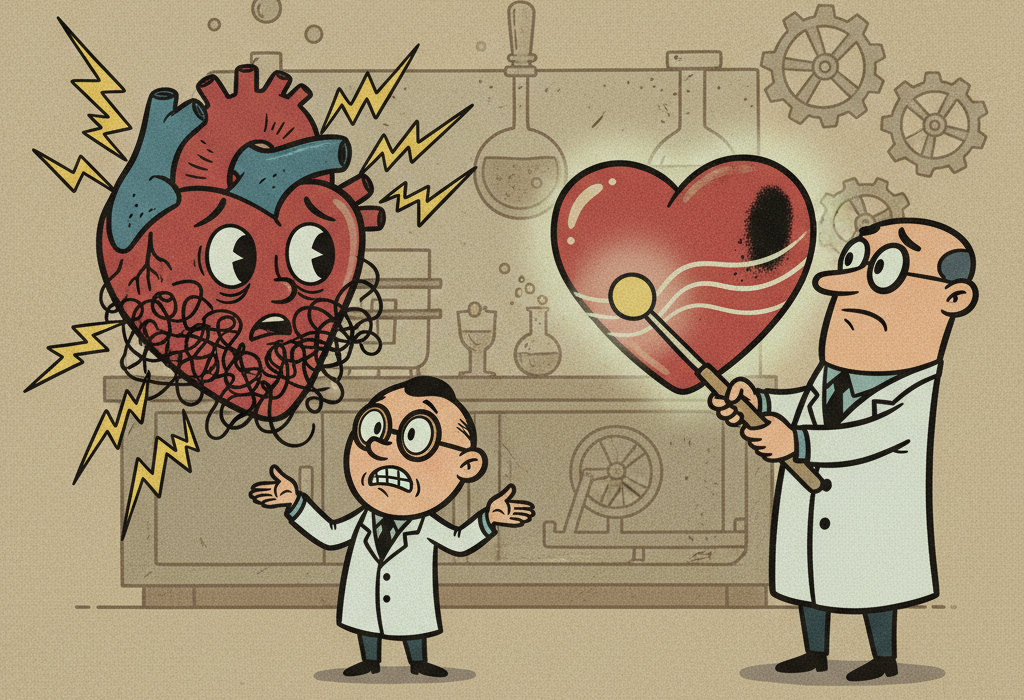
Your heart is essentially a muscular pump controlled by a complex electrical grid. Just like the wiring in a house, this system relies on precise timing. When a wire misfires, the lights might flicker. When the heart’s electrical system misfires, it causes an irregular heartbeat.
For decades, doctors have relied on daily medications to manage these electrical glitches. But in recent years, science has shifted toward fixing the physical wiring itself using a procedure called ablation.
If you or a loved one are dealing with an irregular heartbeat, you might wonder whether medication or a physical procedure is the better path. This article explores what the latest peer-reviewed research actually says about how we diagnose, manage, and treat heart arrhythmias today.
How the Heart’s Electrical Grid Works
To understand the treatments, it helps to understand a few key terms:
- Arrhythmia (uh-RITH-mee-uh): An abnormal heart rhythm. It can be too fast (tachycardia), too slow (bradycardia), or completely irregular (like atrial fibrillation).
- Ablation (uh-BLAY-shun): A procedure that uses targeted energy to create tiny scars inside the heart. These scars act as roadblocks, stopping faulty electrical signals from spreading.
- Cardiomyopathy (kar-dee-oh-my-AHP-uh-thee): A disease of the heart muscle that makes it harder to pump blood.
When an arrhythmia forces the heart to beat too fast for a long time, it can actually exhaust the heart muscle. This causes a condition known as arrhythmia-induced cardiomyopathy. According to a 2018 review in Deutsches Arzteblatt international, this type of heart failure is unique because it is often completely reversible. A 2025 paper in Cardiac Electrophysiology Clinics confirms that if doctors can control the rhythm early, the heart muscle can heal, and the heart failure often goes away.
What the Research Shows About Antiarrhythmic Drugs
For many patients, the first step in treating an arrhythmia is medication. Antiarrhythmic drugs work by altering the flow of charged particles (like sodium, potassium, and calcium) in and out of heart cells. Think of them as chemical traffic cops slowing down electrical signals.
A 2025 clinical consensus in Europace outlines an “ABC” framework for how doctors use these drugs today:
- Appropriate therapy: For some patients, drugs are the best and only treatment needed to keep the heart in a normal rhythm.
- Backup therapy: Used when invasive procedures like ablation are not possible, too risky, or ineffective.
- Complementary therapy: Used alongside other treatments. For example, half of all patients who get an ablation still take medications afterward to help keep their rhythm stable.
While medications are helpful, they are not perfect. They require daily use and can cause side effects. Because they alter the heart’s electrical system, some drugs can actually trigger different types of arrhythmias if not monitored carefully.
The Rise of Catheter Ablation
When medications fail or cause too many side effects, doctors often turn to catheter ablation. During this procedure, a doctor guides a thin, flexible tube (catheter) through a blood vessel in the groin up to the heart. Once inside, the catheter delivers energy to destroy the small cluster of cells causing the bad signals.
Research consistently shows that ablation is highly effective. For example, research from 2016 looking at adults with congenital heart defects found that catheter ablation is often superior to long-term medication for curing certain fast heart rhythms.
Radiofrequency Ablation: The Standard Approach
The most common type of energy used is heat, known as radiofrequency (RF) ablation. A 2023 study in Europace examined a newer type of RF catheter that controls both temperature and fluid flow. The researchers found that using higher power for a shorter duration (about 25 seconds per application) was safe and effective. It also reduced the risk of “steam pops”, which are tiny, potentially dangerous gas bubbles that can form when heart tissue gets too hot.
Pulsed Field Ablation: A New Alternative
While heating or freezing tissue works well, it carries a small risk of damaging nearby structures, like the esophagus or nerves. To solve this, scientists developed a non-thermal option called Pulsed Field Ablation (PFA).
According to a 2022 review in Cardiac Electrophysiology Clinics, PFA uses ultra-fast electrical pulses to poke microscopic holes in the cell membranes of heart muscle cells. Because heart cells are highly sensitive to these electrical pulses, they die off while surrounding tissues (like blood vessels and nerves) remain unharmed.
A 2024 animal study in JACC Clinical Electrophysiology compared PFA directly to traditional heat ablation. The researchers found that PFA created deeper, more effective lesions without causing any dangerous steam pops, making it a highly promising tool for the future.
Artificial Intelligence and Radiation-Free Mapping
Before a doctor can ablate an arrhythmia, they have to find exactly where it is coming from. Historically, this required continuous X-ray imaging (fluoroscopy), which exposes both the patient and the medical team to radiation.
Today, doctors use advanced 3D mapping systems to create a virtual model of the heart in real time. A 2021 study on mapping systems demonstrated that doctors can now perform complex procedures, like passing a needle through the heart’s inner wall, with near-zero X-ray radiation by relying entirely on 3D computer visualization.
Artificial intelligence (AI) is also playing a larger role. A 2021 review in the European Heart Journal highlighted how AI algorithms can now analyze data from smartwatches and standard electrocardiograms (ECGs) to detect hidden signs of atrial fibrillation before a patient even feels symptoms. AI is also being used to process MRI scans and predict the exact location of an arrhythmia, allowing doctors to plan the ablation before the procedure even begins.
Related: What to Expect During a Cardiac Stress Test: A Science-Backed Guide
Future Tech: Lasers and Particle Beams
Science is currently testing even less invasive ways to treat arrhythmias.
- Targeted Nanoparticles: A 2015 study in Science Translational Medicine tested a technique called photodynamic therapy in animals. Researchers injected tiny particles that specifically attach only to heart muscle cells. When a specific laser light was shined on the heart, the particles activated and destroyed the bad cells, leaving nearby blood vessels and structural cells completely untouched.
- Particle Beams: A 2018 study in Medical Physics explored using targeted radiation beams, similar to those used in cancer therapy, to treat arrhythmias from outside the body. While still experimental, this could eventually allow patients to undergo ablation without any catheters entering their body.
Who Benefits Most Or Needs Caution
While ablation is generally safe, it is not a perfect fit for everyone. The research points out specific groups that require specialized care.
Patients with Structural Heart Disease
People who have suffered a heart attack or have a condition that thickens the heart muscle often have deep, complex scars. A 2019 review in Cardiac Electrophysiology Clinics notes that in these patients, the bad electrical signals often hide deep inside the heart wall or on the outside surface of the heart (the epicardium). Treating these requires advanced MRI imaging to locate the hidden scars.
Related: Coronary Calcium Score and Heart Disease Risk: What Science Says
Epicardial Ablation Risks
When the arrhythmia is on the outside of the heart, doctors must perform an epicardial ablation by inserting a needle just under the ribcage. A 2020 clinical review highlights that this approach carries unique risks, such as accidentally puncturing the right ventricle, causing bleeding, or injuring the phrenic nerve (which controls breathing).
Complex Congenital Heart Disease and LVADs
Patients born with complex heart defects, or those relying on a Left Ventricular Assist Device (LVAD), face unique challenges. A 2015 study in Circulation looked at patients who had a specific childhood heart surgery called the Fontan procedure. Their altered anatomy makes reaching the arrhythmia very difficult. However, the study showed that with careful 3D mapping, successful ablation is still possible and greatly improves symptoms.
Similarly, a 2024 consensus statement notes that patients with LVAD pumps often experience arrhythmias due to mechanical irritation from the pump itself. In these cases, adjusting the pump settings or using targeted medications is often the first step before attempting ablation.
Common Questions About Heart Arrhythmia Ablation
Can an irregular heartbeat cause heart failure?
Yes. If the heart beats too fast for weeks or months, the muscle becomes exhausted and weakens, leading to heart failure. The good news is that if the normal rhythm is restored through medication or ablation, this type of heart failure is often completely reversible.
Is ablation better than medication?
It depends on the patient. For many common arrhythmias, ablation offers a higher chance of a permanent cure compared to lifelong medication. However, medications are less invasive and remain a crucial first step or backup option for many people.
Does ablation guarantee the arrhythmia won’t come back?
No. While ablation is highly successful, arrhythmias can sometimes return if the heart heals in a way that allows electrical signals to reconnect, or if the underlying heart disease progresses. Some patients may require a second procedure or continued use of medication.
The Bottom Line
The treatment of heart arrhythmias has evolved significantly. While antiarrhythmic drugs remain a cornerstone of care, they are increasingly used alongside or replaced by catheter ablation. Modern ablation techniques are becoming safer and more precise, moving away from simple heat toward electrical pulses (PFA) that spare healthy tissue.
For patients with complex heart disease, advanced 3D mapping and MRI imaging are making it possible to find and fix electrical misfires that were once considered untreatable. If you suffer from an arrhythmia, a specialized cardiologist (electrophysiologist) can help determine if a medication, an ablation, or a combination of both is the safest path for your specific heart anatomy.
Quick Reference: Key Studies
| Study Focus | Key Finding | Source |
|---|---|---|
| Antiarrhythmic Drugs | Medications remain essential as appropriate, backup, or complementary therapy alongside ablation. | PMID 40159403 |
| Arrhythmia & Heart Failure | Heart failure caused by a fast, irregular heartbeat is often fully reversible once the rhythm is fixed. | PMID 29875055 |
| Pulsed Field Ablation (PFA) | PFA uses electrical pulses rather than heat, creating deeper lesions without damaging surrounding structures. | PMID 38878017 |
| Zero-Fluoroscopy Mapping | Advanced 3D mapping allows doctors to perform complex ablations with near-zero X-ray radiation exposure. | PMID 33782753 |
| Epicardial Ablation Risks | Ablating the outside of the heart carries specific risks, such as bleeding or nerve injury, requiring careful mapping. | PMID 32771194 |
| Future Non-Invasive Tech | Experimental therapies using targeted nanoparticles and lasers can destroy bad cells without harming nearby tissue. | PMID 26511509 |
Last updated: March 2026
This article synthesizes findings from peer-reviewed research. It is for educational purposes only and does not constitute medical advice. Consult a healthcare provider before starting any new regimen.



Leave a Reply