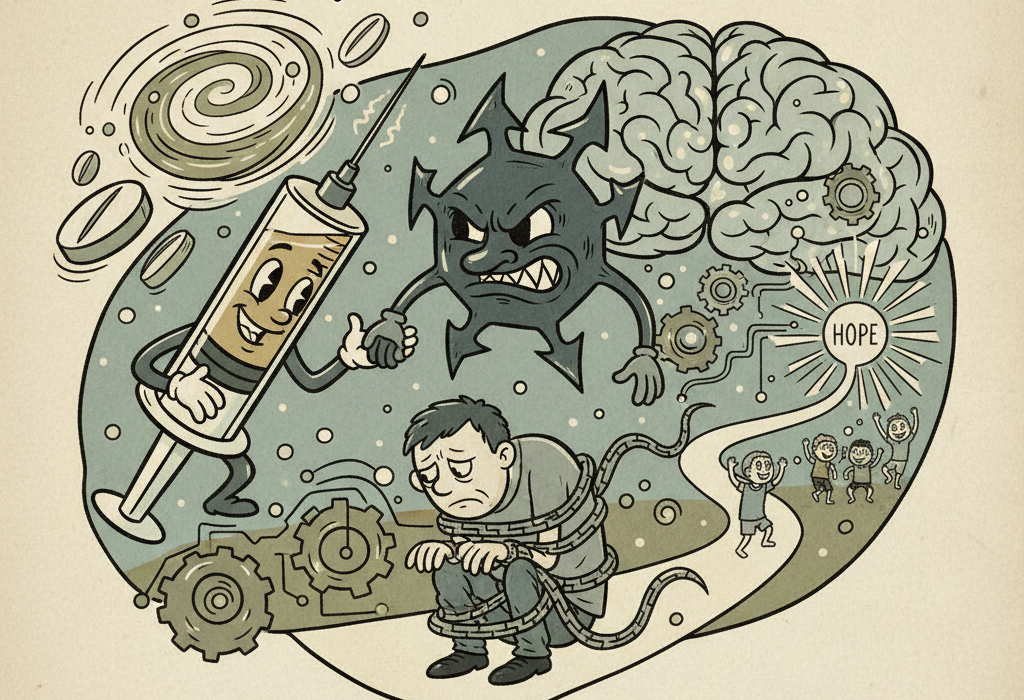
The opioid crisis is frequently in the news, but discussions often focus on the problem rather than the solutions. For decades, society viewed addiction as a moral failing or a simple lack of willpower. However, modern medical science paints a very different picture.
Research shows that long-term opioid use physically changes the structure and function of the brain. When a person tries to stop using opioids, their brain sends out severe distress signals. This is why simply going “cold turkey” rarely works. To truly treat opioid addiction, doctors must treat it like any other chronic medical condition, such as asthma or diabetes.
This article synthesizes decades of peer-reviewed research to explain how opioid addiction alters the brain, why traditional detox often fails, and how modern medical treatments actually work to restore balance.
How Opioids Rewire the Brain
To understand how treatments work, it helps to understand what opioids do to the body. The human brain has a built-in reward system. When you eat a good meal or hug a loved one, your brain releases feel-good chemicals.
Opioids mimic these natural chemicals but at a much higher volume. They attach to specific docking stations in the brain called mu-opioid receptors.
When a person takes opioids regularly, the brain tries to adapt to this massive chemical flood. It turns down its own natural production of feel-good chemicals. It is like a house with a smart thermostat. If you constantly pump heat into the house from a space heater, the main furnace will eventually shut down.
If the person stops taking opioids, their brain is left with almost no natural feel-good chemicals. This leads to severe physical illness, anxiety, and pain. This condition is known as Opioid use disorder (OH-pee-oyd yoos dis-OR-der), defined as a chronic condition where a person cannot stop using opioids despite harmful consequences.
Why “Detox” Alone Usually Fails
For a long time, the standard treatment for addiction was detoxification, or “detox.” The goal was simply to help the person get the drugs out of their system, often in a 28-day inpatient program.
However, scientific research shows that detox alone is generally ineffective for opioid use disorder. A 2010 review in the European Journal of Clinical Pharmacology noted that patients who only go through detox have extremely high relapse rates. In fact, over 90 percent of people who only use detox and abstinence will relapse, often within the first month.
Even worse, detox alone can be dangerous. When a person stops using opioids, they lose their physical tolerance to the drug. If they relapse and take the same dose they used to take, their body cannot handle it. This loss of tolerance is a major cause of fatal overdoses.
What the Research Shows: The Three Main Medications
Because the brain’s chemistry is physically altered by opioids, the most effective treatment involves medication that stabilizes the brain. This approach is called Medication for Opioid Use Disorder (MOUD).
Related: What Science Says About Medication-Assisted Treatment for Opioids
There are three main medications approved to treat opioid addiction. They all interact with the brain’s opioid receptors, but they do so in very different ways.
1. Methadone: The Full Agonist
Methadone is the oldest and most studied medication for opioid addiction. It is a “full agonist.” This means it perfectly fits into the brain’s opioid receptors and activates them, much like illicit opioids do.
However, methadone acts very slowly and stays in the body for a long time (up to 36 hours). Because it acts slowly, it does not create a sudden “high” or euphoria in people who are already tolerant to opioids. Instead, it simply stops the withdrawal symptoms and blocks drug cravings. A 2023 review in the Journal of Addictions Nursing refers to methadone as the gold standard for keeping people in treatment. The main drawback is that it must be dispensed daily at a specialized clinic.
2. Buprenorphine: The Partial Agonist
Buprenorphine (byoo-pruh-NOR-feen) is a newer medication that acts as a “partial agonist.” If the opioid receptor is a light switch, methadone turns the light all the way on, while buprenorphine works like a dimmer switch. It turns the receptor on just enough to stop withdrawal and cravings, but no more.
Because of this dimmer-switch effect, buprenorphine has a “ceiling.” Taking more of the drug will not increase its effects. This makes it much safer than methadone and significantly reduces the risk of overdose. A 2019 review in Science Advances explains that buprenorphine binds so tightly to the receptors that it actually blocks other opioids from working. If a person takes heroin while on buprenorphine, they will not feel the effects of the heroin.
3. Naltrexone: The Antagonist
Naltrexone (nal-TREK-sohn) works completely differently. It is an “antagonist.” It fits into the opioid receptors but does not activate them at all. Instead, it acts like a shield, blocking any other opioids from attaching to the receptors.
Related: What Science Actually Says About Treating Alcohol Use Disorder
If a person on naltrexone uses opioids, they will feel absolutely nothing. A 2018 study in CNS Spectrums points out that naltrexone can help reverse the habit of addiction. When a person uses drugs and gets no reward, the brain slowly unlearns the addiction habit. The major challenge with naltrexone is that a patient must be completely free of all opioids for 7 to 14 days before starting it. If they take it while opioids are still in their system, it will trigger immediate and severe withdrawal.
Comparison of Opioid Addiction Medications
| Feature | Methadone | Buprenorphine | Naltrexone |
|---|---|---|---|
| How it works | Full Agonist (fully activates receptors) | Partial Agonist (partially activates receptors) | Antagonist (blocks receptors) |
| Prevents Withdrawal? | Yes | Yes | No (requires prior detox) |
| Blocks other opioids? | Yes (by building tolerance) | Yes (binds tightly to receptors) | Yes (acts as a physical shield) |
| Where to get it | Specialized daily clinics | Regular doctor’s office | Regular doctor’s office |
The Challenge of Staying in Treatment
While these medications are highly effective, they only work if patients actually take them. Staying in treatment is one of the biggest hurdles in managing opioid addiction.
A 2019 study of healthcare data in Denver tracked over 1,000 patients who started medication for opioid addiction. The researchers found that less than one-third of these patients were still taking their medication a year later.
To solve this problem, medical science has developed long-acting versions of these medications. Instead of requiring a patient to take a pill or a film every single day, doctors can now use implants or injections that last for weeks or months.
For example, a 2017 clinical trial in the Expert Review of Clinical Pharmacology evaluated a buprenorphine implant that is placed under the skin of the arm. The implant slowly releases a steady dose of medication for six months. The study found that the implant was just as effective as daily sublingual (under the tongue) tablets, but it completely removed the daily burden of remembering to take medication.
Similarly, naltrexone is now available as a monthly injection. A 2018 clinical trial showed that once patients successfully started the monthly naltrexone injection, it was just as effective at preventing relapse as daily buprenorphine.
Does Counseling Make a Difference?
For decades, the standard advice was that medication must always be paired with intense psychological counseling. However, recent large-scale studies have painted a more nuanced picture.
The Prescription Opioid Addiction Treatment Study (POATS), published in Drug and Alcohol Dependence in 2017, followed 653 patients. Half received standard medical management (short weekly check-ins with a doctor about their medication). The other half received standard medical management plus intensive drug counseling.
Surprisingly, the study found no overall difference in success rates between the two groups. The medication itself was the primary driver of success.
That said, counseling can be highly beneficial for specific groups. A 2016 systematic review in the Journal of Addiction Medicine found that a specific type of therapy called Contingency Management (which provides small, tangible rewards for drug-free urine tests) did improve attendance and reduce drug use in methadone programs.
Managing Pain During Recovery
One of the most complex challenges in treating opioid addiction is that many patients also suffer from chronic physical pain. In fact, many people develop opioid use disorder after being prescribed painkillers for legitimate injuries.
Using opioids for a long time can actually change how the body processes pain. A 2021 review in Addiction Biology highlights a condition called Opioid-induced hyperalgesia (OH-pee-oyd in-DOOST hy-per-al-JEE-zee-uh). This happens when long-term opioid use makes the nervous system highly sensitive, causing the person to feel pain more intensely than a normal person would.
Treating pain in someone with opioid use disorder requires careful medical strategy. Research shows that non-opioid medications, such as gabapentin or ketamine, can help manage pain in these patients without triggering a relapse into addiction.
Missed Opportunities in Healthcare
Despite the existence of effective treatments, the healthcare system often misses chances to help people. A 2019 report in the Journal of Addiction Medicine pointed out a major flaw in how hospitals operate.
Often, a person with opioid addiction is admitted to a general hospital for a severe complication, such as a heart valve infection caused by dirty needles. The hospital will spend weeks treating the infection with intravenous antibiotics. However, when the patient is discharged, they are rarely given medication to treat the underlying addiction. They are simply handed a phone number for a rehab clinic.
Research shows that starting addiction medication while the patient is still in the hospital drastically reduces the chances that they will relapse or return to the emergency room.
Future Treatments on the Horizon
Medical science is continuously looking for new ways to treat opioid addiction. Since medications like buprenorphine and methadone do not work for everyone, researchers are exploring entirely different approaches.
Some scientists are testing brain stimulation techniques. A 2023 review in Frontiers in Public Health discussed the use of Transcranial Magnetic Stimulation (TMS), which uses magnetic fields to gently stimulate the parts of the brain involved in cravings and impulse control.
Even more distinct is the development of opioid vaccines. A 2025 paper in The Journal of Pharmacology and Experimental Therapeutics outlines how researchers are creating antibodies that specifically target opioids. If a person receives this treatment, the antibodies act like microscopic sponges in the bloodstream. If the person takes an opioid, the antibodies bind to the drug and neutralize it before it can ever cross into the brain. Without reaching the brain, the drug cannot cause a high or suppress breathing.
The Bottom Line
Opioid addiction is a complex physical condition that fundamentally alters the brain’s chemistry and reward pathways.
- What we know: Detoxification and willpower alone are rarely enough to sustain long-term recovery. Medications like methadone, buprenorphine, and naltrexone are highly effective at stabilizing the brain, stopping cravings, and preventing fatal overdoses.
- What remains challenging: Keeping people in treatment is difficult. Long-acting implants and injections offer a promising solution by removing the need to take a daily pill.
- How confident we are: The scientific consensus is very strong that Medication for Opioid Use Disorder (MOUD) saves lives and should be the frontline treatment for anyone struggling with opioid addiction.
Quick Reference: Key Studies
| Study Focus | Key Finding | Source |
|---|---|---|
| Medication Comparison | Buprenorphine is safe and effective for office-based treatment, while methadone remains highly effective for retention. | PMID 34224485 |
| Detoxification Risks | Detoxification alone leads to high relapse rates and increases the risk of fatal overdose due to lost tolerance. | PMID 20169438 |
| Treatment Adherence | Less than one-third of patients in a public health system remained adherent to their opioid medication for more than a year. | PMID 31302412 |
| Buprenorphine Implants | A 6-month buprenorphine implant is just as effective as daily sublingual tablets for maintaining stability. | PMID 28571505 |
| Naltrexone vs. Buprenorphine | Once initiated, monthly naltrexone injections are as effective as daily buprenorphine at preventing relapse. | PMID 29676241 |
| Role of Counseling | Adding intensive counseling to standard medical management did not significantly improve outcomes for prescription opioid users. | PMID 28363320 |
| Future Therapies | Antibody therapies and vaccines are being developed to neutralize opioids in the bloodstream before they reach the brain. | PMID 40112764 |
Last updated: March 2026
This article synthesizes findings from peer-reviewed research. It is for educational purposes only and does not constitute medical advice. Consult a healthcare provider before starting any new regimen.
Leave a Reply