
Have you ever wondered how fish oil supplements manage to hide the fishy taste, or how probiotics survive the harsh acid of your stomach? The secret lies in a microscopic technology called microencapsulation.
Think of a microcapsule like an M&M candy. The chocolate center is the “core” containing the medicine or nutrient. The hard candy coating is the “wall material.” This outer shell protects the sensitive core from oxygen, light, heat, and stomach acid.

While the concept is simple, finding the perfect wall material is a complex science. If the wall is too weak, the core leaks out early. If the wall is too strong, the core never releases at all.

Here is what the latest science says about how these tiny protective shells are made and why they matter for your health.
What Are Microcapsule Wall Materials?
Before diving into the research, it helps to understand a few key terms:
- Microencapsulation (my-kroh-en-KAP-suh-lay-shun) – the process of putting a microscopic protective shell around a sensitive substance.
- Polymer (PAH-lih-mer) – a large molecule made of repeating smaller building blocks, often used to build these tiny shells.
- Oxidative stress (ox-ih-DAY-tiv stress) – a process where oxygen damages cells or degrades oils, causing them to spoil.
The wall material is the physical barrier that wraps around the active ingredient. In the food and medical industries, researchers typically use natural polymers found in food, such as proteins, starches, and plant fibers.
What the Research Shows: Types of Wall Materials
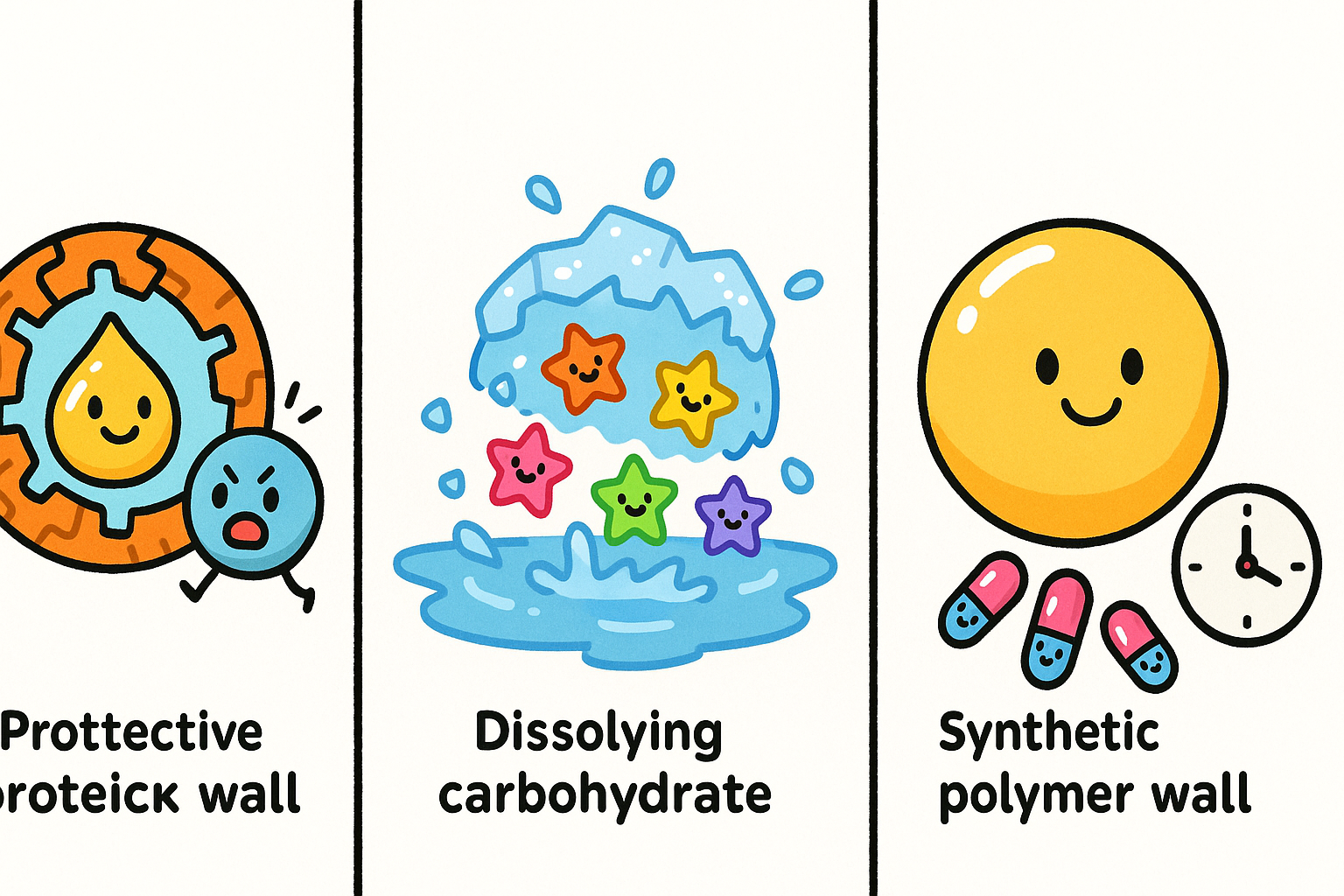
Scientists choose different wall materials depending on what they are trying to protect. The research generally divides these materials into three main categories.
Protein-Based Walls
Proteins are highly effective at trapping oils and preventing them from spoiling. Common protein wall materials include whey protein, soy protein, and sodium caseinate (a milk protein).
A 2021 study in Molecules tested fish oil wrapped in three different materials: whey protein, gum arabic, and maltodextrin. The researchers found that whey protein was the most effective at stopping the fish oil from oxidizing and spoiling during storage.
Similarly, a 2025 study in the Journal of the Science of Food and Agriculture looked at sea buckthorn oil. The researchers found that protein-based walls (like whey and soy) captured up to 89 percent of the oil, outperforming carbohydrate-based walls. The protein microcapsules also released more of the beneficial fatty acids during simulated digestion.
Carbohydrate and Fiber Walls
Carbohydrates are the most common wall materials in the food industry because they are inexpensive, neutral in taste, and dissolve easily in water.
- Maltodextrin: A 2022 review in Carbohydrate Polymers notes that maltodextrin is widely used because it forms a nice film and dissolves quickly. However, it does not always hold onto oils well on its own.
- Starch: A 2023 review in Carbohydrate Polymers highlights that starch is non-toxic, low cost, and biodegradable.
- Chitosan (KY-toh-san): Made from the shells of crustaceans, chitosan is frequently used to protect live bacteria. A 2023 study in the International Journal of Biological Macromolecules found that a modified chitosan wall successfully protected probiotic yeast. Related: What Science Actually Says About Fecal Transplants for Gut Health
Synthetic and Modified Polymers
When doctors need a drug to release very slowly over weeks or months, natural food proteins often break down too quickly. In these cases, scientists use synthetic or highly modified polymers.
A 2019 review in the Journal of Biomedical Materials Research explains that synthetic polymers like polylactic acid (PLA) are highly controllable. PLA slowly degrades into lactic acid, a natural substance your body can easily process. This makes it highly useful for timed-release medications.
How Do Different Wall Materials Compare?
Because no single material is perfect, scientists often compare them to find the best fit for specific tasks.
| Wall Material Type | Common Examples | Best Used For | Drawbacks |
|---|---|---|---|
| Proteins | Whey, Soy, Gelatin | Trapping oils, preventing oxygen damage | Can be sensitive to heat and stomach acid |
| Carbohydrates | Maltodextrin, Starch | Fast dissolving, neutral taste | Poor at trapping oils on their own |
| Fibers/Gums | Gum Arabic, Pectin | Forming thick, stable gels | Can be expensive or difficult to process |
| Synthetic | PLA, Polyurethane | Slow, controlled drug release | Not typically used in everyday foods |
To overcome the drawbacks of individual materials, researchers often blend them together. For example, a 2022 study in Pharmaceutics found that mixing a modified starch with maltodextrin captured 98 percent of the target oil, achieving better results than either material could alone.
Common Questions About Microencapsulation
Are microcapsule wall materials safe to eat?
Yes. In the food and supplement industries, wall materials are made from natural, food-grade ingredients like milk proteins, plant starches, and dietary fibers. Your body digests the outer shell just like regular food.
Why is my fish oil supplement still fishy?
If a fish oil supplement smells or tastes strongly of fish, the wall material may have degraded, or the manufacturer may not have used microencapsulation. High-quality microencapsulated fish powders generally have very little odor.
Do microcapsules only exist in food and medicine?
No. Microencapsulation is used in many industries. For example, a 2025 study in PLoS One explored using microcapsules inside cement. When the cement cracks, the capsules break open and release a healing agent to repair the concrete automatically.
The Bottom Line
Microencapsulation is a highly effective way to protect sensitive nutrients, live probiotics, and important medications from degrading before they reach their target.
The effectiveness of a microcapsule depends heavily on its wall material. Protein-based walls excel at protecting oils from spoiling, while carbohydrate walls are great for quick-dissolving powders. For long-term drug delivery, synthetic biodegradable polymers offer the most control.
While the science of matching the right core to the right wall is complex, the result is simple: better supplements, safer medicines, and longer-lasting foods.
Quick Reference: Key Studies
| Study Focus | Key Finding | Source |
|---|---|---|
| Fish Oil Protection | Whey protein was superior to gum arabic and maltodextrin at preventing fish oil oxidation. | PMID 34684694 |
| Sea Buckthorn Oil | Protein-based walls (whey, soy) provided higher encapsulation efficiency than carbohydrates. | PMID 39390660 |
| MCT Oil Blends | Mixing modified starch with maltodextrin achieved a 98% encapsulation efficiency. | PMID 35745850 |
| Agricultural/Medical Use | Biodegradable synthetic polymers like PLA offer highly controlled, sustained release for drugs and pesticides. | PMID 31161699 |
| Chitosan for Probiotics | Modified chitosan effectively protected live probiotic yeast. | PMID 37793535 |
Last updated: March 2026
This article synthesizes findings from peer-reviewed research. It is for educational purposes only and does not constitute medical advice. Consult a healthcare provider before starting any new regimen.



Leave a Reply