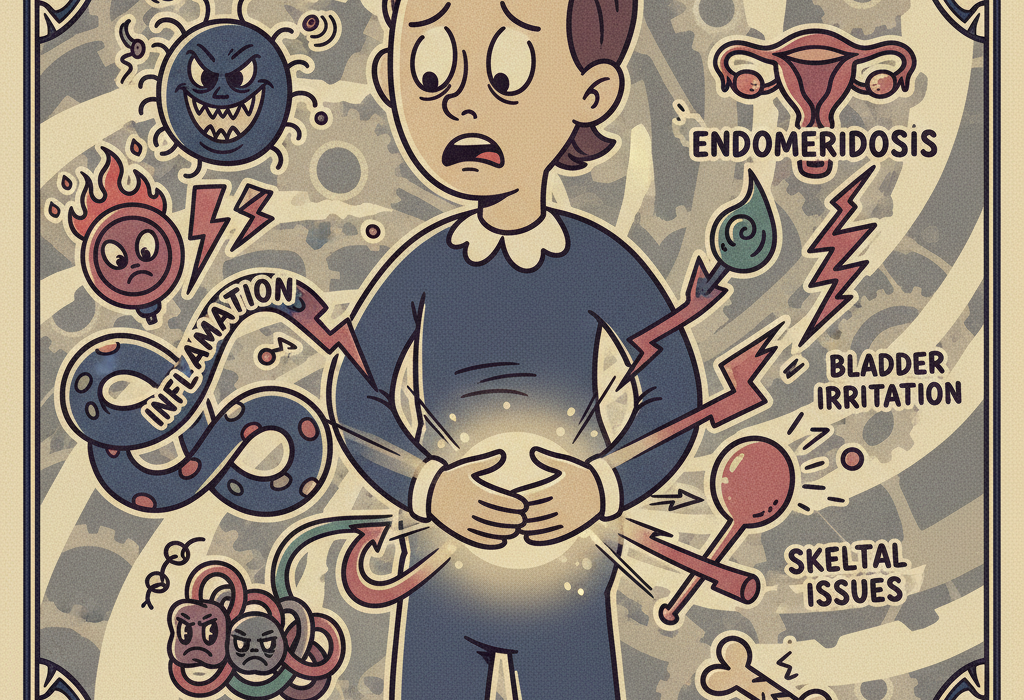
Many people visit their doctor for persistent pelvic pain only to be told that their tests look completely normal. This experience can be incredibly frustrating. However, a lack of obvious test results does not mean the pain is in your head.
Pelvic pain is a complex symptom that can originate from reproductive organs, the digestive tract, the urinary system, or the nerves and muscles supporting the pelvis. Because so many different systems are packed into one small area of the body, pinpointing the exact cause requires looking at the whole picture.
This article explains what the latest scientific research shows about the different causes of pelvic pain, why it is so hard to diagnose, and how doctors approach finding the right treatment.
Why is Pelvic Pain So Hard to Pinpoint?
To understand pelvic pain, it helps to think of the pelvis as a crowded bowl. Inside this bowl, you have the bladder, the lower intestines, the rectum, and the reproductive organs. Supporting all of these organs is a hammock of muscles called the pelvic floor, which is woven with a complex network of blood vessels and nerves.
When you feel pain in your pelvis, it could be coming from any of these structures. Furthermore, the nerves in this area often overlap. This means a problem in your digestive tract might feel like a problem in your reproductive organs.
Medical professionals generally divide pelvic pain into two categories:
- Acute pelvic pain: Pain that comes on suddenly and sharply. This often requires immediate medical attention to rule out emergencies.
- Chronic pelvic pain: Pain that lasts for six months or longer. This type of pain often involves multiple organ systems and requires a long-term management plan.
Gynecological and Reproductive Causes
When women experience pelvic pain, reproductive organs are usually the first suspects. Research points to several common conditions.
Primary Dysmenorrhea
Primary dysmenorrhea (dis-men-oh-REE-uh) is the medical term for severe menstrual cramps that occur without any underlying disease. According to a 2020 review in Revista brasileira de ginecologia e obstetricia, this is the most common gynecological illness in menstruating women.
The pain is caused by the overproduction of prostaglandins (pross-tuh-GLAN-dins). These are chemicals that prompt the muscles of the uterus to contract and shed its lining. When prostaglandin levels are too high, the uterus contracts too hard. This cuts off oxygen to the muscle tissue and causes severe cramping. Guidelines from a 2017 review in the Journal of obstetrics and gynaecology Canada note that non-steroidal anti-inflammatory drugs (NSAIDs) and hormonal contraceptives are highly effective because they directly lower prostaglandin production.
Endometriosis and Adenomyosis
If menstrual pain does not respond to standard treatments, doctors often look for structural issues.
Endometriosis (en-doh-mee-tree-OH-sis) occurs when tissue similar to the lining of the uterus grows outside of it, such as on the ovaries or fallopian tubes. A 2025 review in JAMA notes that endometriosis affects up to 10% of reproductive-age women. It causes inflammation, scar tissue, and chronic pain. Because it can impact fertility, it is a major focus in reproductive health. Related: Understanding Female Infertility: What the Latest Science Shows
Adenomyosis (ad-uh-no-my-OH-sis) is a related condition. Instead of growing outside the uterus, the lining grows deep into the muscular wall of the uterus itself. A 2022 review in American family physician explains that this causes an enlarged, tender uterus and heavy menstrual bleeding.
Digestive and Urinary Causes
Because the bladder and intestines share the pelvic bowl, digestive and urinary issues are frequently mistaken for reproductive problems.
Irritable Bowel Syndrome (IBS)
IBS is a common disorder affecting the large intestine, causing cramping, bloating, gas, and changes in bowel habits. A 2001 study in the World journal of urology found that IBS is the most common gastroenterological cause of chronic pelvic pain. Interestingly, many people with IBS notice that their pelvic and abdominal pain worsens during their menstrual cycle. Related: Does Leaky Gut Syndrome Actually Exist? What the Latest Science Says
Interstitial Cystitis (Bladder Pain Syndrome)
This condition involves chronic inflammation of the bladder wall. A 2013 review in Gastroenterology clinics of North America explains that patients often feel a constant pressure or pain in the pelvis, along with a frequent and urgent need to urinate.
Acute Non-Gynecological Emergencies
Sometimes, sudden pelvic pain is a sign of a digestive or urinary emergency. A 2019 review in Obstetrics and gynecology clinics of North America highlights that conditions like acute appendicitis, kidney stones, or severe bowel obstructions can easily mimic gynecological emergencies.
Blood Vessels, Muscles, and Nerves
When tests show healthy organs, the pain might be coming from the support structures of the pelvis.
Pelvic Congestion Syndrome (PCS)
Just as people can get varicose veins in their legs, they can also develop enlarged, twisted veins in their pelvis. This is known as Pelvic Congestion Syndrome. A 2024 review in the Australian journal of general practice explains that PCS accounts for up to 40% of chronic pelvic pain cases where no other cause is found. The pain is typically described as a dull ache or heaviness that gets worse after standing for long periods and improves when lying down.
Pelvic Floor Muscle Tension
The pelvic floor muscles can become chronically tight or go into spasm, much like a tension headache in your neck or shoulders. A 2003 study in Clinical obstetrics and gynecology details how trigger points (tight knots) in the pelvic muscles, lower back, or hips can refer pain directly into the pelvis.
Nerve Pain (Neuralgia)
Nerves act like alarm wires. If they are pinched or irritated, they send continuous pain signals. Pudendal neuralgia (pyoo-DEN-dul noo-RAL-juh) involves the pudendal nerve, which supplies sensation to the lower pelvis and genitals. A 2017 review in Physical medicine and rehabilitation clinics of North America notes that this nerve can be compressed by tight muscles or prolonged sitting, leading to sharp, burning, or electric pain. Related: Treating Neuropathic Pain: What the Latest Science Says
| Cause Category | Common Conditions | Typical Symptoms |
|---|---|---|
| Reproductive | Dysmenorrhea, Endometriosis, Adenomyosis | Cramping tied to menstrual cycle, heavy bleeding, deep pelvic ache |
| Digestive/Urinary | IBS, Interstitial Cystitis, Appendicitis | Bloating, bowel changes, painful urination, sudden sharp right-sided pain |
| Vascular | Pelvic Congestion Syndrome | Dull ache or heaviness that worsens with standing or at the end of the day |
| Musculoskeletal | Pelvic floor tension, Pudendal neuralgia | Burning or electric pain, pain that worsens with sitting, muscle spasms |
How This Might Work: The “Cross-Talk” Phenomenon
One of the most confusing aspects of pelvic pain is how it spreads. Science offers a biological explanation for this: organ cross-talk and central sensitization.
A 2009 review in Best practice & research. Clinical gastroenterology explains that the organs in the pelvis share nerve pathways to the spinal cord and brain. If the bladder is inflamed, the distress signals travel up the same nerve highways as signals from the uterus or intestines. The brain gets confused about where the pain is coming from, and soon, the whole pelvic region feels painful.
Over time, this constant barrage of pain signals can change how the brain and spinal cord process sensation. This is called central sensitization (SEN-trul sen-sih-tih-ZAY-shun). A 2015 review in Human reproduction update found that women with severe menstrual pain actually become more sensitive to pain throughout their entire body, even during times of the month when they are not menstruating. The nervous system becomes stuck in a highly reactive state, making normal sensations feel painful.
Common Questions About Pelvic Pain
How do doctors figure out what is causing pelvic pain?
Because the causes are so varied, doctors usually start with a thorough history and a pelvic ultrasound. A 2025 review in European radiology confirms that ultrasound is the best first step because it is safe, uses no radiation, and clearly shows issues like ovarian cysts or twisted organs. For women of reproductive age, a pregnancy test is also a critical first step to rule out ectopic pregnancy, as noted in a 2019 review in Emergency medicine clinics of North America.
Is it normal for periods to be extremely painful?
While mild cramping is common, pain that causes you to miss school or work, or pain that does not improve with over-the-counter medication, is not considered normal. It warrants medical evaluation to check for conditions like endometriosis or adenomyosis.
Practical Guidance: Finding the Right Treatment
Because pelvic pain can stem from multiple systems, treatment often requires a team approach.
- Medical Therapies: For reproductive causes, hormonal medications (like birth control pills) and targeted pain relievers are usually the first line of defense.
- Physical Therapy: Specialized pelvic floor physical therapy can help release tight muscles, improve posture, and relieve pressure on trapped nerves.
- Dietary Changes: For those with IBS or bladder sensitivities, identifying and removing trigger foods can significantly reduce inflammation and discomfort.
- Surgical Options: In cases of severe endometriosis, structural blockages, or damaged nerves, minimally invasive surgery may be considered to remove the problematic tissue.
The Bottom Line / Takeaways
Pelvic pain is a very real, measurable condition, even if initial tests come back normal. The research shows that the pelvis is a highly connected environment where a problem in one system (like the digestive tract) can easily aggravate another (like the reproductive organs or pelvic muscles).
We know with high confidence that conditions like endometriosis, pelvic congestion syndrome, and pelvic floor muscle tension are major drivers of chronic pain. We also know that long-term pain can cause the nervous system to become overly sensitive. Finding relief usually requires looking beyond just one organ and treating the pelvis as an interconnected system.
Quick Reference: Key Studies
| Study Focus | Key Finding | Source |
|---|---|---|
| Endometriosis Treatments | Hormonal suppression is an effective first-line treatment for endometriosis, reducing pain significantly compared to placebo. | PMID 40323608 |
| Pelvic Congestion Syndrome | PCS accounts for 30-40% of unexplained chronic pelvic pain and is effectively diagnosed with ultrasound. | PMID 39693749 |
| Primary Dysmenorrhea | NSAIDs and hormonal contraceptives are the most effective initial treatments for severe menstrual pain. | PMID 28625286 |
| Central Sensitization | Women with severe menstrual pain develop heightened pain sensitivity across their entire body, even when not menstruating. | PMID 26346058 |
| Diagnostic Imaging | Ultrasound is recommended as the first-line imaging tool for both gynecological and non-gynecological pelvic pain. | PMID 40397032 |
| Nerve & Muscle Pain | Physical therapy and nerve mobilization are highly effective for treating pelvic floor muscle spasms and nerve entrapment. | PMID 14595218 |
Last updated: March 2026
This article synthesizes findings from peer-reviewed research. It is for educational purposes only and does not constitute medical advice. Consult a healthcare provider before starting any new regimen.

Leave a Reply