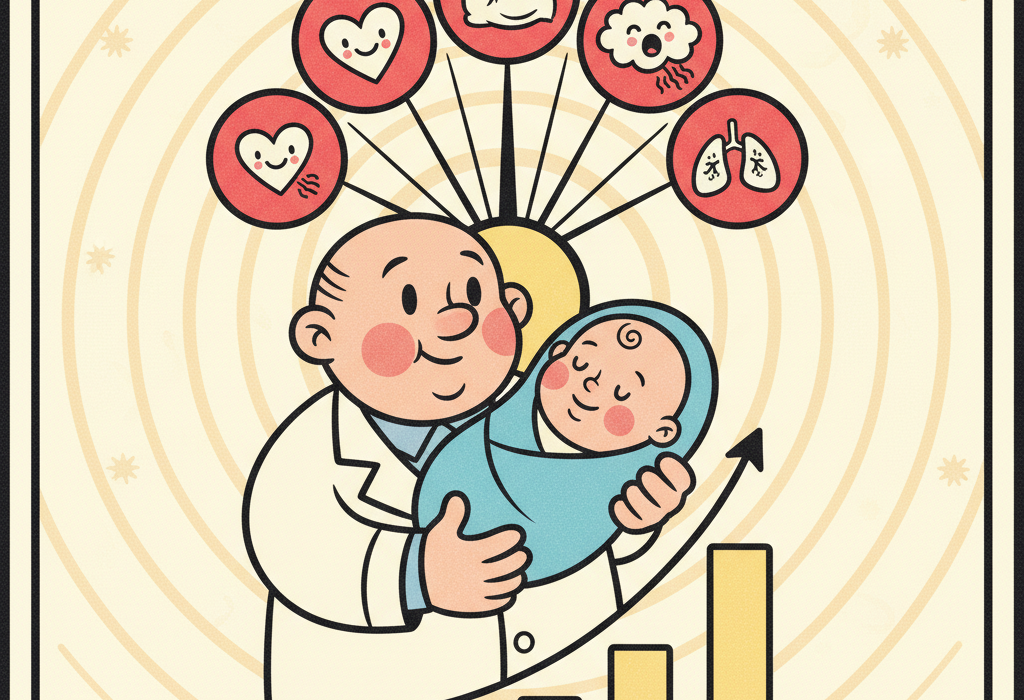
The moments immediately following childbirth are a whirlwind of activity. Amid the crying and the cutting of the umbilical cord, you will likely hear a nurse or doctor call out two numbers, usually something like “Eight and nine!”
These numbers are the baby’s Apgar score. For decades, this simple test has been the standard way to evaluate a newborn’s condition in the first few minutes of life.
But what do these numbers actually mean? Does a lower score mean your baby is in danger? Will it impact their intelligence or development later in life?
In recent years, researchers have looked closely at millions of birth records to understand exactly what the Apgar score tells us, what it gets wrong, and why scientists are debating its future. Here is what the latest evidence says.
What is the Apgar Score?
In 1952, an anesthesiologist named Dr. Virginia Apgar noticed a problem in delivery rooms. There was no standard way to tell if a newborn baby needed urgent medical help. To fix this, she created a rapid scoring system to evaluate a baby’s physical condition at exactly one minute and five minutes after birth.
Today, the medical community uses her name as an acronym to remember the five areas they check:

- A – Appearance (Color): Is the baby pink all over, or are their hands, feet, or body blue and pale?
- P – Pulse (Heart rate): Is the heart beating above 100 beats per minute?
- G – Grimace (Reflex irritability): Does the baby cry, sneeze, or pull away when stimulated?
- A – Activity (Muscle tone): Are the baby’s arms and legs flexed and active, or limp?
- R – Respiration (Breathing): Is the baby crying vigorously, or struggling to breathe?
Each category is given a score of 0, 1, or 2. These are added together for a total score ranging from 0 to 10.
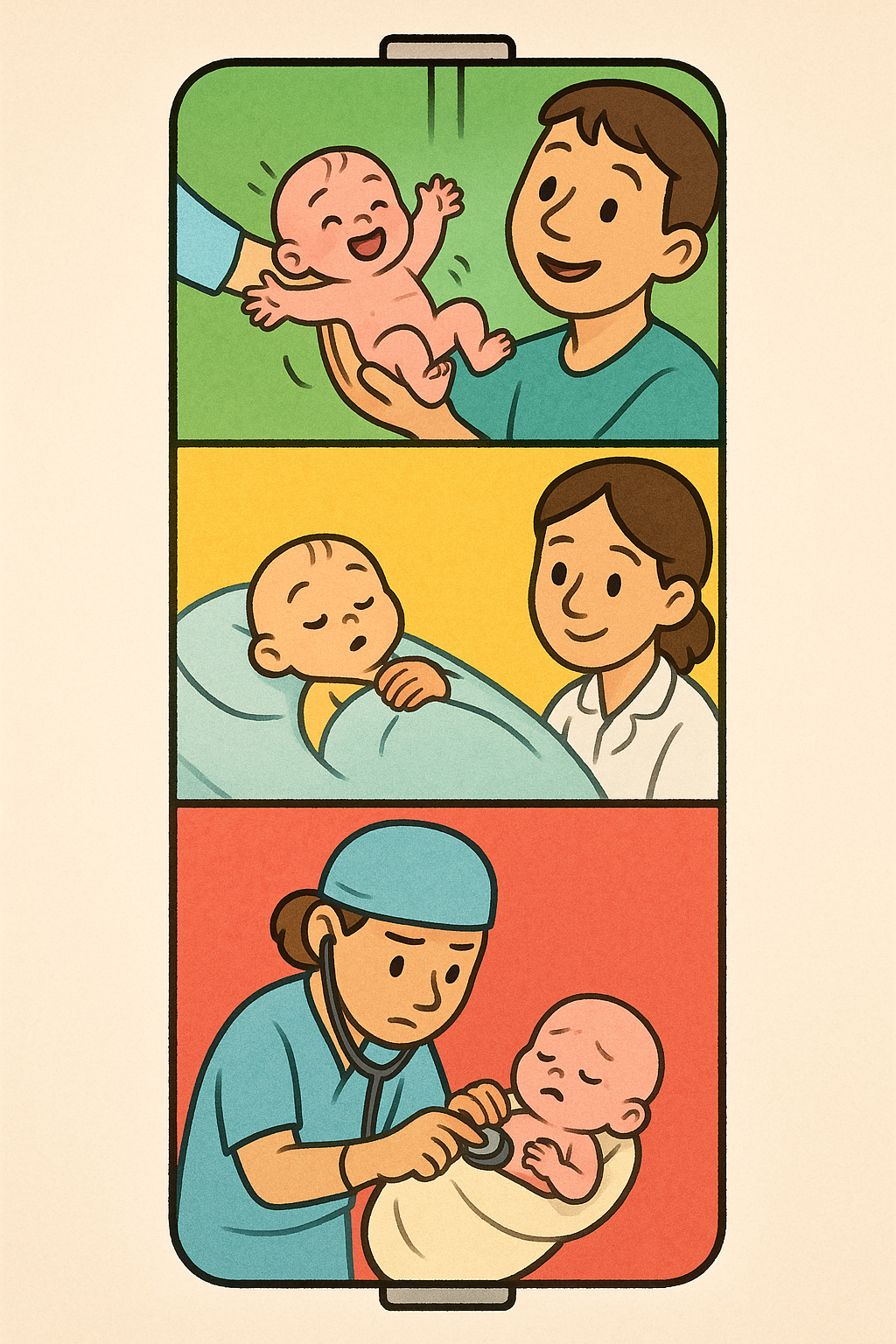
A score of 7 to 10 is considered reassuring. A score of 4 to 6 is moderately abnormal. A score of 0 to 3 is considered low.
It is very rare for a baby to score a perfect 10 at the one-minute mark. Most newborns have slightly blue hands and feet right after birth, which usually drops their score to an 8 or 9.
What the Research Shows About Immediate Survival
The Apgar score was originally designed to predict immediate survival and to tell doctors if a baby needed help breathing. Decades of research confirm that it does this job very well.
A 2020 study in The New England Journal of Medicine looked at over 113,000 premature babies in Sweden. The researchers found that lower Apgar scores at the 5-minute mark were strongly linked to a higher risk of neonatal (nee-oh-NAY-tul) death, which refers to death within the first 28 days of life. This held true even for extremely premature babies.
The trend continues at the 10-minute mark. Usually, if a baby scores a 7 or higher at five minutes, the medical team stops scoring. But if the 5-minute score is low, they will take another score at 10 minutes.
A 2022 study in The Journal of Maternal-Fetal & Neonatal Medicine examined over 111,000 low-risk pregnancies in the United States. Researchers found that if a baby had a low score at five minutes but improved to a normal score by ten minutes, their risk of severe complications dropped dramatically. However, if the score remained between 0 and 3 at the 10-minute mark, the risk of severe newborn complications and infant mortality was significantly higher.
These studies confirm that the Apgar score is an excellent tool for assessing a baby’s immediate vitality and their response to medical help in the delivery room.
Common Misunderstandings About the Apgar Score
Because the Apgar score is so famous, it is often misunderstood by parents and even some medical professionals. The American Academy of Pediatrics (AAP) has issued specific guidelines to clear up these myths.
Myth: The score tells doctors when to do CPR
One common belief is that doctors wait for the 1-minute Apgar score to decide if a baby needs resuscitation. This is false. If a baby is born limp and not breathing, doctors begin clearing their airway and helping them breathe within seconds. They do not wait for a stopwatch to hit one minute. The score is simply a way to record how the baby is doing after those initial steps have started.
Myth: A low score means the baby has brain damage
Many parents panic if their baby receives a score of 4 or 5, fearing it means permanent brain damage. According to the AAP, the Apgar score alone cannot diagnose asphyxia (as-FIX-ee-uh), which is a dangerous condition where the brain and body are deprived of oxygen.
While a low score means the baby had a rough transition into the world, it does not predict an individual baby’s future. Most babies who have low Apgar scores go on to live completely normal, healthy lives.

Does the Apgar Score Predict Long-Term Health?
While the Apgar score is not a crystal ball for an individual child, scientists have looked at massive populations of children to see if low scores correlate with long-term trends in brain development and learning.
School Performance
Do babies with lower scores struggle more in school? A 2022 study in Acta Paediatrica linked the birth records of over 390,000 Australian children to their standardized test scores in primary and middle school.
The researchers found a clear pattern: babies with lower 5-minute Apgar scores were slightly more likely to have developmental vulnerabilities when they started school. They also scored slightly lower on reading and math tests in the 3rd grade.
However, there was a silver lining. The study revealed a “catch-up” effect. By the time the children reached the 7th grade, the academic gap between the children who had low Apgar scores and those who had perfect scores had largely closed. The early struggles washed out over time for most children.
Autism Risk
Scientists have also investigated whether birth stress, as measured by the Apgar score, is linked to autism. A massive 2019 study in the European Journal of Epidemiology analyzed data from 5.5 million individuals across four countries.
The researchers found that babies with low Apgar scores (1 to 3) at five minutes were about 42% more likely to be diagnosed with autism spectrum disorder later in life compared to babies with normal scores.
It is critical to understand the difference between correlation and causation here. A low Apgar score does not cause autism. Instead, the researchers suggest that whatever underlying genetic or environmental factors make a child more likely to develop autism might also make them more likely to experience a stressful birth. Furthermore, while the relative risk increased, the absolute risk remained very small. The vast majority of babies with low scores did not develop autism.
Where the Science is Still Uncertain
Despite its widespread use, the Apgar score has several known flaws. Some researchers argue that it is time to retire the score entirely, or at least update it for modern medicine.
The Problem of Subjectivity
The Apgar score relies on human judgment. What looks like “pink” to one nurse might look “pale” to another. A 2022 review in Advances in Neonatal Care highlighted that the score suffers from poor inter-rater reliability. This means if you have three different doctors look at the same baby, they might give three slightly different scores.
Premature Babies Naturally Score Lower
Another major limitation is how the score applies to premature babies. The Apgar score measures things like muscle tone and strong crying. A baby born at 26 weeks of gestation (jes-TAY-shun) simply does not have the muscle development or lung capacity to flex their limbs or cry loudly.
Because of this, premature babies naturally receive lower scores just for being underdeveloped, not necessarily because they are in acute distress.
Outdated Testing Methods
Finally, modern medicine has changed how we treat newborns. When Dr. Apgar created the score, doctors tested “reflex irritability” by sticking a soft rubber catheter into the baby’s nose to see if they would grimace or sneeze.
Today, pediatricians know that unnecessary pain can be harmful to newborns. A 2021 editorial in JAMA Pediatrics argued that the Apgar score needs to be re-evaluated because poking or suctioning a baby just to see if they react is no longer considered ethical or safe practice.
The Bottom Line
The Apgar score remains a fast, practical way for delivery room teams to communicate how a newborn is handling their first few minutes of life.
Here is what we know for sure:
- It is a snapshot: The score tells doctors how the baby is doing right now, not how they will be doing in ten years.
- Improvement matters: A low score at one minute is common. What matters most is whether the score improves by the five-minute and ten-minute marks.
- It is not a diagnosis: A low score does not mean your baby has brain damage, and it should never be used alone to diagnose a lack of oxygen.
- Population risk vs. individual risk: While huge studies show that low scores correlate with slightly higher risks of autism or early school struggles, the vast majority of babies with low scores grow up healthy and neurotypical.
For parents, especially those managing high-risk conditions like gestational diabetes, hearing a low number in the delivery room can be terrifying. But science reassures us that the Apgar score is just the first sentence in your baby’s medical history, not the entire story.
Quick Reference: Key Studies
| Study Focus | Key Finding | Source |
|---|---|---|
| 10-Minute Scores | In low-risk pregnancies, babies whose scores improved by 10 minutes had much lower risks of severe complications than those whose scores stayed low. | PMID 34167421 |
| Preterm Infants | Even though premature babies naturally score lower, the Apgar score is still a reliable predictor of immediate neonatal survival. | PMID 32609981 |
| Autism Risk | A study of 5.5 million children found a correlation between low 5-minute Apgar scores and a higher risk of autism, though absolute risk remains small. | PMID 30291529 |
| School Outcomes | Lower Apgar scores were linked to early developmental vulnerabilities in school, but most children “caught up” academically by the 7th grade. | PMID 35665536 |
| Clinical Guidelines | The AAP explicitly states that the Apgar score cannot predict individual neurologic outcomes and should not be used to diagnose asphyxia. | PMID 26416932 |
Last updated: March 2026
This article synthesizes findings from peer-reviewed research. It is for educational purposes only and does not constitute medical advice. Consult a healthcare provider before starting any new regimen.

Leave a Reply