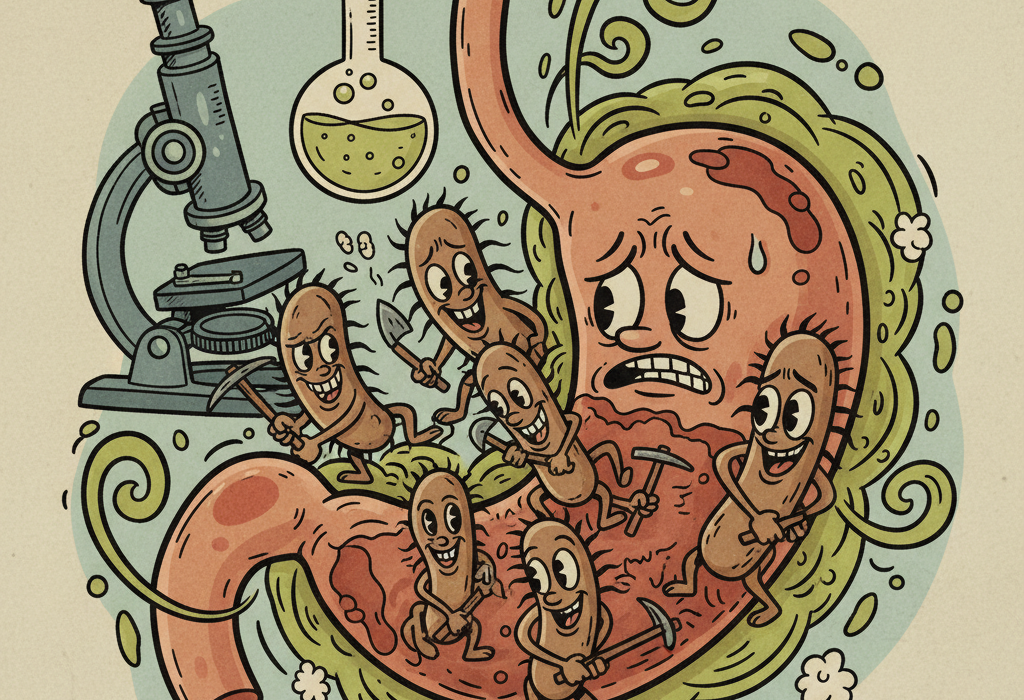
For a long time, doctors believed that stomach ulcers were caused by stress, spicy foods, or too much stomach acid. The human stomach is essentially a vat of acid designed to break down food and destroy invading germs. It seemed impossible that anything could live there.
But in the 1980s, scientists made a startling discovery. A spiral-shaped bacteria was not only surviving in the stomach but actively thriving. This bacteria, known as Helicobacter pylori (HEEL-ih-koh-bak-ter pie-LORE-ee), is now recognized as one of the most successful human pathogens in the world.
Today, research shows that H. pylori infects roughly half of the global population. While most people never experience symptoms, it is the leading cause of chronic gastritis, stomach ulcers, and a major risk factor for gastric cancer.
But how does a tiny microbe survive a bath of acid? And why do some people get sick while others do not?
How This Might Work: Surviving the Stomach Acid
To survive the harsh environment of the human stomach, H. pylori has evolved a fascinating set of biological tools. It does not just endure the acid; it actively changes its surroundings.
A 2021 review in Methods in Molecular Biology details the primary survival strategies of this bacteria. First, it uses long, whip-like tails called flagella to swim through the thick layer of mucus that coats the stomach lining. By burrowing deep into this mucus, the bacteria escapes the most acidic parts of the stomach.
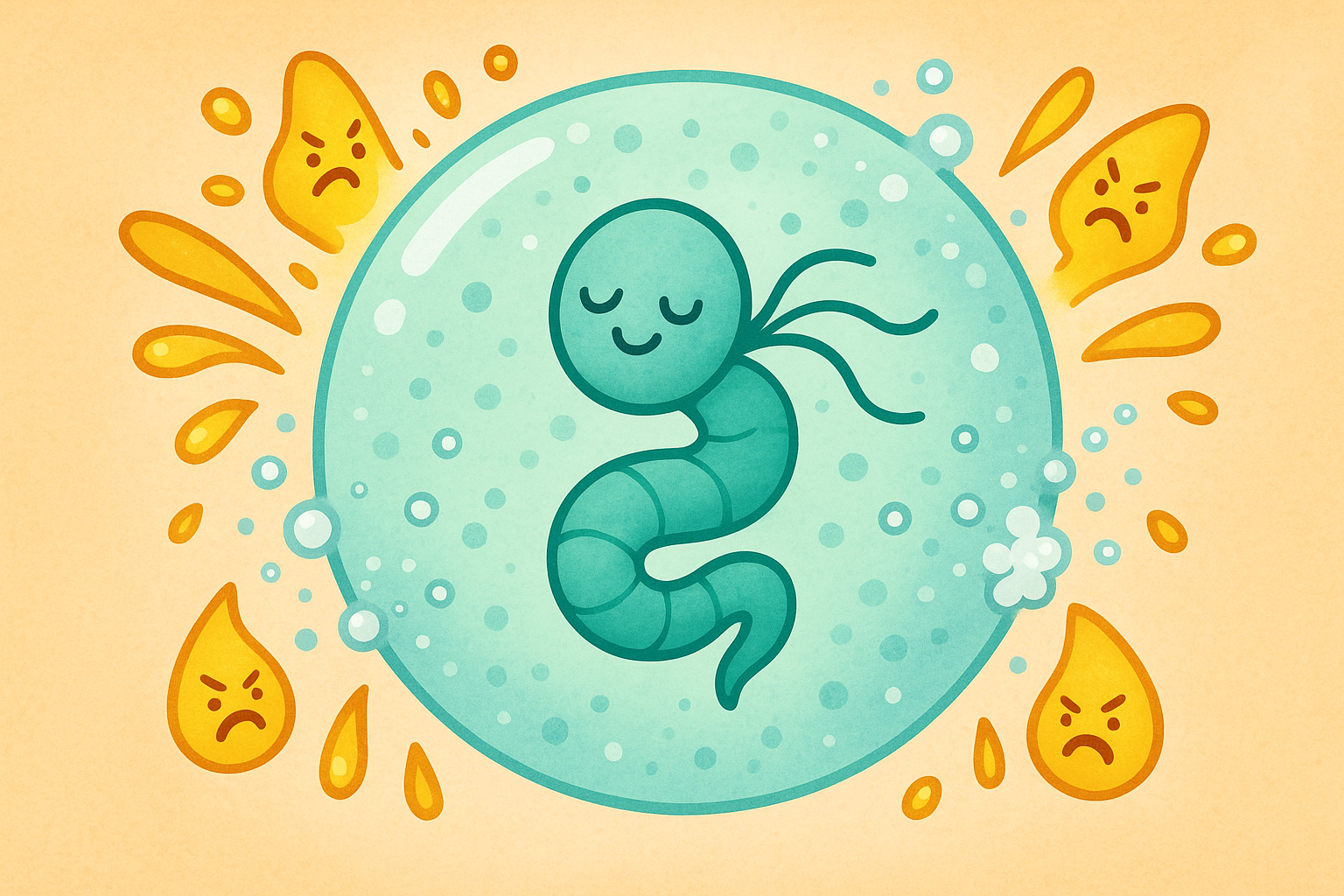
More impressively, H. pylori produces large amounts of an enzyme called urease (YUR-ee-ace). Urease breaks down urea, a natural compound found in the stomach, and turns it into ammonia. This ammonia acts like a neutralizing bubble, creating a safe, acid-free shield around the bacteria.
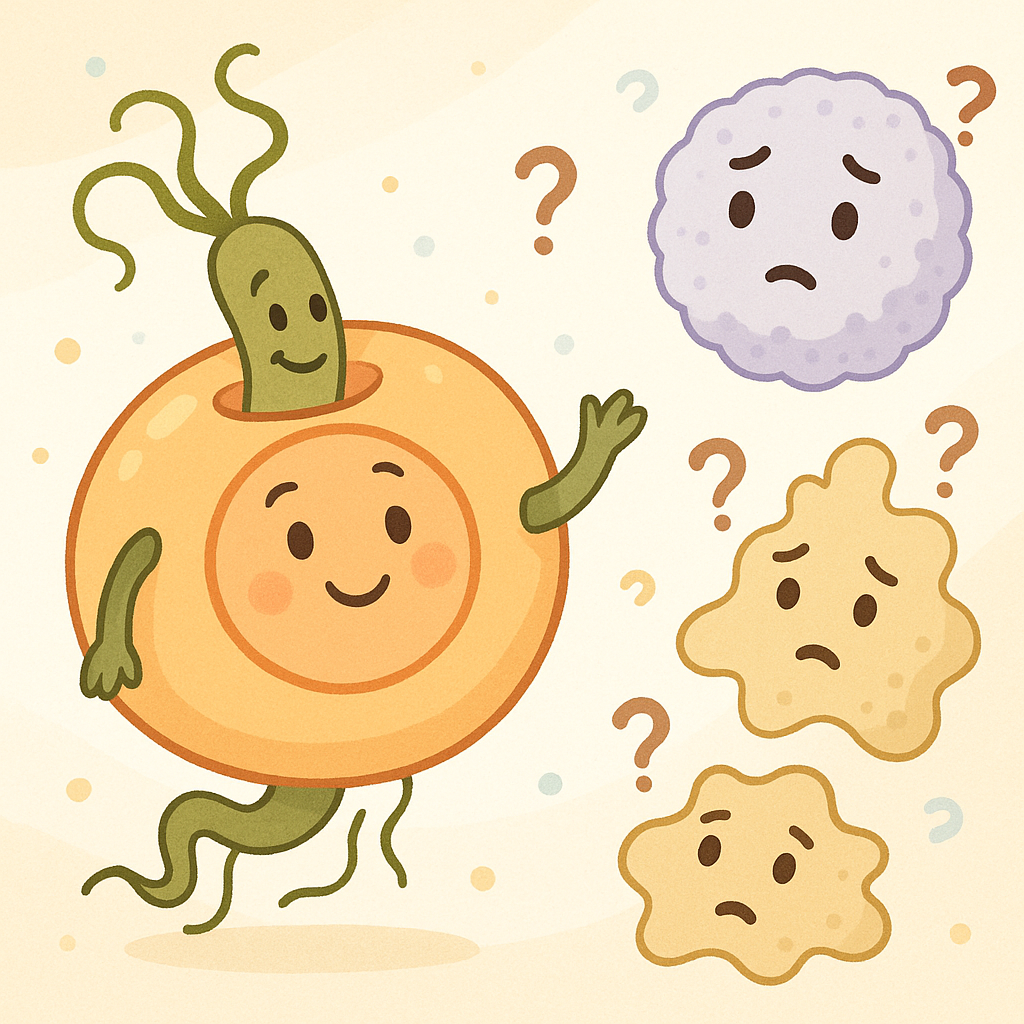
Once safely settled in the stomach lining, the bacteria must avoid the body’s immune system. A 2025 study in FEMS Microbiology Reviews explains that H. pylori alters its outer coat to become almost invisible to immune cells. It changes its surface structures to mimic human cells, essentially wearing a disguise that prevents the immune system from launching a full-scale attack.
What the Research Shows: The Stomach and Beyond
While H. pylori is famous for causing stomach issues, its effects can ripple throughout the entire body.
Ulcers and Cancer Risk
The most well-known consequence of H. pylori infection is damage to the stomach lining. The bacteria produces specific toxins that harm human cells. Two of the most studied are CagA (kag-AY) and VacA (vak-AY).
According to a 2016 review in Advances in Experimental Medicine and Biology, strains of H. pylori that carry the CagA protein are associated with a significantly higher risk of severe inflammation and stomach cancer. The CagA protein is injected directly into human stomach cells, where it disrupts normal cell behavior and causes the cells to lose their structure. Meanwhile, VacA acts like a poison that causes large holes, or vacuoles, to form inside host cells, eventually leading to cell death.
Impact on the Microbiome
We often hear about the importance of a diverse gut microbiome for overall health. Interestingly, H. pylori seems to dominate its environment. The same 2016 review notes that people without H. pylori have a highly diverse community of bacteria in their stomachs. However, when H. pylori moves in, it significantly reduces this diversity, becoming the single most abundant bacteria present. This shift in the stomach’s ecosystem may contribute to long-term disease progression.
Skin Conditions and Iron Levels
Scientists are increasingly finding links between H. pylori and conditions outside the digestive tract. A 2018 review in the World Journal of Gastroenterology highlighted several surprising extragastric (outside the stomach) effects:
- Iron Deficiency Anemia: H. pylori can directly steal iron from the host’s body for its own survival. It also causes inflammation that changes how the human body absorbs iron. Eradicating the bacteria often cures unexplained iron deficiency.
- Skin Disorders: Research has found connections between H. pylori and skin conditions like rosacea and chronic hives (urticaria). A 2014 study in the Hong Kong Medical Journal noted that in some patients with chronic hives, treating the H. pylori infection completely resolved their skin symptoms.
- Neurological Links: There is emerging, though still debated, evidence linking chronic H. pylori infection to conditions like Parkinson’s disease and migraines, potentially due to long-term, low-grade inflammation in the body.
Practical Guidance: Testing and Treatment
Because H. pylori can cause long-term damage, accurate testing and treatment are critical for those experiencing symptoms.
How Diagnosis Works
Doctors use several methods to test for H. pylori. According to a 2018 review in The Korean Journal of Gastroenterology, tests are generally divided into two categories: non-invasive and invasive.
| Test Type | How It Works | Best Used For |
|---|---|---|
| Urea Breath Test | You drink a special solution. If H. pylori is present, its urease enzyme breaks down the solution, and you breathe out a specific gas. | Initial diagnosis and confirming the bacteria is gone after treatment. |
| Stool Antigen Test | Checks a stool sample for proteins associated with the bacteria. | Initial diagnosis, especially in children, and confirming eradication. |
| Blood Test | Checks for antibodies against the bacteria. | Screening, but cannot tell if the infection is current or from the past. |
| Endoscopy & Biopsy | A tube is passed into the stomach to take a small tissue sample. | Checking for ulcers or cancer, and testing the bacteria for antibiotic resistance. |
The Challenge of Treatment
Treating H. pylori usually requires a heavy dose of medications, typically two different antibiotics combined with an acid-reducing drug (like a proton pump inhibitor) taken for 10 to 14 days.
However, treatment is becoming more difficult. A 2024 study in the International Journal of Molecular Sciences explains that H. pylori is developing resistance to common antibiotics. One way it does this is through efflux pumps (EE-fluks pumps). These are tiny proteins on the surface of the bacteria that act like vacuums. When an antibiotic enters the bacteria, the efflux pump simply spits it back out before it can do any harm.

Because of this resistance, doctors sometimes have to try multiple combinations of antibiotics to fully clear the infection. Related: Treating H. pylori: Why Antibiotics Fail and What Science Says Works
Common Misunderstandings or Myths
Myth: If the bacteria comes back, you caught it again from someone else.
When a patient tests positive for H. pylori shortly after finishing treatment, they often assume they were reinfected by a family member or contaminated food. However, a 2019 study in the Journal of Cellular and Molecular Medicine explains that early return of the bacteria is usually due to recrudescence (ree-kroo-DESS-ents).
Recrudescence means the original infection was never entirely killed. H. pylori has a clever survival trick: when exposed to antibiotics, it can transform from its normal spiral shape into a dormant, round “coccoid” shape. It can also hide under protective layers called biofilms. Once the antibiotics are gone, the bacteria wakes up and begins multiplying again.
Common Questions About H. pylori
How do you catch H. pylori?
While the exact transmission route is still being studied, it is primarily passed from person to person. A 2017 review in Helicobacter notes that transmission usually happens in childhood, often from mother to child. It can also be spread through contaminated food and water in areas with poor sanitation.
Does everyone with H. pylori need to be treated?
Not necessarily. While the bacteria is present in about 50% of the world’s population, roughly 85% of infected people never develop symptoms. However, if a person has stomach ulcers, a history of gastric cancer in their family, or unexplained iron deficiency, doctors usually recommend aggressive treatment.
The Bottom Line
Helicobacter pylori is a highly adapted bacteria that has lived alongside humans for tens of thousands of years.
- What we know: It survives stomach acid by creating an ammonia shield and causes disease by injecting toxins into stomach cells. It is the primary cause of stomach ulcers and a major risk factor for gastric cancer.
- What is increasingly clear: The inflammation caused by H. pylori can affect the whole body, contributing to iron deficiency and skin conditions like rosacea.
- What remains challenging: Eradicating the bacteria is becoming harder due to antibiotic resistance and the bacteria’s ability to hide in dormant states.
If you suffer from chronic stomach pain, unexplained anemia, or recurring ulcers, testing for H. pylori is a simple and potentially life-changing step.
Quick Reference: Key Studies
| Study Focus | Key Finding | Source |
|---|---|---|
| Immune Evasion | H. pylori alters its outer coat (LPS) to avoid detection by the human immune system. | PMID 40720770 |
| Antibiotic Resistance | The bacteria uses “efflux pumps” to push antibiotics out of its cells, leading to treatment failure. | PMID 39596287 |
| Cancer Risk | Strains carrying the CagA and VacA proteins are strongly associated with higher risks of gastric cancer. | PMID 27573782 |
| Recurrence | Return of the infection within a year is usually due to dormant bacteria waking up, not a new infection. | PMID 31536675 |
| Body-Wide Effects | Infection is linked to issues outside the stomach, including iron deficiency anemia and skin disorders like rosacea. | PMID 30090002 |
| Diagnostics | Urea breath tests and stool antigen tests are highly accurate, non-invasive ways to diagnose the infection. | PMID 30642138 |
Last updated: March 2026
This article synthesizes findings from peer-reviewed research. It is for educational purposes only and does not constitute medical advice. Consult a healthcare provider before starting any new regimen.


Leave a Reply