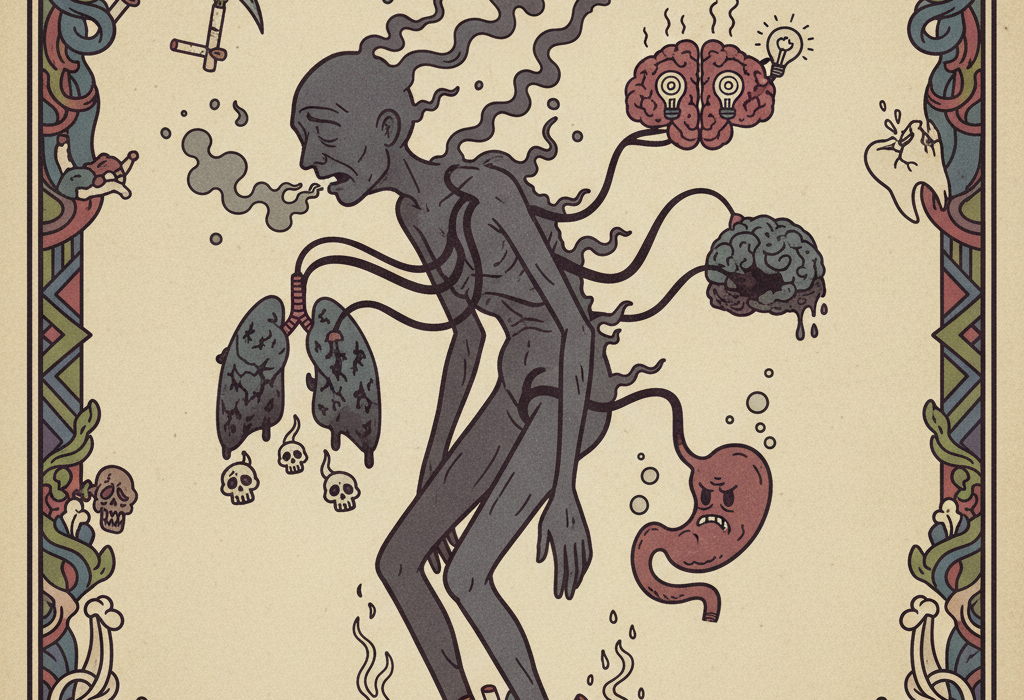
Most people know that smoking is harmful to human health. However, the exact ways tobacco smoke alters our biology are often misunderstood. When we think about smoking, we usually think about lung health. But the human body is like a highly complex factory. When you introduce tobacco smoke into the ventilation system, it does not just affect the air filters. It impacts the entire assembly line.
Over the past few decades, scientists have looked closer at how tobacco smoke affects our cells, our hormones, and the people around us. The findings show that the effects of smoking stretch far beyond a simple cough.
This article explores what peer-reviewed research actually says about active smoking, the hidden dangers of secondhand smoke, the truth about waterpipes, and how public health policies change our physical health.
What the Research Shows About Direct Smoking
When a person inhales cigarette smoke, they are taking in thousands of chemicals. Research shows that these chemicals cause physical and genetic changes throughout the body.
Cellular and Genetic Changes
Scientists can now look at the DNA of lung cancer cells and see exactly how they formed. A 2024 review in Nature Reviews Clinical Oncology explains that lung cancer in people who smoke looks completely different at a genetic level compared to lung cancer in people who have never smoked.
Tobacco smoke leaves a specific “mutational signature” on human DNA. This is essentially a chemical fingerprint left behind by a Carcinogen (kar-SIN-uh-jen), which is any substance that promotes the formation of cancer. Cancers in non-smokers tend to be driven by different genetic glitches and generally have a much lower number of total mutations.
Heavy Metal Accumulation
Cigarette smoke also contains heavy metals pulled from the soil by the tobacco plant. A study in Environmental Health Perspectives highlights the dangers of cadmium, a metal found in both food and tobacco. Because the body has no active way to eliminate cadmium, it builds up in the kidneys and bones over time. In smokers, this accumulation can lead to bone fragility and kidney dysfunction over many years.
Immediate Immune Responses
Even short-term smoking changes how the body functions. A 2018 study on healthy volunteers found that just a few years of smoking alters the gene expression in human blood cells. The smoke triggers Oxidative stress (ox-ih-DAY-tiv stress), a state where unstable molecules damage cells. This forces the body to constantly fight off inflammation, which can eventually lead to chronic lung diseases.
How Smoking Affects Hormones and Fertility
Smoking has a profound impact on the reproductive system. A 2016 review in Current Opinion in Obstetrics & Gynecology outlines how tobacco smoke acts as an anti-estrogen in the female body.
Chemicals in smoke tell the body to break down estrogen too quickly. This throws off the delicate hormonal balance required for pregnancy. Furthermore, animal and human studies show that smoking physically alters human eggs. Women who smoke tend to have a thicker Zona pellucida (ZO-nuh puh-LOO-sih-duh), which is the protective outer shell of the egg. A thicker shell makes it significantly harder for sperm to enter and fertilize the egg, which can lower the success rates of fertility treatments like IVF.
Related: How to Reduce Miscarriage Risk: What the Latest Science Actually Says
The Ripple Effect: Secondhand Smoke and Children
The research is clear that tobacco smoke does not only affect the person holding the cigarette. Secondhand smoke has measurable, long-lasting effects on bystanders, especially children.
Respiratory and Immune Health
Children have smaller lungs and developing immune systems, making them highly sensitive to air pollution. A 2020 study of over 41,000 children in China found that simply having the odor of tobacco smoke in the home was strongly linked to childhood respiratory issues. Children exposed to indoor smoke during infancy had significantly higher rates of night coughs, croup, and pneumonia.
Related: Does COVID-19 Cause a Different Kind of Pneumonia? What the Science Says
Unexpected Effects on Teeth and Mental Health
Secondhand smoke even affects oral health. A 2023 study in BMC Oral Health examined children aged 5 to 7 who lived with smokers. These children had higher rates of tooth decay, weaker tooth enamel, and more gum inflammation. Researchers found that exposure to smoke actually reduced the protective antibodies in the children’s saliva.
Furthermore, childhood exposure can cast a long shadow. A 2024 study using Australian data found that adults who were exposed to parental smoking during childhood generally reported poorer mental health later in life.
Prenatal and Paternal Risks
Most people know that mothers should not smoke during pregnancy. However, a 2022 review in Clinical Obstetrics and Gynecology highlights that a father’s smoking habits matter too. Paternal smoking around the time of conception and during pregnancy is linked to an increased risk of childhood leukemia and congenital heart defects. The chemicals in smoke can damage the DNA in sperm before conception even occurs.
Common Questions About Smoking Alternatives
Is smoking a waterpipe (hookah) safer than cigarettes?
No. Many people believe the water in a hookah pipe filters out toxins, but science shows otherwise. A 2016 review in the Journal of Hazardous Materials found that a single hour-long hookah session involves inhaling roughly 90,000 milliliters of smoke. A single cigarette produces about 500 to 600 milliliters. Hookah smoke contains high levels of carbon monoxide, heavy metals, and cancer-causing chemicals from both the tobacco and the burning charcoal.
Does rolling the windows down in a car protect passengers?
While ventilation helps, it does not eliminate the risk. Toxic particles from smoke cling to fabrics, dust, and surfaces. This is known as thirdhand smoke. Children can absorb these lingering chemicals through their skin or by breathing them in long after the cigarette is extinguished.
Do Public Smoking Bans Actually Work?
Because secondhand smoke is so harmful, many governments have banned smoking in public spaces and workplaces. A systematic review of global policies found that smoke-free laws and tobacco taxes are the two most effective ways to reduce smoking rates and protect public health.
But what happens to the human body when a ban goes into effect?
In 2004, Ireland became the first country to ban smoking in all indoor workplaces, including pubs. Researchers tracked the air quality in 42 Dublin pubs and tested the health of 81 bartenders before the ban and one year later. The results were dramatic:
- Air Quality: Fine Particulate matter (par-TIK-yoo-lit mat-er), tiny particles that damage the lungs, dropped by 83% inside the pubs.
- Toxins: Benzene, a known cancer-causing chemical, dropped by 80%.
- Worker Health: The bartenders saw an 81% drop in cotinine (a marker of nicotine) in their saliva. They also experienced significant improvements in lung function and a major drop in coughing and shortness of breath.
Similarly, a review in the Annual Review of Public Health found that when workplaces ban smoking, employees who smoke tend to consume fewer cigarettes per day and are more likely to successfully quit entirely.
The Bottom Line
The scientific consensus on tobacco smoke is clear and well-established. Active smoking alters the body at a genetic level, increases oxidative stress, and disrupts delicate hormonal balances. Alternatives like waterpipes are not safer and expose users to massive volumes of toxic smoke.
Crucially, the research shows that smoke does not respect personal boundaries. Secondhand smoke actively harms the respiratory, oral, and long-term health of children and bystanders. However, public health interventions like workplace smoking bans have proven highly effective. They rapidly clean the air, improve the lung function of workers, and encourage overall reductions in tobacco use.
Quick Reference: Key Studies
| Study Focus | Key Finding | Source |
|---|---|---|
| Lung Cancer Genetics | Lung cancers in smokers have distinct genetic “mutational signatures” not seen in non-smokers. | PMID 38195910 |
| Kids’ Oral Health | Household smoke exposure increases cavities and lowers protective saliva antibodies in children. | PMID 38114982 |
| Prenatal Risks | Paternal smoking around conception increases the risk of childhood leukemia. | PMID 35467559 |
| Waterpipes (Hookah) | One hookah session exposes users to roughly 90,000 mL of smoke, plus charcoal toxins. | PMID 27285594 |
| Fertility | Smoking thickens the outer shell of the human egg, making fertilization more difficult. | PMID 27285958 |
| Public Bans | The Irish pub smoking ban reduced indoor fine particle pollution by 83% in one year. | PMID 17204724 |
Last updated: March 2026
This article synthesizes findings from peer-reviewed research. It is for educational purposes only and does not constitute medical advice. Consult a healthcare provider before starting any new regimen or if you need help quitting smoking.
Leave a Reply