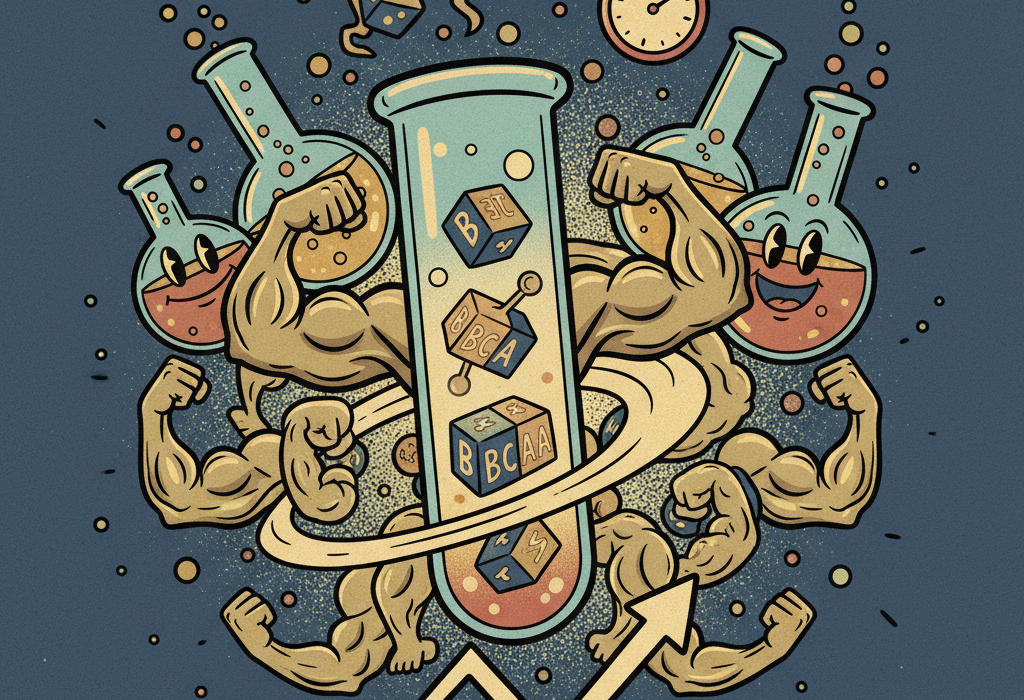
You have probably seen those colorful tubs of BCAA powder at the gym or in supplement stores. Maybe you have even mixed a scoop into your water bottle during a workout. Branched-chain amino acids are one of the most popular sports supplements in the world, marketed as a way to build muscle, reduce soreness, and speed recovery.
But here is the tension at the heart of BCAA science: the same amino acids that your muscles love can, in excess, be linked to metabolic problems like insulin resistance and obesity. And the supplement you are buying may not do much if you are already eating enough protein.
So what does the research actually show? Let us walk through it.
What Are BCAAs and Why Do People Take Them?
Branched-chain amino acids (BCAA, pronounced BEE-see-ay-ay) are three essential amino acids: leucine (LOO-seen), isoleucine (eye-so-LOO-seen), and valine (VAL-een). “Essential” means your body cannot make them on its own. You have to get them from food or supplements.
BCAAs make up about one-third of the protein in your muscles. Unlike most amino acids, which are processed first by the liver, BCAAs are broken down primarily in skeletal muscle. This is what makes them unique and why they caught the attention of exercise scientists decades ago.
Leucine, in particular, is a key activator of a cellular pathway called mTORC1 (em-TOR-see-one), which acts like a master switch for muscle protein synthesis (MPS), the process by which your body builds new muscle protein. A comprehensive review in Nutrition & Metabolism describes how leucine triggers this pathway even when energy intake is low, which is why it has been studied so heavily in dieting and recovery contexts.
BCAA supplements typically come in a 2:1:1 ratio of leucine to isoleucine to valine and are marketed for three main purposes:
- Building or preserving muscle
- Reducing post-exercise soreness
- Improving recovery after tough workouts
But there is a crucial distinction that often gets lost: having the right building blocks available is not the same as needing a supplement to get them.
Do BCAAs Actually Help Build or Preserve Muscle?
This is the question most people care about, and the answer depends heavily on context.
When Protein Intake Is Already Sufficient
A 2021 narrative review in the International Journal of Sport Nutrition and Exercise Metabolism examined the accumulated evidence on BCAA and leucine supplementation for muscle strength and hypertrophy. The authors concluded that while leucine clearly stimulates the initial acute anabolic response in muscle, this does not reliably translate into greater muscle growth when total protein intake is adequate.
The reasoning is straightforward. To build new muscle protein, your body needs all nine essential amino acids, not just the three BCAAs. Taking BCAAs alone is like having some of the bricks but not all of the mortar. A 2025 narrative review in Nutrients reinforced this point, noting that whole-protein sources like whey provide BCAAs alongside all essential amino acids and are likely superior for supporting muscle protein synthesis.
In a large 16-week randomized controlled trial involving 132 adults with overweight or obesity, researchers compared a standard-protein diet, the same diet plus BCAAs, and a high-protein diet during calorie restriction. Weight loss was similar across groups (about 8% of body weight). The BCAA group lost slightly less lean mass (4.4%) than the standard-protein group (5.4%), but the difference was not statistically significant. The high-protein group performed best at 3.7% lean mass loss. This study, cited in the 2025 Nutrients review, suggests BCAAs offer limited additive benefit when protein intake is already reasonable.
When Protein Intake Is Limited
The picture changes when people struggle to eat enough protein. This includes:
- Older adults with poor appetite or difficulty chewing
- Patients recovering from bariatric surgery
- People on very-low-calorie diets
- Individuals taking GLP-1 weight loss medications that suppress appetite
In these situations, essential amino acid (EAA) or BCAA supplementation may genuinely help. The 2025 Nutrients review describes several studies where EAA supplementation during calorie restriction helped older adults preserve lean body mass and even improve grip strength, particularly when food-based protein intake was inadequate.
After bariatric surgery, one study found that patients receiving whey protein fortified with BCAAs and vitamin D lost only 4.1% of lean body mass in the first month, compared to 11.4% in those receiving protein alone.
Related: Not All Protein Is Created Equal: What Your Body Actually Absorbs
When Combined With Resistance Exercise
BCAA supplementation appears to work better when paired with resistance training during calorie restriction. One randomized trial in resistance-trained men on a hypocaloric diet found that the BCAA group maintained lean body mass over 8 weeks while the carbohydrate-only group lost about 0.9 kg. However, the 2025 Nutrients review notes an important caveat: the control group received only carbohydrates with no extra protein, meaning the BCAA group simply had a higher protein intake overall.
| Scenario | BCAA Benefit? | Notes |
|---|---|---|
| Adequate protein intake (>1.2 g/kg/day) | Minimal | Whole protein sources likely sufficient |
| Low protein intake or restricted eating | Moderate | May help preserve lean mass |
| Combined with resistance exercise | Moderate | Better than carbs alone, but whole protein may be equal or better |
| Post-bariatric surgery | Possibly helpful | Limited food tolerance makes supplements practical |
Can BCAAs Reduce Muscle Soreness and Speed Recovery?
This is where BCAAs have some of their strongest evidence. A 2024 systematic review and meta-analysis in Sports Medicine – Open pooled data from 18 randomized controlled trials involving 331 participants and found:
- Muscle soreness (DOMS): BCAA supplementation produced large, significant reductions in delayed-onset muscle soreness at 24, 48, 72, and 96 hours after exercise-induced muscle damage.
- Creatine kinase (CK): BCAAs significantly lowered CK levels, a blood marker of muscle damage, immediately after exercise and at 72 hours.
- Lactate dehydrogenase (LDH): No significant effect at any time point.
The meta-regression analysis revealed that higher daily doses and longer supplementation periods before the damaging exercise were associated with larger benefits. Most studies used doses between 5 and 20 grams per day.
A 2022 study in the Journal of the International Society of Sports Nutrition added an interesting finding: combining BCAAs with fish oil (omega-3 fatty acids) better preserved muscle strength immediately after eccentric exercise compared to BCAAs alone. The BCAA-plus-fish-oil group retained 69% of their pre-exercise strength, while the placebo group dropped to 52%.
It is worth noting that most of these studies involved a specific type of exercise designed to cause muscle damage (heavy eccentric contractions). The benefits may be less pronounced during typical training sessions.
How BCAAs Work in the Body
Understanding why BCAAs do what they do requires a quick look at their biology.
When you consume BCAAs, they bypass the liver and go directly to your muscles. There, the enzyme BCAT (bee-cat) converts them into compounds called branched-chain keto acids (BCKAs). These BCKAs are then further broken down by a second enzyme complex called BCKDH (bee-see-kay-dee-aitch), which is the rate-limiting step in BCAA metabolism.
A 2022 review in the International Journal of Molecular Sciences explains that this BCKDH enzyme is regulated like a switch: it can be turned on (active) or off (inactive) through a phosphorylation process. Exercise turns this switch on, which is why your body burns more BCAAs during physical activity. A 2004 study in The Journal of Nutrition demonstrated that exercise activates BCKDH in both muscle and liver, increasing BCAA breakdown.
This matters because it means your BCAA requirements genuinely increase with exercise. A 1999 review in Sports Medicine suggested the recommended daily intake for leucine should be at least 45 mg/kg body weight for sedentary people and higher for athletes, well above the then-standard recommendation of 14 mg/kg.
Beyond muscle, a 2019 study published in Nature revealed something unexpected: brown adipose tissue (brown fat, the type that generates heat) is a major site of BCAA breakdown. Cold exposure activated BCAA burning in brown fat through a newly identified transporter called SLC25A44. When researchers disabled BCAA breakdown specifically in brown fat, mice became obese and glucose intolerant on a high-fat diet. This suggests BCAAs play a broader role in energy balance than previously understood.
The Metabolic Dark Side: BCAAs, Obesity, and Insulin Resistance
Here is where things get complicated. While BCAA supplements are marketed for fitness, elevated blood levels of BCAAs have been consistently linked to obesity, insulin resistance, and type 2 diabetes in observational studies.
A mouse study published in Molecular Medicine in 2024 found that feeding mice a high-BCAA diet (150% of normal BCAA content) for 16 weeks led to:
- Increased body weight
- Worse glucose tolerance
- Greater insulin resistance
- More inflammation in fat tissue
The mechanism involved BCAAs activating a specific inflammatory pathway (IFNGR1/JAK1/STAT1) in fat tissue immune cells called macrophages, pushing them toward a pro-inflammatory state.
However, a 2021 study in Endocrinology found that BCAA supplementation in mice on a high-fat diet did not worsen insulin resistance or glucose tolerance, despite raising blood BCAA levels. The authors emphasized that the relationship between BCAAs and metabolic disease may differ substantially between species and between diet-induced versus genetic obesity models.
A 2025 study in Diabetes, Obesity & Metabolism added another layer of complexity. Researchers found that aerobic exercise reduced circulating BCAA levels in obese mice by 15-21%, and this reduction was important for the metabolic benefits of exercise. When they supplemented BCAAs back to pre-exercise levels, the metabolic benefits of exercise were substantially blunted. The mechanism involved a liver hormone called FGF21: exercise increased it, and BCAAs suppressed it.
The emerging picture, described in a 2024 review in Nutrients, is that the context of BCAA levels matters enormously:
- In obesity, BCAA levels rise because fat tissue loses its ability to break them down properly
- The elevated BCAAs may contribute to insulin resistance through chronic mTOR activation
- During exercise or calorie restriction, BCAA supplementation may help preserve muscle but could theoretically interfere with some metabolic improvements
It remains unclear whether elevated BCAAs cause metabolic problems or are simply a marker of underlying metabolic dysfunction.
Related: Intermittent Fasting: What the Latest Science Actually Says
BCAAs and Heart Health in Diabetes
A 2024 study in Theranostics uncovered a surprising protective role for BCAAs in diabetic heart disease. Researchers found that among patients with type 2 diabetes, those who developed diabetic cardiomyopathy (heart muscle disease) had significantly lower BCAA levels, about 15-21% lower, than diabetic patients without heart problems.
In mouse models, BCAA deficiency worsened heart function and increased cardiac fibrosis. Conversely, BCAA supplementation improved cardiac function and reduced fibrosis. The mechanism involved an autophagy pathway: low BCAAs activated excessive cellular self-digestion in heart fibroblasts, leading to scar tissue formation.
This finding adds nuance to the BCAA story. While high BCAAs in the blood may signal metabolic trouble in obesity, low BCAAs in people with established diabetes could indicate risk for heart complications.
BCAAs for Older Adults and Sarcopenia
Age-related muscle loss, called sarcopenia (sar-ko-PEE-nee-uh), affects 10-27% of people over 60. A 2023 systematic review in Nutrients examined 12 randomized controlled trials with 1,337 older adults and found:
- BCAAs combined with vitamin D improved muscle mass, grip strength, gait speed, and physical performance in 6 out of 9 trials
- BCAAs alone (without vitamin D) were not effective
- One study found BCAAs improved mitochondrial function in malnourished older adults
The review concluded that for older adults with sarcopenia or malnutrition, the combination of BCAAs (or whey protein) with vitamin D, ideally alongside resistance exercise, offers the most consistent benefits.
A 2023 study in Frontiers in Sports and Active Living followed frail nursing home residents (ages 83-93) through a 40-week exercise-and-supplementation program. While BCAA supplementation combined with exercise did not dramatically change blood markers, the groups that exercised (with or without BCAAs) maintained their frailty status during an 8-week break, while the control group deteriorated.
BCAAs and Liver Disease
BCAAs have a long history in liver disease treatment. A 2024 review in Nutrients details how BCAA levels drop in cirrhosis because the body uses them to detoxify ammonia, and this imbalance contributes to hepatic encephalopathy (brain dysfunction caused by liver failure).
BCAA supplementation in cirrhosis patients has been shown to:
- Improve serum albumin levels
- Reduce risk of hepatic encephalopathy
- Improve quality of life
- Potentially reduce liver cancer risk in certain subgroups
European and American liver disease guidelines recommend BCAA-enriched formulas for cirrhosis patients. However, the 2024 Nutrients review notes the evidence remains somewhat inconsistent due to study heterogeneity.
Common Questions About BCAA Supplements
Are BCAAs worth taking if I already eat enough protein?
Probably not for muscle building. If you consume 1.2-1.6 g of protein per kg of body weight daily from whole foods or protein shakes, you are likely getting plenty of BCAAs already. A chicken breast, for example, contains roughly 6-7 grams of BCAAs.
What dose of BCAAs is used in research?
Most studies showing benefits for soreness and recovery used 5-20 grams per day, typically in a 2:1:1 ratio of leucine:isoleucine:valine. For muscle preservation during calorie restriction, leucine doses of at least 2.5-3 grams per meal are often cited as the threshold to stimulate muscle protein synthesis.
Can BCAAs cause harm?
At typical supplement doses, BCAAs appear safe. Animal toxicity studies found no adverse effects at doses up to 2.5 g/kg/day. However, people with maple syrup urine disease (a rare genetic condition) cannot process BCAAs and must avoid them. People with liver disease should consult their doctor, as BCAA metabolism is altered in these conditions.
Should I take BCAAs or whole protein?
For most people, whole protein sources (food, whey, or casein supplements) are preferable because they provide all essential amino acids. BCAAs may have a niche role as a low-calorie option around workouts or for people who cannot tolerate whole protein sources.
The Bottom Line
BCAAs are not useless, but they are not the muscle-building miracle that marketing suggests either. Here is what we can say with reasonable confidence:
What the evidence supports:
- BCAAs can reduce muscle soreness after intense or unfamiliar exercise
- BCAAs (especially with vitamin D) may help preserve muscle in older adults with sarcopenia or malnutrition
- BCAA or EAA supplements may help maintain lean mass during severe calorie restriction when whole-protein intake is limited
- BCAAs play an established role in managing liver cirrhosis and hepatic encephalopathy
What remains uncertain:
- Whether BCAAs offer any advantage over adequate whole-protein intake for muscle growth
- Whether chronically elevated BCAAs from supplements contribute to insulin resistance in certain populations
- The optimal dose and timing for different goals
- How BCAA supplementation interacts with the metabolic benefits of exercise in humans
What the evidence does not support:
- Taking BCAAs as a substitute for adequate total protein intake
- Expecting significant muscle growth from BCAAs alone without sufficient total protein and resistance training
For most healthy, active people eating a balanced diet with adequate protein, BCAA supplements are an unnecessary expense. Your money is better spent on whole protein sources. But for specific populations, including older adults at risk of muscle loss, people recovering from surgery, or those on severely restricted diets, targeted amino acid supplementation may fill a genuine nutritional gap.
Related: Bodybuilding Nutrition: What Science Actually Says
Quick Reference: Key Studies
| Study Focus | Key Finding | Source |
|---|---|---|
| BCAA supplementation during weight loss | Limited benefit when protein intake is adequate; EAAs may help when protein is restricted | PMID 40573110 |
| Muscle soreness and damage (meta-analysis of 18 RCTs) | BCAAs significantly reduce DOMS at 24-96h and CK at 72h post-exercise | PMID 38625669 |
| BCAAs in liver diseases (review) | Complex role; supplementation helps cirrhosis but efficacy varies | PMID 38931228 |
| BCAA deficiency and diabetic cardiomyopathy | Lower BCAAs in T2D patients associated with worse cardiac outcomes; supplementation improved heart function in mice | PMID 39659577 |
| BCAAs and adipose tissue inflammation (mouse study) | High BCAA diet promoted pro-inflammatory macrophage polarization and insulin resistance | PMID 39267003 |
| BCAAs and sarcopenia in older adults (systematic review) | BCAAs + vitamin D improved muscle outcomes in 6/9 trials; BCAAs alone ineffective | PMID 37686735 |
| BCAAs + exercise in frail elderly (40-week trial) | Exercise + BCAAs maintained frailty status; control group worsened | PMID 37720080 |
| BCAA + fish oil for muscle damage recovery | Combined supplementation better preserved strength post-eccentric exercise | PMID 36105122 |
| BCAA catabolic enzymes in disease (review) | Dysregulated BCAA catabolism linked to diabetes, heart failure, cancer | PMID 35409380 |
| BCAAs in diet-induced obese mice | BCAA supplementation did not worsen glucose homeostasis | PMID 33765118 |
| BCAA catabolism in brown fat (Nature) | Brown fat uses BCAAs for thermogenesis via SLC25A44; defects cause obesity | PMID 31435015 |
| BCAA metabolism overview | Context-dependent effects; benefits in CRF and cirrhosis, unclear in obesity | PMID 29755574 |
| Exercise and BCAA catabolism | Exercise activates BCKDH, increasing BCAA oxidation and requirements | PMID 15173434 |
| Leucine supplementation review | Leucine needs may be 3-4x higher than standard RDI, especially for athletes | PMID 10418071 |
| BCAAs counteract exercise benefits in obese mice | BCAA supplementation blunted metabolic benefits of aerobic exercise | PMID 40826910 |
| BCAA/leucine for strength and hypertrophy (review) | Insufficient evidence that BCAAs enhance muscle growth beyond adequate protein | PMID 33741748 |
Last updated: February 2026
This article synthesizes findings from peer-reviewed research. It is for educational purposes only and does not constitute medical advice. Consult a healthcare provider before starting any new regimen.
Leave a Reply