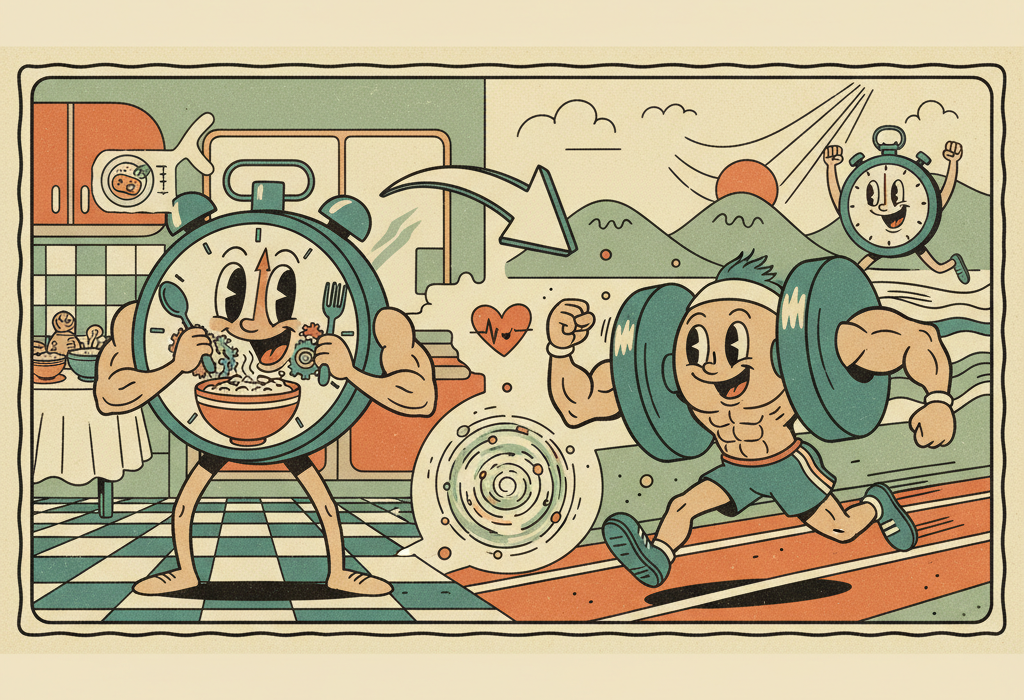
For decades, health advice focused entirely on what we eat and how much we exercise. However, an emerging field of science shows that timing plays a critical role in how our bodies process food and respond to physical activity.
Our bodies operate on a 24-hour internal clock known as a Circadian rhythm (sir-KAY-dee-un RIH-thum). This system dictates when we feel awake, when we feel tired, and when our metabolism is most active. Because of this clock, a meal eaten at 8:00 AM is processed differently than the exact same meal eaten at 8:00 PM. Similarly, a morning workout triggers different biological responses than an evening workout.

This article explores what current peer-reviewed research says about meal timing, exercise timing, and how combining the two can influence your metabolic health and body composition.
Does Meal Timing Actually Matter?
Yes. To understand why, think of your metabolism like a restaurant. In the morning, the staff is fresh, the grills are hot, and they are ready for a rush of customers. By late evening, the staff is cleaning up and preparing to close. If a massive order comes in right before closing, the kitchen struggles to handle it efficiently.

Research clearly shows that our bodies are optimized to digest food and process sugar earlier in the day. A 2020 study in Nutrients tracked the daily habits of 83 adults. The researchers found that for every one hour later a person started their eating window, their body fat increased by 1.25 percent. Later sleep and meal times were strongly linked to higher body fat and lower overall physical activity.
The Benefits of Eating Early
One of the most revealing studies on this topic looked at a strategy called Early Time-Restricted Feeding (eTRF). In this 2018 clinical trial published in Cell Metabolism, men with prediabetes ate all their meals within a 6-hour window, finishing dinner by 3:00 PM.
The researchers strictly controlled the participants’ diets so they did not lose any weight. Even without weight loss, the early eating schedule significantly improved their blood pressure, reduced oxidative stress, and improved Insulin sensitivity (IN-suh-lin ree-ZIS-tuhns). This is a condition where your cells respond well to insulin, making it easier to absorb blood sugar.
Other research supports this pattern. A 2019 review in Nutrients concluded that consuming a higher proportion of your daily calories early in the day, maintaining a regular meal pattern, and avoiding late-night eating provides significant physiological benefits.
Related: How Your Circadian Rhythm Controls Sleep (And What Science Says About Fixing It)
When Is the Best Time to Exercise?
Just as your body handles food differently throughout the day, it also responds uniquely to exercise depending on the clock. A 2020 review in Frontiers in Nutrition highlighted that athletic performance and metabolic responses fluctuate naturally over 24 hours.
Morning Exercise for Fat Loss and Blood Pressure
Research suggests that morning exercise may be optimal for burning fat. When you wake up, your body has been fasting overnight, meaning your carbohydrate stores are relatively low. A 2023 review in Current Opinion in Clinical Nutrition and Metabolic Care noted that exercising after an overnight fast can lead to different metabolic adaptations compared to exercising after a meal, often resulting in higher rates of fat oxidation during the workout.
Morning exercise also appears to have a unique benefit for blood pressure. Studies show that morning workouts can lead to greater reductions in blood pressure throughout the day compared to evening workouts.
Evening Exercise for Muscle and Performance
If your goal is to build strength, the late afternoon or early evening might be your best window. Human muscle power naturally peaks in the late afternoon, closely tracking with our daily peak in core body temperature. Some studies suggest that resistance training in the evening leads to slightly greater increases in muscle mass over time compared to morning training.
However, intense exercise too close to bedtime can disrupt sleep for some people. A 2022 review in Sleep Medicine Reviews warns that insufficient sleep creates a catabolic state, which means the body breaks down muscle tissue rather than building it.
| Goal | Optimal Timing | Why It Works |
|---|---|---|
| Fat Oxidation | Morning (Fasted) | Low carbohydrate stores force the body to rely more on fat for fuel. |
| Blood Pressure Control | Morning | Greater reduction in daily blood pressure averages. |
| Peak Strength & Power | Late Afternoon / Evening | Core body temperature and muscle power naturally peak. |
| Muscle Growth | Late Afternoon / Evening | Hormonal environment and body temperature favor muscle adaptation. |
Combining Meals and Movement: What the Research Shows
The most practical application of timing science involves how we mix our meals and our movement.
Post-Meal Walks for Blood Sugar Control
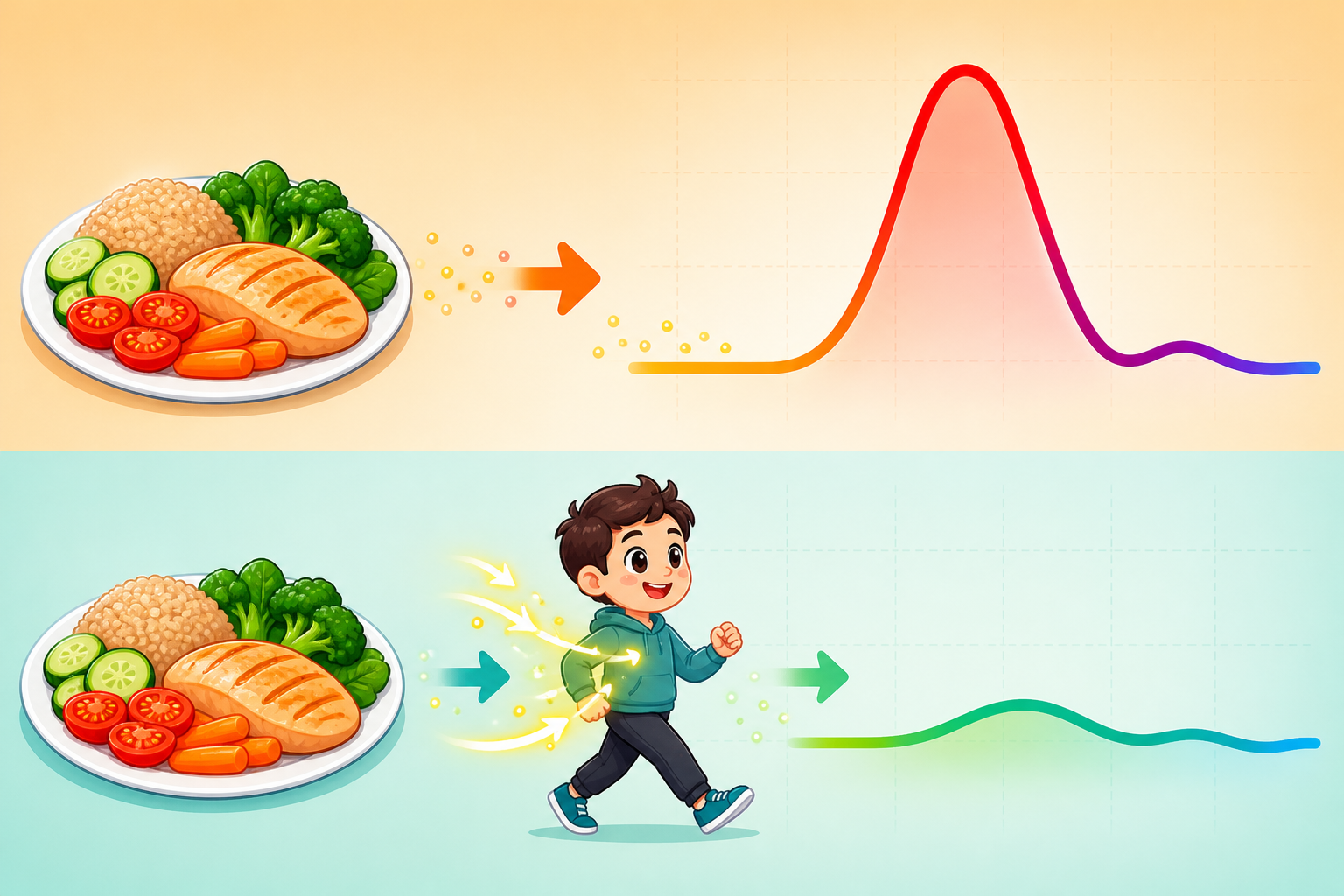
If you want to manage your blood sugar, the timing of your exercise relative to your meals is highly important. A 2024 review in Nutrients found that engaging in moderate-intensity exercise shortly after a meal substantially improves how the body handles glucose.
The researchers concluded that starting light to moderate exercise about 15 to 30 minutes after a meal is the sweet spot. This timing catches the blood sugar right as it begins to peak in the bloodstream. The active muscles absorb the sugar for energy, preventing a large spike. Even short “activity snacks”, such as 3 minutes of walking or light resistance exercise every 30 minutes, proved highly effective at controlling post-meal blood sugar.
Protein Timing for Muscle Repair
For those engaging in resistance training, the timing of protein intake has been heavily debated. The International Society of Sports Nutrition (ISSN) clarified this in their 2017 Position Stand on Nutrient Timing.
The ISSN concluded that while the total amount of protein you eat in a day is the most important factor, spreading it out is the most efficient way to build muscle. They recommend ingesting a 20 to 40 gram dose of high-quality protein every three to four hours.
Additionally, consuming protein immediately to two hours after a workout stimulates robust increases in Muscle protein synthesis (MUS-ul PRO-teen SIN-thuh-sis), which is the biological process of repairing and building muscle tissue.
Appetite Control After Workouts
Can the timing of your post-workout meal dictate how much you eat later? A 2020 study in Pediatric Obesity tested this in adolescents. The researchers had participants eat lunch either 30 minutes or 90 minutes after an exercise session.
Surprisingly, the group that delayed their meal for 90 minutes after exercising consumed significantly fewer calories at lunch and throughout the rest of the day, without feeling any hungrier. While this study focused on adolescents, it suggests that giving your body some time to settle after a workout before eating a large meal might naturally reduce overall calorie intake.
Related: The Science of Intermittent Fasting vs. Calorie Restriction: What Actually Works
How This Might Work: The Biology of Clocks
Why does timing matter so much? It comes down to cellular clocks.
While the master clock in your brain responds primarily to light, you also have peripheral clocks in your organs, including your liver, gut, and muscles. A 2022 paper in The Journal of Physiology explains that these peripheral clocks are heavily influenced by when you eat.
When you eat late at night, you send a “wake up” signal to your liver and digestive system, even though your brain’s master clock is telling the rest of your body to sleep. This misalignment creates metabolic confusion. The body becomes less efficient at processing sugars and fats, which can lead to higher blood sugar, increased fat storage, and poor sleep quality.
Who Benefits Or Needs Caution
Night Owls: People who naturally stay up late and sleep in often struggle with metabolic health because their schedules conflict with typical societal hours. A 2019 study in Sleep Medicine showed that when “night owls” deliberately shifted their sleep and meal times a few hours earlier, they saw significant improvements in mental health, stress levels, and morning physical performance.
Female Athletes: Timing strategies may need to be adjusted based on biology. The ISSN’s 2023 Position Stand on Female Athletes notes that female hormones influence carbohydrate and fat metabolism. Women may need to tailor their carbohydrate intake to different phases of their menstrual cycle, particularly prioritizing carbohydrates during the luteal phase when the body relies more heavily on them during exercise.
People with Prediabetes: Individuals struggling with blood sugar regulation stand to gain the most from timing strategies. Shifting calories to the morning and taking short walks after meals are highly effective, non-medical interventions for managing glucose.
Practical Guidance
Based on the synthesized research, here are evidence-based ways to optimize your timing:
- Front-load your calories: Try to consume the majority of your daily calories before 4:00 PM. Make breakfast or lunch your largest meal of the day.
- Walk after you eat: Aim for a 10 to 15-minute walk starting about 15 minutes after your largest meals to blunt blood sugar spikes.
- Space your protein: Instead of eating most of your protein at dinner, aim for 20 to 40 grams of protein every three to four hours throughout the day.
- Stop eating 2-3 hours before bed: Give your digestive system time to rest so it does not send conflicting signals to your brain’s sleep centers.
Common Questions About Meal and Exercise Timing
Should I work out on an empty stomach?
It depends on your goal. Fasted cardio in the morning can increase the percentage of fat burned during the workout. However, if you are doing high-intensity interval training or heavy weightlifting, exercising on an empty stomach might reduce your performance and energy output.
Does eating at night really make you gain weight?
Yes, if it becomes a habit. Studies show that late-night eating is correlated with higher body fat percentages. The body is less insulin sensitive at night, meaning it is more likely to store late-night calories as fat rather than burning them for energy.
Do I have to drink a protein shake immediately after lifting weights?
Not necessarily immediately, but soon. The concept of a rigid 30-minute “anabolic window” has been largely debunked. However, consuming protein within one to two hours after your workout is still highly recommended to optimize muscle repair.
The Bottom Line
Total daily calories and overall physical activity are still the foundation of good health. However, the timing of those behaviors acts as a crucial fine-tuning dial.
Research confidently shows that aligning your food intake with daylight hours and taking advantage of post-meal movement can significantly improve your metabolic health. While the exact “perfect” time to exercise varies based on personal goals, consistency is ultimately the most important factor. What remains clear is that treating your body’s internal clock with respect by establishing regular, predictable patterns of eating and moving yields profound health benefits.
Quick Reference: Key Studies
| Study Focus | Key Finding | Source |
|---|---|---|
| Early Time-Restricted Feeding | Eating dinner before 3:00 PM improved insulin sensitivity and blood pressure in men with prediabetes, even without weight loss. | PMID 29754952 |
| Post-Meal Exercise | Moderate exercise 15 to 30 minutes after eating significantly lowers post-meal blood sugar spikes. | PMID 38674861 |
| Protein Timing | Consuming 20 to 40 grams of protein every 3 to 4 hours maximizes muscle repair and growth. | PMID 28919842 |
| Late Eating Risks | Later meal and sleep timing are linked to higher body fat and lower physical activity levels. | PMID 33383648 |
| Meal Frequency | Consuming a higher proportion of energy early in the day with regular fasting periods provides physiological benefits. | PMID 30925707 |
Last updated: September 2026
This article synthesizes findings from peer-reviewed research. It is for educational purposes only and does not constitute medical advice. Consult a healthcare provider before starting any new regimen.
Leave a Reply