
Walk down any health store aisle, and you will see shelves packed with collagen powders, pills, and drinks. The labels often promise to erase wrinkles, restore youthful skin, and turn back the clock on aging. But does eating a protein powder actually change the structure of your skin?
The short answer is yes, but with some conditions. A growing body of scientific evidence shows that taking specific forms of collagen can improve skin elasticity, increase hydration, and reduce the depth of wrinkles. However, the media often exaggerates these effects. Collagen is a helpful tool for skin health, not a magic eraser.
To understand how collagen supplements work, we first have to understand how our skin changes as we get older.
How Skin Aging Actually Works
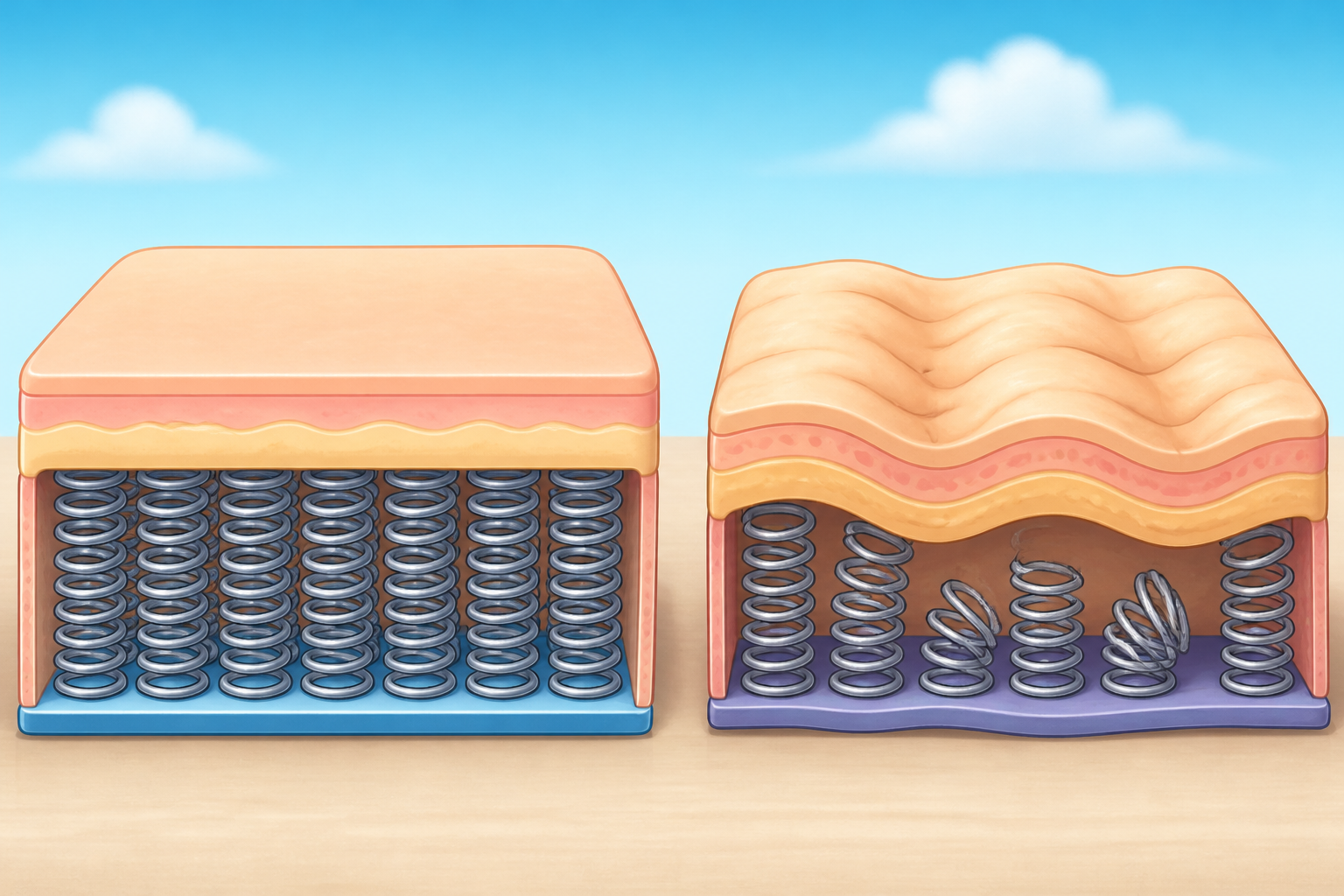
Think of your skin like a mattress. The outer layer of your skin is the fabric cover, but the thick layer underneath (the dermis) contains the springs that keep the mattress firm and bouncy. In your skin, these “springs” are made of a protein called collagen.
When we are young, our skin has a thick, organized network of collagen. Two main groups of workers manage this network:
- Fibroblasts (FIE-bro-blasts) – specialized cells that act as builders, constantly making new collagen.
- Matrix metalloproteinases (MAY-triks meh-TAL-oh-PRO-tee-in-ay-ses) or MMPs – enzymes that act as a demolition crew, breaking down old or damaged collagen so it can be replaced.

As we age, this system falls out of balance. The builders slow down, and the demolition crew speeds up. This process is accelerated by outside factors like ultraviolet radiation from the sun. Sunlight triggers an increase in MMPs, leading to fragmented, disorganized collagen. You can read more about this process in our article on How UV Rays Actually Damage Skin (And What Science Says Protects It).
When the collagen network fragments, the skin loses its structural support. The “mattress” begins to sag, leading to wrinkles, dryness, and a loss of elasticity.
What the Research Shows About Oral Collagen
When scientists first started studying collagen supplements, many doctors were skeptical. Collagen is a large protein. When you eat it, your digestive system breaks it down into individual amino acids before it enters your bloodstream. Skeptics argued that eating collagen was no different than eating a piece of chicken or a bowl of beans.
However, modern supplements do not use whole collagen. They use Hydrolyzed collagen (hie-DRO-lized KAHL-uh-jen). This means the collagen has already been broken down into tiny fragments called Peptides (PEP-tydes).

These peptides survive digestion in small clusters. Once they enter the bloodstream, they travel to the skin. Research suggests these peptides do two things:
1. They provide the exact building blocks the skin needs.
2. They send chemical signals to the fibroblasts, tricking the body into thinking collagen is breaking down. This prompts the builders to start making new collagen and hyaluronic acid (a molecule that holds water in the skin).
The Evidence for Skin Elasticity and Hydration
A large 2023 review in Nutrients analyzed 26 randomized controlled trials involving over 1,700 people. The researchers found that hydrolyzed collagen supplementation significantly improved both skin hydration and skin elasticity compared to a placebo. The analysis showed that the benefits were most noticeable after taking the supplement consistently for at least eight weeks.
Another 2014 study in Skin Pharmacology and Physiology looked at 69 women aged 35 to 55. They took either a placebo, 2.5 grams of collagen, or 5.0 grams of collagen daily for eight weeks. Both collagen groups saw a significant improvement in skin elasticity. Interestingly, the positive effects were most pronounced in women over the age of 50. Furthermore, the improvements lasted for a full four weeks after the women stopped taking the supplement, suggesting a real structural change in the skin.
The Evidence for Wrinkles and Dermal Density
Beyond simple elasticity, researchers have used advanced imaging to look deep inside the skin. A 2015 study in the Journal of Cosmetic Dermatology used high-resolution ultrasound to measure the collagen network in women taking 10 grams of collagen peptides daily.
After just four weeks, the density of the collagen in their skin significantly increased. More importantly, the fragmentation of the collagen network (the broken “springs”) significantly decreased.
Recently, a 2025 study in the Journal of Microbiology and Biotechnology tested a lower dose of 1.65 grams of low-molecular-weight collagen peptides on 70 adults. Over eight weeks, the researchers noted significant improvements in wrinkle depth, skin hydration, and dermal density. They even observed reductions in pore size and sebum (oil) production, suggesting broad benefits for overall skin texture.
Marine vs. Bovine Collagen: Does the Source Matter?
If you decide to try collagen, you will quickly notice it comes from different sources. The most common are bovine (cow), porcine (pig), and marine (fish).
According to a 2022 review in Marine Drugs, marine collagen has become highly favored in medical research. It is absorbed very efficiently by the human body and avoids the risk of diseases that can occasionally be transmitted by land animals. Marine collagen is primarily Type I collagen, which is the exact type that makes up the majority of human skin.
However, you do not necessarily have to buy marine collagen to see results. The large 2023 meta-analysis mentioned earlier compared the different sources of collagen. The researchers found no significant differences in effectiveness between fish, cow, or pig collagen when it came to improving skin elasticity.
| Feature | Marine (Fish) Collagen | Bovine/Porcine (Cow/Pig) Collagen |
|---|---|---|
| Primary Type | Mostly Type I | Types I and III |
| Absorption | Very high | High |
| Dietary Notes | Pescatarian-friendly | Not suitable for pescatarians |
| Skin Efficacy | Proven highly effective | Proven highly effective |
Common Misunderstandings or Myths
Because collagen is a popular beauty trend, it is surrounded by misinformation. A 2022 review in the Journal of Cosmetic Dermatology investigated the claims made by collagen companies on social media compared to actual scientific evidence.
The researchers noted that while science supports improvements in elasticity and hydration, social media claims often surpass reality. Collagen will not instantly erase deep wrinkles, cure severe skin conditions, or replace the need for sunscreen and a healthy diet.
Another common myth is that rubbing raw collagen on your skin works just as well as eating it. Whole collagen molecules are simply too large to pass through the outer barrier of your skin. Topical creams containing whole collagen mainly just sit on the surface and act as a moisturizer. If you want to target skin aging from the outside, you need specific topical peptides or retinoids, which we cover in detail in The Science of Anti-Aging Skincare: What Actually Works.
Practical Guidance
If you want to incorporate collagen into your routine based on the current science, here is what the research suggests:
- Look for “Hydrolyzed” or “Peptides”: Ensure the product label specifies hydrolyzed collagen or collagen peptides. Whole collagen (like gelatin) is not absorbed the same way.
- Check the Dose: Studies show benefits at doses ranging from 2.5 grams to 10 grams per day. You do not need massive scoops to see results.
- Be Patient: Skin cells take time to turn over and rebuild. Almost all clinical trials measure results after 8 to 12 weeks of daily use. Do not expect visible changes in the first month.
- Pair with Vitamin C: Your body requires Vitamin C to synthesize new collagen. While many supplements include it, eating a diet rich in fruits and vegetables ensures your skin has the raw materials it needs.
Common Questions About Collagen
Does bone broth do the same thing as collagen powder?
Bone broth does contain collagen, but the amount and the size of the peptides vary wildly depending on how it was cooked. Hydrolyzed collagen powders provide a consistent, measured dose of peptides that are guaranteed to be small enough for easy absorption.
Can vegans take collagen?
True collagen only comes from animal sources. “Vegan collagen” supplements do not contain actual collagen; instead, they contain the individual amino acids and vitamins (like Vitamin C) that your body uses to build its own collagen. While healthy, they do not provide the exact peptide signals that animal-based collagen supplements do.
Will collagen help my joints as well as my skin?
While this article focuses on skin, several studies suggest that collagen peptides also accumulate in cartilage and can help reduce joint discomfort, though the mechanisms are slightly different than in the skin.
The Bottom Line / Takeaways
The science on oral collagen supplementation has moved past initial skepticism. Multiple high-quality, placebo-controlled trials confirm that taking hydrolyzed collagen peptides can genuinely improve skin health.
What we know: Taking 2.5 to 10 grams of hydrolyzed collagen daily for at least 8 weeks improves skin elasticity, increases hydration, and increases the density of the dermal collagen network.
What remains uncertain: We still do not know the absolute perfect dose, or whether marine collagen is vastly superior to bovine collagen in the long term, as both show positive results.
Confidence level: High. The evidence for collagen’s ability to improve basic skin parameters like elasticity and hydration is well-supported by multiple meta-analyses and randomized trials. However, consumers should maintain realistic expectations and ignore exaggerated marketing claims.
Quick Reference: Key Studies
| Study Focus | Key Finding | Source |
|---|---|---|
| Meta-analysis of 26 trials | Hydrolyzed collagen significantly improves skin hydration and elasticity, especially after 8 weeks. | PMID 37432180 |
| Low-molecular-weight peptides | 1.65g daily for 8 weeks improved wrinkles, dermal density, and pore size. | PMID 40935395 |
| Dermal network fragmentation | 10g daily decreased the fragmentation of the skin’s collagen network after 4 weeks. | PMID 26362110 |
| Elasticity in older women | 2.5g and 5g daily improved elasticity significantly, with the best results in women over 50. | PMID 23949208 |
| Media claims vs. Science | Research supports elasticity/hydration benefits, but social media claims often exaggerate the effects. | PMID 34694676 |
Last updated: October 2026
This article synthesizes findings from peer-reviewed research. It is for educational purposes only and does not constitute medical advice. Consult a healthcare provider before starting any new regimen.



Leave a Reply