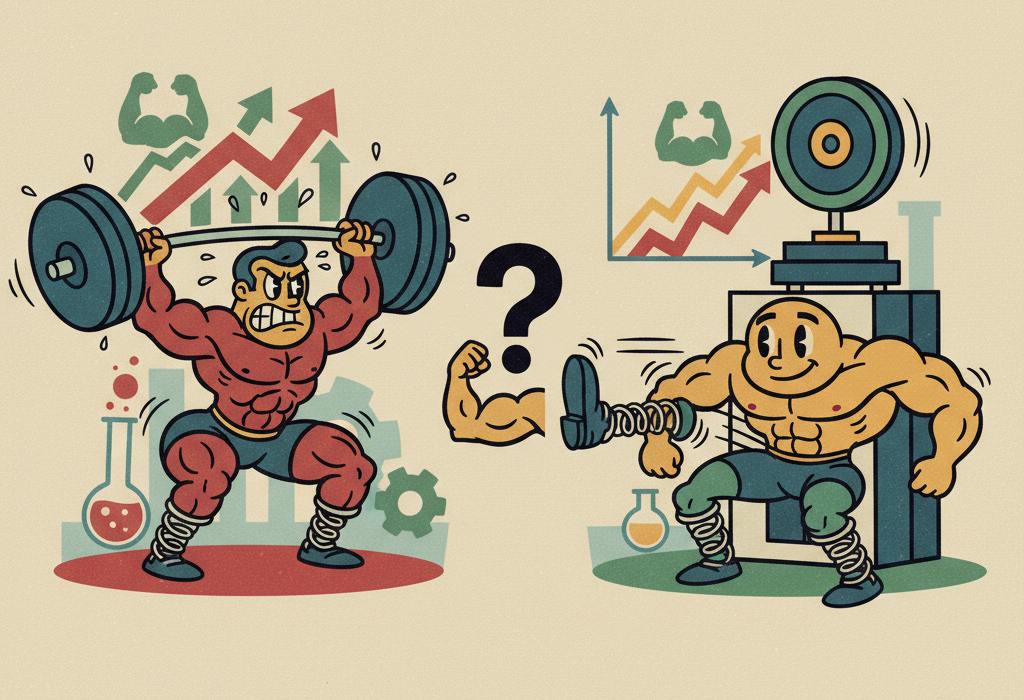
For decades, the back squat has been called the “king of leg exercises.” Walk into any gym, and you will likely hear that compound movements (exercises that use multiple joints) are superior to isolation movements (exercises that use just one joint) like the leg extension.
But is the squat actually enough to build the entire front of your thigh?
A growing body of evidence suggests the answer is no. While squats are excellent for overall mass, they leave specific parts of your quadriceps under-stimulated. Meanwhile, the machine leg extension, often dismissed as a “finisher”, might be essential for complete growth.
Here is what the latest science says about how these two exercises affect your muscles differently.
Which Exercise Builds More Muscle?
To understand the difference, we first need to look at the anatomy of the quadriceps. As the name suggests, this muscle group is made of four “heads.” Three of them (the vastus muscles) only cross the knee joint. The fourth, the Rectus Femoris (REK-tus FEM-or-is), crosses both the knee and the hip.
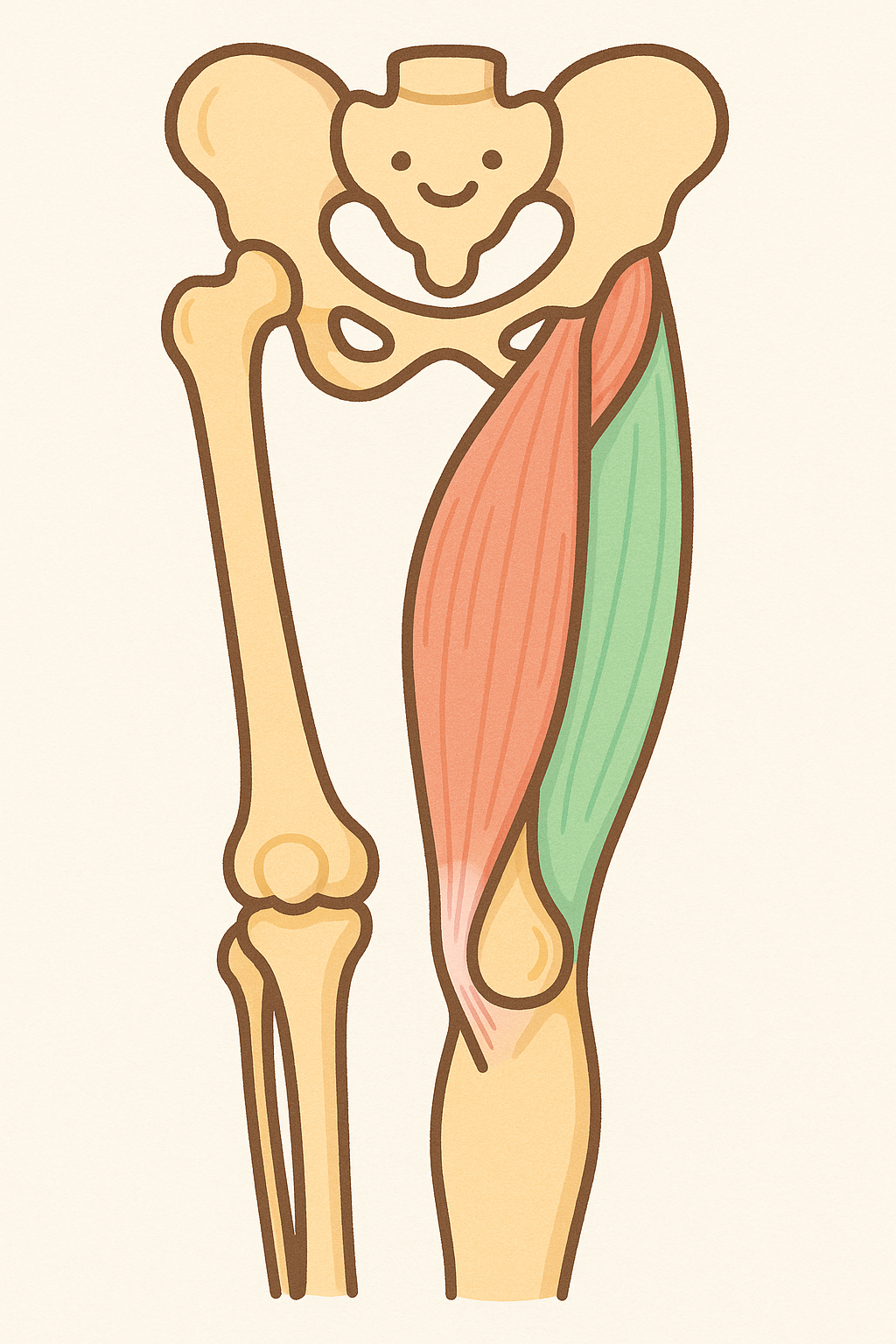
This anatomy matters because different exercises challenge these heads differently.
A 2025 study in the Journal of Strength and Conditioning Research directly compared the Smith machine back squat against the leg extension in 63 untrained women over eight weeks. The researchers measured muscle growth at different spots along the thigh.
The Findings
- The Leg Extension Won for the “Middle” Quad: The Rectus Femoris grew significantly more in the leg extension group compared to the squat group. At the distal (lower) thigh, it grew 17.5% vs. 7.9%. At the proximal (upper) thigh, it grew 11.4% vs. 2.0%.
- The Squat Won for the “Outer” Quad: The squat was superior for growing the Vastus Lateralis (the “sweep” on the outside of the leg), particularly at the lower part of the thigh.
- Strength Gains: Unsurprisingly, people who squatted got much stronger at squats. However, both groups saw similar improvements in leg extension strength.
Comparison of Muscle Growth
| Muscle Part | Best Exercise | Why? |
|---|---|---|
| Rectus Femoris (Middle Thigh) | Leg Extension | This muscle is mechanically disadvantaged during squats but fully active during extensions. |
| Vastus Lateralis (Outer Thigh) | Back Squat | The squat places high tension on the “single-joint” quads, especially in the stretched position. |
Why Squats Miss the “Middle” Muscle
It seems confusing that a heavy squat wouldn’t grow the entire leg. The reason lies in a concept called bi-articular (bi-are-TIK-yoo-ler) mechanics.
The Rectus Femoris attaches to your hip and your knee. During a squat:
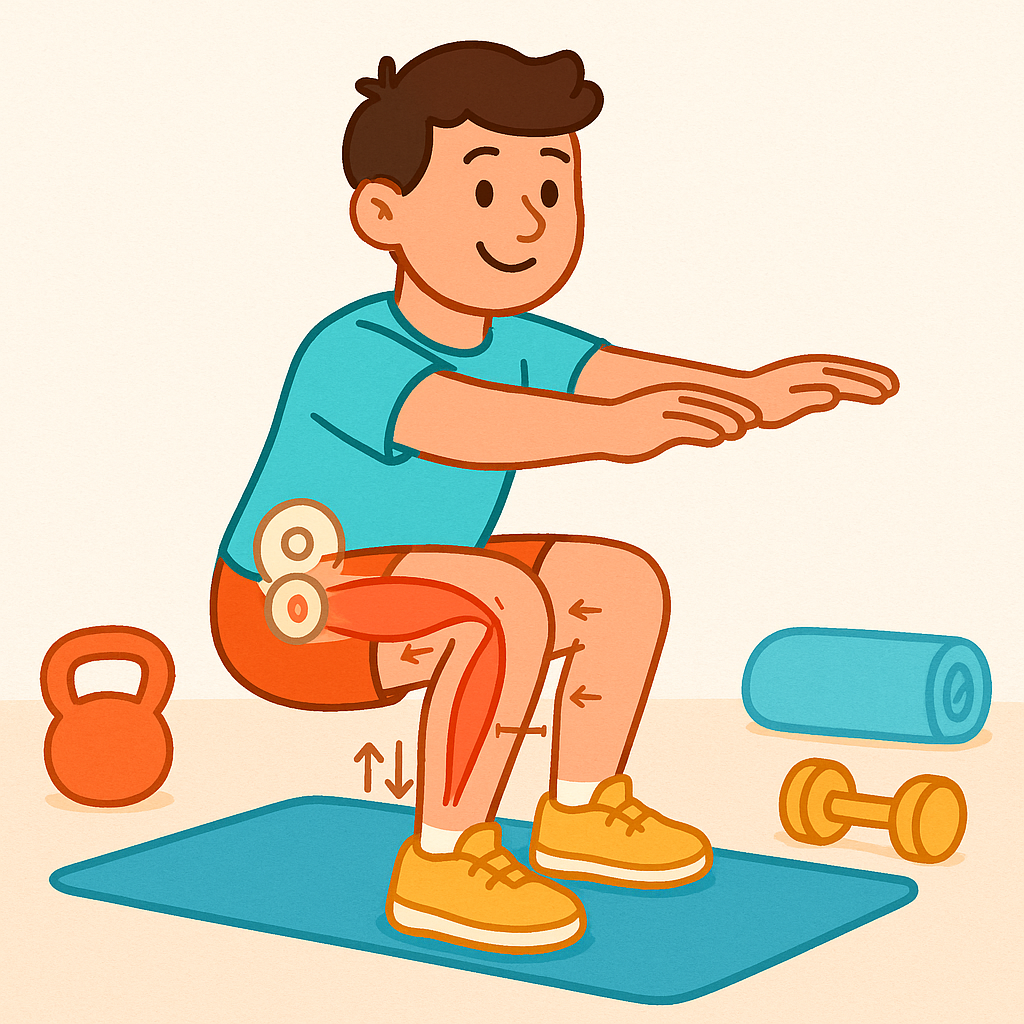
1. At the hip: You are bending forward, which shortens the muscle at the top.
2. At the knee: You are bending the knee, which stretches the muscle at the bottom.
Because the muscle is being shortened at one end while lengthened at the other, its overall length doesn’t change much during the movement. It acts more like a stabilizer than a prime mover.
In a leg extension, your hips are fixed in a seated position. As you kick your leg out, the Rectus Femoris is forced to contract hard to straighten the knee, receiving a much stronger stimulus for growth.
Related: How to Build Bigger Quads: What Science Actually Says
How to Keep Growing: Weight vs. Reps
Once you have selected your exercises (ideally both squats and extensions), the next question is how to progress. Do you need to constantly add heavy weight, or can you just do more repetitions?
A 2022 study in PeerJ explored this by taking 43 resistance-trained participants and splitting them into two groups for an 8-week lower-body program. One group kept the repetitions the same and tried to add weight (load). The other group kept the weight the same and tried to add repetitions.
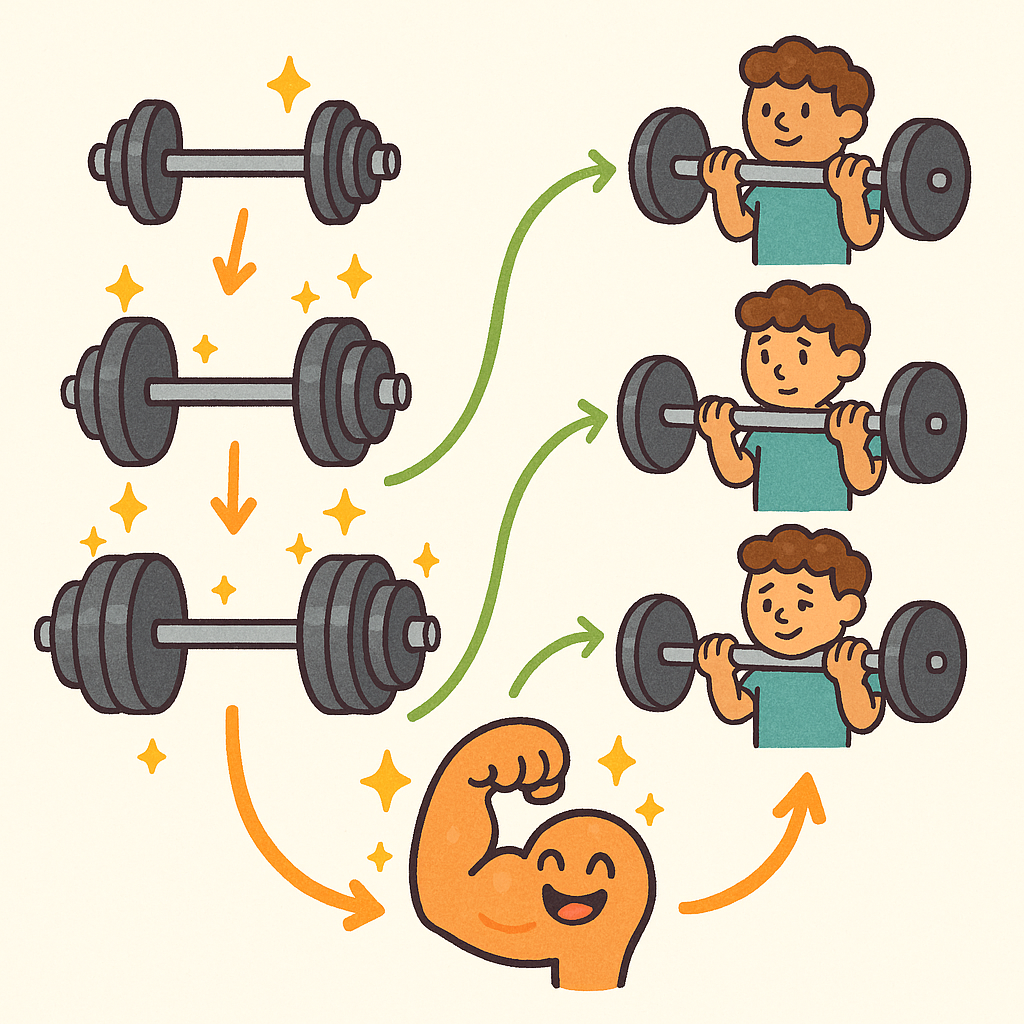
The results showed that both methods work.
- Muscle Growth: Both groups achieved similar levels of hypertrophy.
- Strength: The group that added weight gained slightly more dynamic strength (1-rep max), but the difference was small.
This is good news for your joints. If you hit a plateau where you cannot safely add more weight to the bar, you can simply try to do one or two more reps with the same weight. As long as you are training close to failure (the point where you cannot complete another rep with good form), your muscles will get the signal to grow.
Why Your Results Might Vary
You might follow the perfect program, squats for the sweep, extensions for the middle quad, progressive overload, and still see slower results than your gym partner.
According to a 2016 study in the American Journal of Physiology, your biology at the cellular level plays a major role. Researchers looked at older adults undergoing resistance training and identified “extreme responders” (people who grew a lot) versus “non-responders” (people who didn’t grow much).
The key difference was Ribosome biogenesis (RY-bo-sohm by-oh-JEN-uh-sis).
Ribosomes are the cellular machines that build proteins. The study found that the “extreme responders” were able to rapidly build more ribosomes, allowing their muscles to synthesize new protein faster. While you cannot change your genetics, this highlights why consistency matters more than comparing yourself to others. Even if you are a “low responder,” training effectively is the only way to maximize the potential you have.
The Bottom Line
The debate between squats and leg extensions creates a false choice. The research suggests they are complementary tools, not competitors.
- Squats are superior for the Vastus Lateralis (outer quad) and overall lower body strength.
- Leg Extensions are superior for the Rectus Femoris (middle quad), which squats largely neglect.
Progression can come from adding weight or* adding repetitions; both drive growth effectively.
For complete leg development, a well-rounded program should include a heavy squatting movement (like a back squat, front squat, or leg press) to build the outer sweep and general mass, followed by a knee-extension movement to target the middle thigh.
Quick Reference: Key Studies
| Study Focus | Key Finding | Source |
|---|---|---|
| Squat vs. Leg Extension | Leg extensions grew the Rectus Femoris more; Squats grew the Vastus Lateralis more. | PMID 41379528 |
| Progression Methods | Increasing reps is as effective for muscle growth as increasing weight (load). | PMID 36199287 |
| Biology of Growth | “High responders” to training naturally produce more ribosomes, aiding protein synthesis. | PMID 26860985 |
Last updated: February 2026
This article synthesizes findings from peer-reviewed research. It is for educational purposes only and does not constitute medical advice. Consult a healthcare provider before starting any new regimen.


Leave a Reply