Your Nose as a Security System
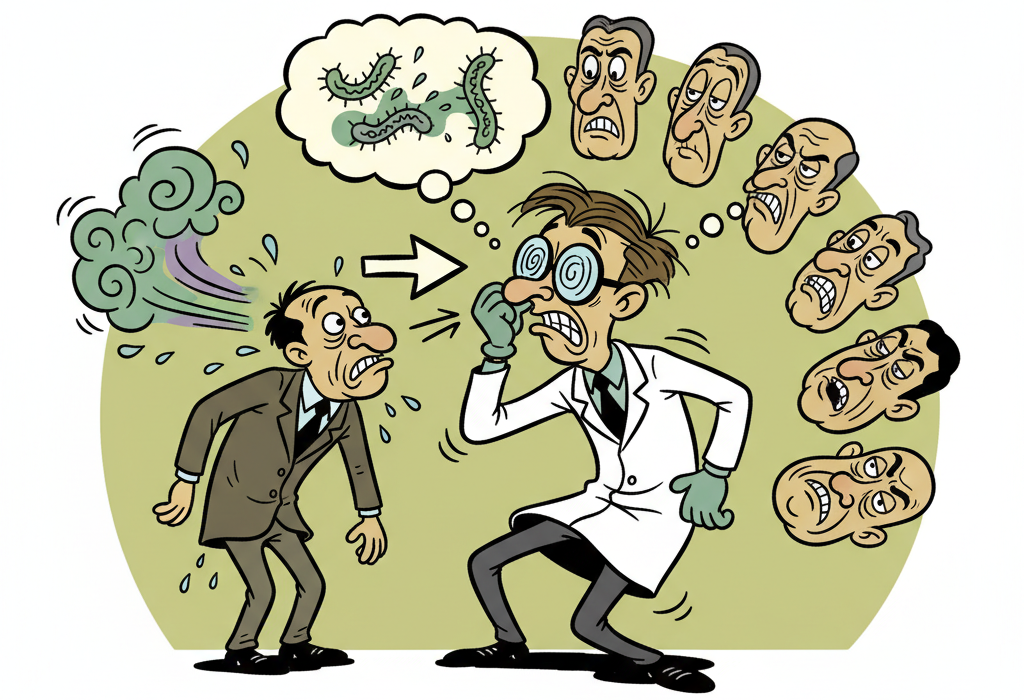
Imagine your body has a built-in alarm system. Not a smoke detector or a burglar alarm, but something older and more basic: a smell alarm. When you walk into a bathroom after a stranger, or sit next to someone on the bus whose deodorant gave up hours ago, that wave of “ugh” you feel is not just a random annoyance. It may be your brain running a very old program designed to keep you safe from germs.
Scientists call this internal alarm system the behavioral immune system (bee-HAY-vyur-ul ih-MYOON SIS-tum), which is a set of psychological reflexes that evolved to help us detect and avoid things that might make us sick. And one of the strongest triggers for this system? Body odors.
A 2024 study published in Frontiers in Behavioral Neuroscience took a deep look at how people react to body odors and what those reactions can tell us about health, behavior, and even how we responded to COVID-19. The researchers validated a specific tool for measuring body odor disgust and, along the way, revealed some fascinating patterns about who feels the most grossed out and why.
What the Research Shows
Measuring the “Ew” Factor
The research team, led by scientists in Italy and Sweden, focused on a questionnaire called the Body Odor Disgust Scale, or BODS (rhymes with “odds”). The BODS asks people to imagine 12 different scenarios involving common body smells: foot odor, sweat, bad breath, urine, feces, and gas. Each smell is presented in two ways:
- Internal source: You notice your own body odor (for example, “You are alone at home and notice that your feet smell strongly.”)
- External source: You notice someone else’s body odor (for example, “You are sitting next to a stranger and notice that their feet smell strongly.”)
Participants rated how disgusted each scenario made them feel on a scale of 1 (not disgusting at all) to 5 (extremely disgusting).
The researchers tested this scale across two large groups of Italian adults. Study 1 included 899 people, and Study 2 included 368 people. Both groups were designed to represent the general Italian population in terms of age and gender.
People Are More Disgusted by Other People’s Smells
One of the clearest findings was that people consistently rated other people’s body odors as more disgusting than their own. In Study 1, the average disgust score for external (stranger’s) body odors was 4.24 out of 5, compared to 3.64 out of 5 for internal (one’s own) body odors.
| Odor Source | Average Disgust Score (Study 1) |
|---|---|
| Other people’s body odors | 4.24 / 5 |
| Your own body odors | 3.64 / 5 |
| Overall | 3.94 / 5 |
This makes sense from a survival standpoint. Your own smells are familiar. A stranger’s smells are unknown, and unknown smells could signal unknown germs.
It Is About Germs, Not Just Being Nervous
An important finding from this research is that body odor disgust is specifically about pathogen avoidance, not just a general tendency to feel negative emotions. In Study 2, the researchers compared BODS scores against two other measures:
- Pathogen disgust sensitivity (measured by a well-known tool called the TDDS pathogen subscale, which asks about things like seeing mold on food)
- Fearfulness (measured by a personality questionnaire)
The BODS was strongly linked to pathogen disgust (correlation coefficient of 0.46) but had essentially zero relationship with fearfulness (correlation coefficient of -0.03). In other words, people who are very grossed out by body odors are not necessarily more anxious or fearful people in general. They are specifically tuned into germ-related threats.
| Trait Compared to BODS | Relationship Strength | What It Means |
|---|---|---|
| Pathogen disgust (TDDS) | 0.46 (moderate-strong) | BODS measures something related to germ avoidance |
| Fearfulness (HEXACO) | -0.03 (essentially zero) | BODS is not just general anxiety |
Body Odor Disgust Predicted COVID-19 Caution
The second study was conducted during the COVID-19 pandemic, which gave the researchers a real-world test. They asked participants about their pandemic-related behaviors: Did they think wearing masks was important? Did they try to keep distance from others? Did they clean their phones?
People who scored higher on the BODS also reported being more cautious about COVID-19. The relationship was modest but consistent (coefficient of 0.22). Interestingly, the general pathogen disgust measure (TDDS) predicted COVID-19 concern at a very similar level (coefficient of 0.20). The BODS did not add much prediction beyond what the TDDS already captured.
This is an honest finding. It suggests that body odor disgust is part of a broader germ-avoidance system rather than a separate, unique predictor of pandemic behavior. The researchers note that this makes sense because COVID-19 spreads through invisible airborne droplets, not through the kind of body odors the BODS measures.
Women Score Higher on Body Odor Disgust
Across Study 1, women rated body odor scenarios as more disgusting than men did, with an average score of 4.11 compared to 3.78 for men. This is a moderate difference (Cohen’s d = 0.49), meaning the groups overlap quite a bit, but the trend is consistent.
| Gender | Average BODS Score | Internal Odors | External Odors |
|---|---|---|---|
| Women | 4.11 | 3.83 | 4.38 |
| Men | 3.78 | 3.45 | 4.11 |
This gender difference has been found repeatedly in disgust research across many countries and cultures. The researchers note that similar patterns appear even in non-human primates: female Japanese macaques spend more time washing food that has been contaminated by feces compared to males.
Several evolutionary hypotheses have been proposed to explain this. One leading idea is that mothers bear a greater biological cost from infection because their health directly affects the survival of their children. Research has also found that disgust sensitivity (dis-GUST sen-sih-TIV-ih-tee), which refers to how strongly a person reacts to disgusting things, tends to increase during pregnancy. However, cultural factors could also play a role, and the researchers are careful to note that proving an evolutionary origin is difficult.
The Scale Works Across Languages
The BODS was originally created and tested in English with American participants. This study confirmed that the Italian translation works just as well. The statistical structure held up across both Italian samples, and the scale showed strong reliability (internal consistency scores above 0.90 in both studies). The scale also passed rigorous tests for measurement invariance (MEH-zhur-ment in-VAIR-ee-uns), which means it measures the same thing in the same way for both men and women. This is important because without this confirmation, any gender differences in scores might just be an artifact of the questionnaire, not a real difference in disgust levels.
Who This Matters For
People Interested in Understanding Their Own Reactions
If you have ever wondered why a coworker’s lunch smells nauseating to you while others barely notice, this research offers a partial explanation. Your level of body odor disgust is a real, measurable individual trait. It is not a sign of being overly sensitive or rude. It reflects how strongly your behavioral immune system responds to potential germ signals.
Researchers and Clinicians
For scientists studying disgust sensitivity, this validated Italian version of the BODS opens the door to cross-cultural research. The scale has already been tested in nine countries (Italy, Sweden, Canada, Chile, Hong Kong, Kenya, Nigeria, New Zealand, and the United Kingdom). Having a reliable tool that works across languages matters for understanding whether disgust responses are universal or shaped by culture.
For clinicians, understanding body odor disgust could be relevant in contexts like:
- Obsessive-compulsive disorder (OCD), where contamination fears are common
- Olfactory impairment, where patients who lose their sense of smell may struggle with personal hygiene and food safety
- Social anxiety, where worry about one’s own body odor can become overwhelming
A Caveat: Who Should Be Careful With This Information
It is worth noting that the BODS measures self-reported disgust in imagined scenarios. It does not measure actual germ exposure or health outcomes. Higher disgust sensitivity does not necessarily mean you are healthier or more protected from illness. And lower disgust sensitivity does not mean something is wrong with you. People vary naturally in this trait, just like they vary in height or taste preferences.
Also, previous research by these same scientists has found that body odor disgust sensitivity is linked to some less flattering tendencies, including implicit and explicit biases toward unfamiliar groups and harsher moral judgments. This is a reminder that the behavioral immune system can misfire. It sometimes flags things as threatening that are not actually dangerous, like unfamiliar people or unfamiliar foods.
How to Think About Your Own Disgust Responses
This research does not come with a specific health intervention to follow, but it does offer some useful ways to think about your everyday reactions.
Recognize Disgust as Information, Not a Command
When you feel grossed out by a smell, your brain is sending you a signal: “This might be dangerous.” That signal is often useful. The smell of spoiled food is a good reason to throw it away. But sometimes the signal is a false alarm. Being disgusted by a coworker’s lunch does not mean it is actually harmful to you.
Understand That Your Sensitivity Level Is Normal for You
Some people barely flinch at a gym locker room. Others feel nauseated on public transportation. Both responses fall within the normal range of human variation. If your disgust reactions are causing you significant distress or interfering with daily life (for example, you avoid public spaces entirely because of potential smells), it may be worth discussing with a mental health professional.
Be Aware of the “Better Safe Than Sorry” Bias
The behavioral immune system follows what researchers call error management theory (AIR-ur MAN-ij-ment THEE-uh-ree). The basic idea is that the cost of missing a real threat (getting sick) is much higher than the cost of a false alarm (feeling grossed out for no reason). So the system is calibrated to over-react rather than under-react. This is why:
- You may feel disgusted by food you ate before getting sick, even if the food had nothing to do with the illness
- Disgust reactions to smells are harder to “unlearn” than fear reactions to visual stimuli
- You might feel a stronger “ew” response to a stranger’s smell than is warranted by the actual germ risk
Knowing this can help you pause and evaluate whether your disgust reaction is proportional to the actual situation.
What We Know and What We Don’t
What we know:
- Body odor disgust is a measurable, reliable individual trait that can be assessed using the BODS questionnaire
- It is specifically linked to pathogen (germ) avoidance, not general fearfulness or anxiety
- Women tend to report higher body odor disgust than men, a pattern found across cultures
- People are more disgusted by other people’s body odors than by their own
- Higher body odor disgust is associated with greater concern about infectious disease (as shown during COVID-19)
- The BODS works reliably in both English and Italian, and preliminary evidence supports it in seven additional countries
What we don’t know:
- Whether higher body odor disgust actually protects people from getting sick (this study measured attitudes, not health outcomes)
- Whether the gender difference in disgust is primarily biological, cultural, or some combination
- How body odor disgust sensitivity changes over the lifespan or in response to life events like pregnancy or illness
- Whether the BODS adds unique predictive value beyond other disgust measures for specific health behaviors
- How this trait interacts with actual olfactory ability (some people may report high disgust sensitivity but have a weak sense of smell, or vice versa)
Important limitations of this research:
- Both studies relied on self-reported responses to imagined scenarios, not real odor exposure
- The samples, while fairly representative by age and gender, had more highly educated participants than the general Italian population
- Data were collected online, so the researchers could not verify participants’ identities or ensure they were paying full attention (though attention checks helped)
- Study 2 had to remove two items from the scale due to statistical issues with a small sample, which limits direct comparison with Study 1
- The COVID-19 concern measure was created for this study and has not been independently validated
Quick Reference: Key Studies
| Study Focus | Key Finding | Source |
|---|---|---|
| Italian validation of the Body Odor Disgust Scale (BODS) across two samples (N = 899 and N = 368) | The BODS showed good structural validity, construct validity, and reliability in Italian; women scored higher than men; BODS predicted COVID-19 avoidance behavior | PMID 38974836 |
Last updated: June 2025
This article synthesizes findings from peer-reviewed research. It is for educational purposes only and does not constitute medical advice. Consult a healthcare provider before starting any new regimen.
Leave a Reply