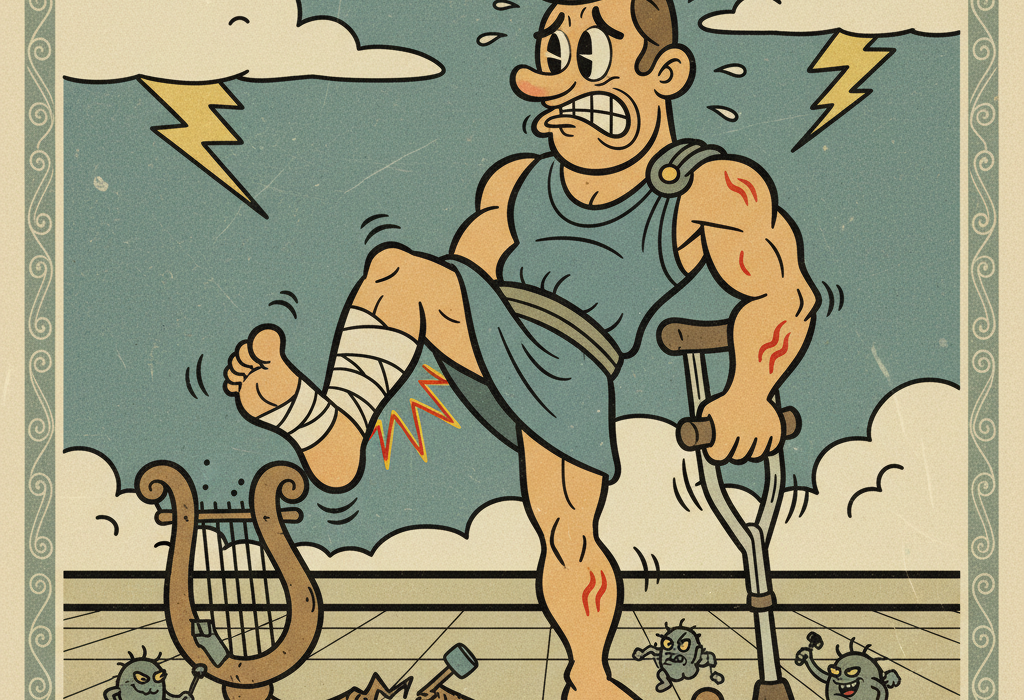
Picture a basketball player pushing off the floor for a rebound, or a runner launching into a sudden sprint. Suddenly, they feel a sharp snap at the back of their ankle. They might even turn around, thinking someone kicked them. This is the classic hallmark of an Achilles tendon injury.
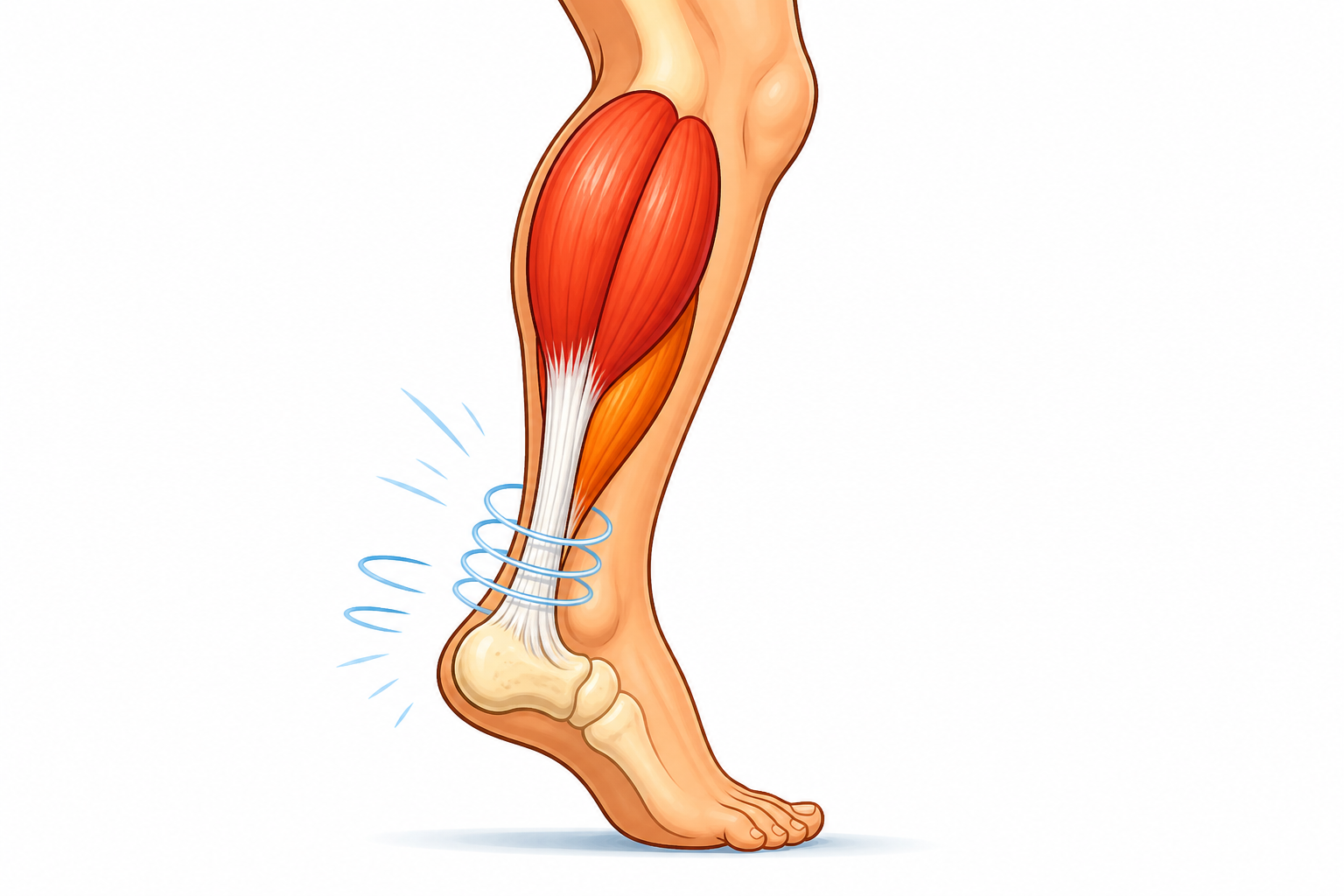
The Achilles tendon is the thickest and strongest tendon in the human body. It connects your calf muscles to your heel bone and acts like a massive biological spring. It is capable of handling immense physical stress, but it is also highly vulnerable to both gradual wear-and-tear and sudden ruptures.
For decades, the standard medical advice for a torn Achilles was strict rest. Doctors would place the injured leg in a cast for up to eight weeks, keeping all weight off the foot. However, modern science has shifted this approach. Today, research shows that controlled, early movement is often the best medicine for tendon recovery, and in many cases, surgery is no longer the only option.
This article breaks down the latest peer-reviewed research on how Achilles injuries happen, why they are so common, and what science actually says about the best ways to recover.
How the Achilles Tendon Works
To understand why the Achilles tendon gets injured, it helps to understand its anatomy and Biomechanics (bye-oh-meh-KAN-iks), which is the study of how the structures of the body move and handle physical forces.
A 2020 review in Annals of Anatomy explains that the Achilles tendon is essentially a thick band of collagen fibers. During a run, this tendon absorbs and releases energy with every step. The research notes that during a sprint, the Achilles tendon can endure loads equal to 12.5 times your body weight.
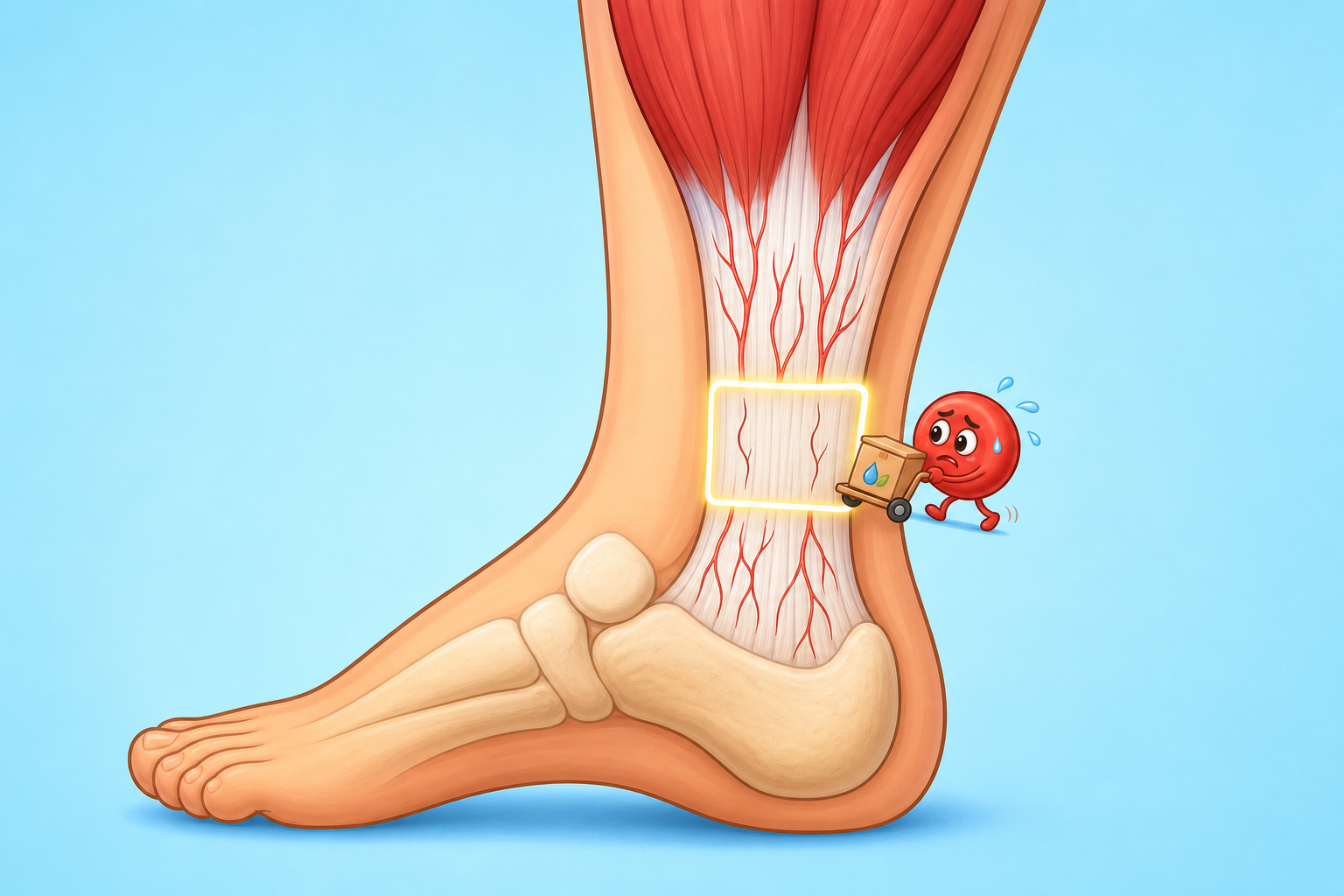
Despite its strength, the Achilles has a structural weak point. About 2 to 6 centimeters above where the tendon attaches to the heel bone, there is a region known as the “watershed area.” This specific zone has a naturally poor blood supply. Because blood delivers the oxygen and nutrients required for cellular repair, injuries in this watershed area heal very slowly. Consequently, this is the exact spot where most tendon ruptures occur.
The Two Main Types of Achilles Injuries
Achilles injuries generally fall into two categories: chronic overuse and acute ruptures.
Achilles Tendinopathy (Overuse)
Tendinopathy (ten-dih-NOP-uh-thee) refers to the gradual breakdown of tendon collagen from overuse.
Many people refer to this as “tendinitis,” assuming the pain is caused by inflammation. However, a 2002 review in Manual Therapy clarified that Achilles tendinopathy is a non-inflammatory condition. Instead of being inflamed, the tendon tissue actually degenerates. The collagen fibers become disorganized, and the tendon fails to heal properly between workouts.
Related: How Endurance Training Actually Changes Your Body and Brain
Achilles Tendon Rupture (Acute Tear)
A rupture is a partial or complete tear of the tendon. While it can happen to anyone, it is most common in sports that require sudden acceleration, jumping, or quick changes in direction.
A 2020 study in International Orthopaedics tracked Achilles injuries among NCAA collegiate athletes over a ten-year period. The researchers found that Achilles injuries were most frequent in women’s gymnastics, men’s basketball, and men’s soccer. In this athletic population, a severe Achilles injury resulted in a median time loss of 48 days for partial injuries, while over 70% of severe ruptures ended the athlete’s season entirely.
However, you do not have to be a collegiate athlete to tear your Achilles. The injury frequently strikes middle-aged recreational athletes, often called “weekend warriors.” As we age, our tendons naturally lose some elasticity and blood supply, making sudden, high-intensity weekend sports a common trigger for ruptures.
Surgery vs. Conservative Care: What the Research Shows
If you suffer a complete Achilles tendon rupture, the most immediate question is whether to have surgery to stitch the tendon back together, or to let it heal naturally in a brace (conservative management).
Historically, surgery was considered mandatory for active individuals because conservative treatment had a high rate of re-rupture. However, recent medical literature has challenged this assumption.
A 2017 review in Clinics in Podiatric Medicine and Surgery synthesized multiple clinical trials comparing the two approaches. The findings revealed a crucial nuance. When patients in the non-surgical group were treated with traditional, strict immobilization (a hard cast with no weight-bearing), their re-rupture rates were significantly higher than the surgical group.
However, when non-surgical patients were placed in a “functional rehabilitation” program, which involves wearing a protective boot but allowing early weight-bearing and gentle movement, the re-rupture rates dropped dramatically. With functional rehabilitation, the re-rupture rates between surgical and non-surgical patients were virtually identical.
Comparison of Treatment Approaches
| Feature | Surgical Repair | Conservative Care (with Functional Rehab) |
|---|---|---|
| Re-rupture Risk | Low | Low |
| Infection Risk | Higher (due to surgical incision) | Zero (no incision) |
| Recovery Speed | May allow slightly faster return to high-level sports | Similar daily function, slightly slower return to sports |
| Best Candidate | Professional athletes, delayed diagnoses | General population, those with high surgical risks |
Despite these findings, a 2019 review in Foot and Ankle Clinics notes that high-level athletes still largely favor surgery. Surgery allows doctors to manually restore the exact resting tension of the tendon, which some sports medicine professionals believe preserves maximum explosive strength. Even with optimal surgical repair, the data shows that professional athletes often require up to a full year to return to their pre-injury performance levels.
For complex or neglected ruptures where the tendon ends have retracted too far apart, standard surgery is not enough. A 2020 review in Clinics in Podiatric Medicine and Surgery outlines how surgeons perform revision operations using tendon transfers. Often, they will reroute the tendon that flexes the big toe to help support the damaged Achilles.
The Power of Early Movement in Rehabilitation
Whether a patient undergoes surgery or chooses conservative care, the most significant shift in Achilles recovery is the timing of physical therapy.
In the past, doctors believed that keeping the ankle completely frozen in a cast for six to eight weeks was necessary to protect the fragile healing tissue. We now know that tendons require mechanical load to heal properly.
A 2014 study in Injury evaluated different rehabilitation protocols following Achilles surgery. The researchers found that patients who were allowed to bear full weight immediately and begin early ankle mobilization recovered much faster than those who were immobilized.
When a healing tendon is subjected to gentle, controlled stress, the body receives biological signals to lay down new collagen fibers in a strong, organized pattern. A 2009 paper in Foot and Ankle Clinics confirms that early functional treatment improves the biochemical and mechanical properties of the healing tendon, reducing muscle atrophy and preventing stiff scar tissue from forming.
Related: The Science of Athletic Injury Recovery: What Actually Works
How is Overuse Tendinopathy Treated?
If you have chronic Achilles pain rather than a sudden rupture, the treatment focuses entirely on rebuilding the tendon’s capacity to handle weight.
According to a 2020 review in the Journal of Athletic Training, the cornerstone of tendinopathy treatment is progressive tendon loading. The most proven method is Eccentric contraction (eek-SEN-trik kun-TRAK-shun) exercises. An eccentric contraction occurs when a muscle lengthens while under tension. For the Achilles, this typically involves standing on the edge of a step, raising up on both toes, and then very slowly lowering the injured heel down below the level of the step.
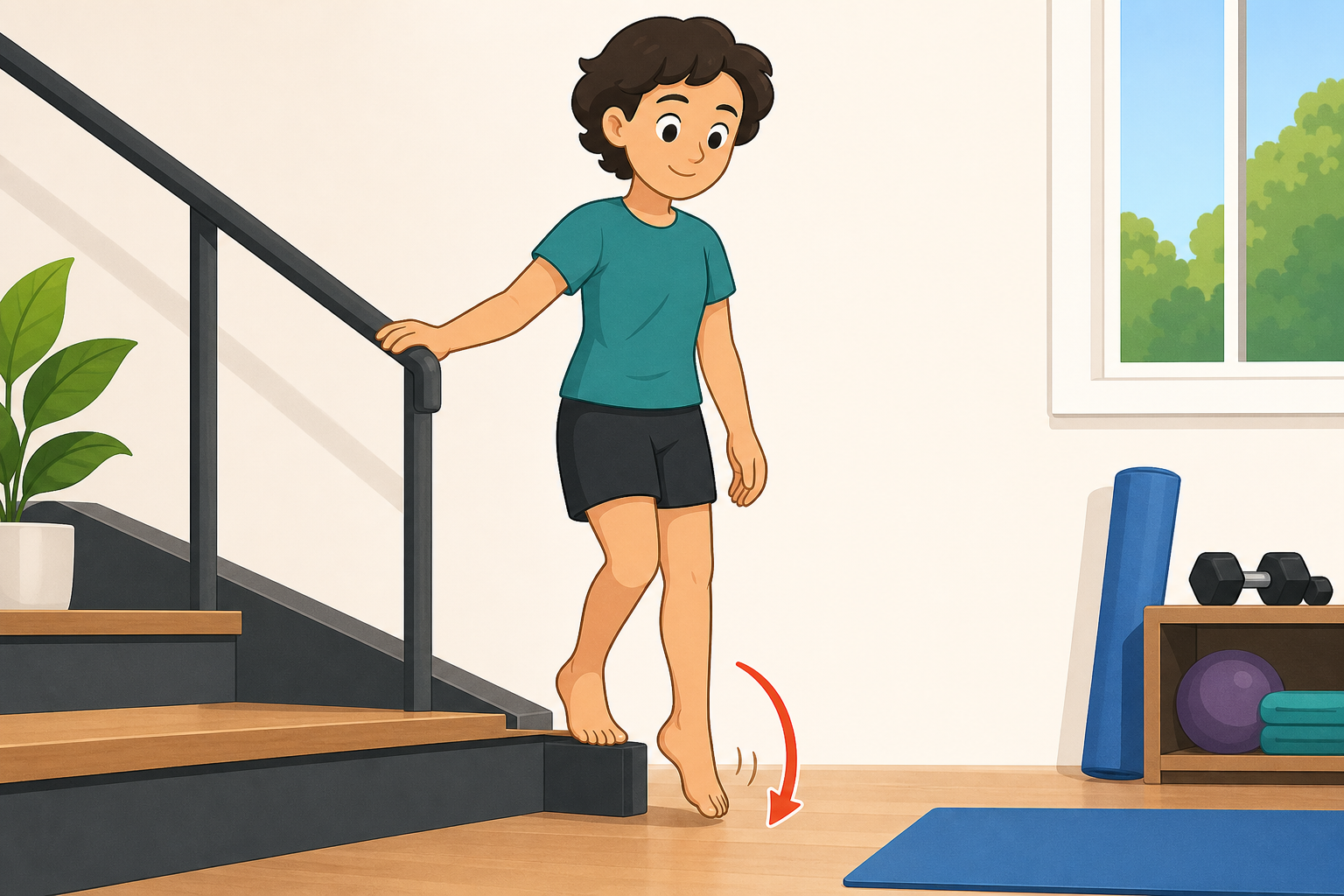
Research consistently shows that eccentric exercises stimulate the tendon cells to produce new, healthy collagen, eventually reversing the degenerative changes and eliminating the pain.
Does Stretching Prevent Achilles Injuries?
It is a common belief that stretching before a run or a basketball game will prevent an Achilles tear. However, the scientific evidence tells a different story.
A 2006 review in Foot & Ankle International examined the existing literature on pre-exercise stretching. The researchers found no definitive evidence that stretching reduces the incidence of Achilles tendon injuries.
In fact, the review highlighted biomechanical studies showing that static stretching actually decreases the maximum voluntary force a muscle can produce for up to an hour after the stretch. By increasing the compliance of the muscle and tendon, stretching might temporarily compromise the musculotendinous unit’s ability to react quickly to sudden, injury-causing forces. While maintaining general flexibility is good for overall joint health, static stretching immediately before explosive sports does not appear to protect the Achilles tendon from tearing.
Achilles Injuries in Children
Achilles injuries are overwhelmingly an adult problem, but they do occasionally happen in children. Because pediatric bodies are still growing, their injury patterns look different.
A 2023 study in the Journal of Pediatric Orthopedics reviewed pediatric Achilles injuries and found a distinct age divide. In children under 12, Achilles injuries were almost entirely caused by direct trauma, such as a deep cut from stepping on sharp glass or metal. In older adolescents (14 and up), the injuries began to mirror adult patterns, with ruptures occurring during forceful athletic movements.
A related 2022 case series in Current Sports Medicine Reports confirmed that when pediatric patients do require surgery for Achilles lacerations or ruptures, their outcomes are generally excellent, with most returning to normal sports activities within six months.
The Bottom Line
The Achilles tendon is a marvel of human engineering, but it operates under massive daily stress. When it comes to Achilles injuries, the scientific consensus has evolved significantly over the last two decades.
- For chronic pain (tendinopathy): The issue is tissue degeneration, not just inflammation. The most effective, evidence-based treatment is progressive loading, specifically using slow, eccentric exercises to rebuild tendon strength.
- For acute ruptures: Surgery is no longer the automatic default for everyone. When paired with early, controlled weight-bearing in a walking boot, conservative treatment yields re-rupture rates similar to surgery, without the risk of surgical infection.
- Movement is medicine: For both surgical and non-surgical recovery, prolonged casting is outdated. Early, controlled movement helps collagen fibers align properly and speeds up the return to daily life.
- Prevention is complex: Static stretching before exercise does not clearly prevent Achilles injuries. Maintaining overall calf strength and avoiding sudden, massive spikes in training intensity are much more reliable prevention strategies.
Quick Reference: Key Studies
| Study Focus | Key Finding | Source |
|---|---|---|
| Acute Rupture Treatment | Conservative treatment has similar re-rupture rates to surgery when early functional rehabilitation is used. | PMID 28257676 |
| Rehabilitation Protocols | Immediate full weight-bearing and early ankle movement significantly improves recovery compared to immobilization. | PMID 25059505 |
| NCAA Epidemiology | Achilles injuries occur at a rate of 2.17 per 100,000 athlete exposures, with high rates in gymnastics and basketball. | PMID 31907586 |
| Tendinopathy Management | Tendinopathy is a degenerative process, and progressive tendon loading is required for recovery. | PMID 32267723 |
| Stretching and Prevention | Pre-exercise static stretching does not clearly prevent Achilles injuries and may temporarily reduce muscle force. | PMID 17207437 |
| Pediatric Injuries | Achilles injuries are rare in kids. Under 12s usually suffer direct trauma, while older teens suffer sports ruptures. | PMID 37254036 |
Last updated: May 2026
This article synthesizes findings from peer-reviewed research. It is for educational purposes only and does not constitute medical advice. Consult a healthcare provider before starting any new regimen.

Leave a Reply