
Think of your face like a house. When the house is new, the foundation is solid, the wooden frame is strong, and the walls are smooth. Over time, the foundation might settle, the frame might bow, and the drywall might crack.

Our faces age in a similar way. We do not just get wrinkles on the surface. The underlying “foundation” of our face changes. We lose bone density in our jaw and cheeks. The fat pads that give our cheeks youthful volume begin to shrink and slide downward. At the same time, our skin produces less of the structural proteins that keep it firm.
For decades, cosmetic medicine has used dermal fillers to address this volume loss. Historically, these gels were viewed simply as physical space-takers. They were injected to push the skin up from the inside, smoothing out a wrinkle or plumping a lip.
However, recent scientific research paints a much more complex picture. Modern dermal fillers do not just sit passively in the skin. They interact with our immune system, influence our cells, and in some cases, prompt the body to grow new, natural tissue.
This article explores what peer-reviewed science actually says about how dermal fillers work, how different materials compare, and what the evidence shows regarding their safety and longevity.
How Facial Aging and Fillers Actually Work
To understand how fillers work, it helps to understand what is physically happening under the skin as we age.
In our twenties, our skin is rich in two key components:
- Hyaluronic acid (HY-uh-luh-RON-ic AS-id) – a natural sugar molecule that acts like a sponge, holding onto water to keep tissues hydrated and plump.
- Collagen (KAHL-uh-jen) – a strong, flexible protein that provides structural support to the skin.
As we age, our bodies produce less of both. Additionally, the deep fat pads in our face begin to deflate. This loss of volume causes the skin to drape loosely, creating folds around the mouth and hollows under the eyes.
Dermal fillers are injected beneath the surface of the skin to restore this lost volume. But different materials achieve this in very different ways. Broadly, science divides fillers into two main categories: replacement fillers and biostimulatory fillers.
What the Research Shows: Hyaluronic Acid Fillers
Hyaluronic acid (HA) fillers are the most common type of dermal filler worldwide. Because HA is a substance naturally found in the human body, it is generally well tolerated.
When injected, HA gel immediately adds volume. It also draws in water from surrounding tissues, which helps maintain hydration.
Longevity and Cross-Linking
Natural hyaluronic acid breaks down in the body within a matter of days. To make it last longer as a filler, scientists use a chemical process called cross-linking. This binds the HA molecules together into a sturdy mesh, making it harder for the body’s natural enzymes to break them down.
A 2023 clinical trial in the Journal of Cosmetic Dermatology compared two popular cross-linked HA fillers injected into the cheeks, jawline, and temples. The researchers found that both fillers successfully maintained restored facial volume for up to 18 months. Ultrasound imaging revealed that the fillers did not just sit in the tissue; they actually increased the density of the dermal layer over time.

The Importance of Reversibility
One of the main reasons HA fillers are so widely used is that they are reversible. If a patient is unhappy with the result, or if a rare complication occurs, a medical provider can inject an enzyme called hyaluronidase to dissolve the filler.
However, laboratory research published in 2022 shows that not all HA fillers dissolve at the same rate. Highly cross-linked fillers take significantly longer to break down than loosely cross-linked or linear HA products. In the study, a highly cross-linked HA filler required 24 hours of enzyme exposure to fully dissolve, whereas a lighter HA complex dissolved in just 3 hours. This is an important consideration for safety and complication management.
What the Research Shows: Biostimulatory Fillers
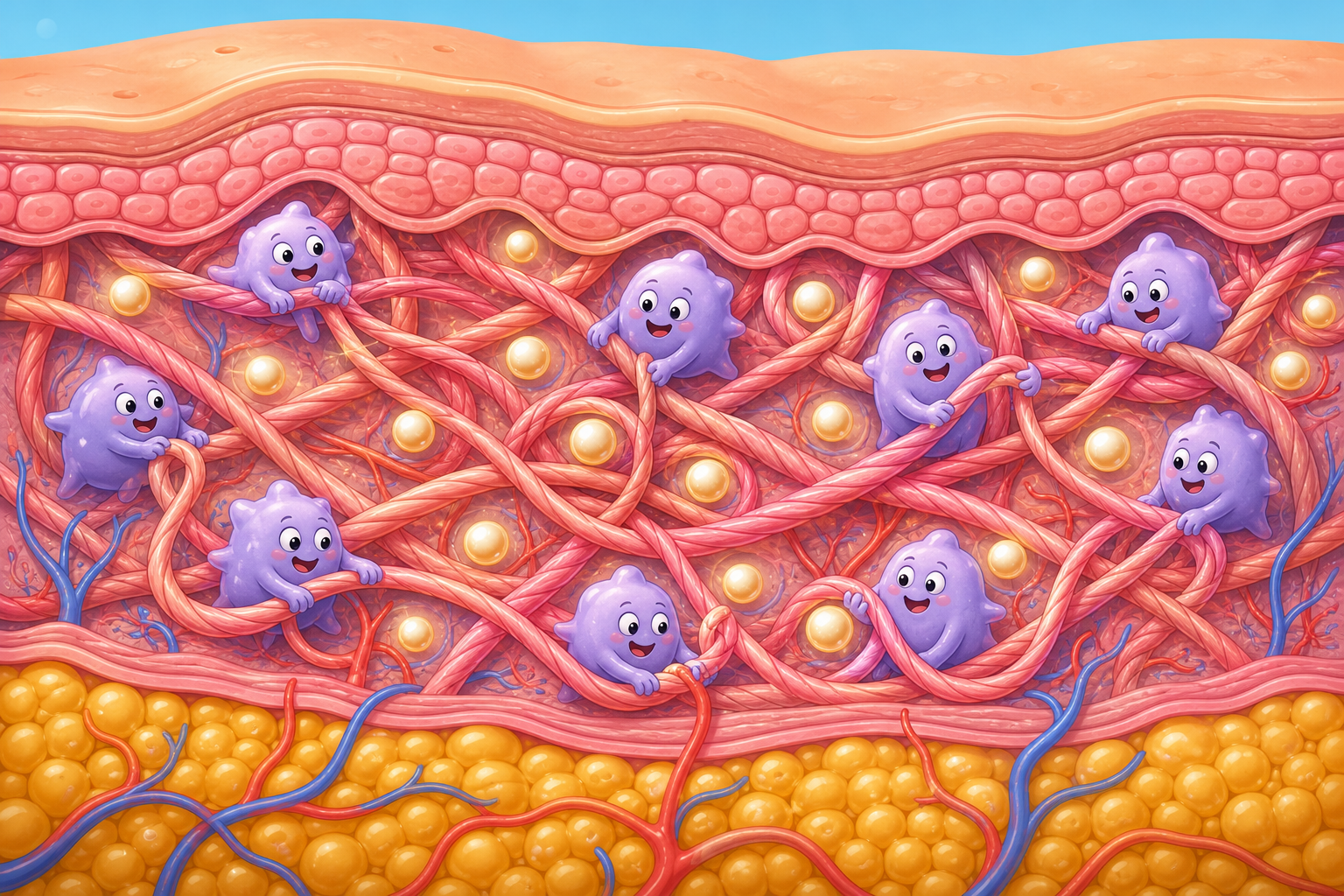
While HA fillers primarily replace lost volume, biostimulatory fillers work by irritating the body just enough to make it produce its own collagen.
These fillers are made from biocompatible synthetic materials. When injected, the immune system recognizes these particles as foreign but safe. This triggers a mild, controlled inflammatory response.
According to a 2023 review in the Journal of Cosmetic Dermatology, this specific immune response activates fibroblasts (FY-bro-blasts), which are the cells responsible for making collagen. Over several months, the body builds a new network of collagen fibers around the filler particles. Even after the filler material eventually degrades and leaves the body, the newly formed collagen remains.
Common biostimulatory materials include:
- Calcium Hydroxyapatite (CaHA): A mineral-like compound similar to what is found in human bones.
- Poly-L-lactic Acid (PLLA): A biodegradable synthetic polymer.
- Polycaprolactone (PCL): A medical-grade polymer used in dissolving stitches.
Evidence for Structural Lifting
Biostimulators are often used for deep structural support. A 2025 study in Aesthetic Plastic Surgery evaluated a specific 6-point injection technique using CaHA along the jawline and brow bone. The researchers used precise measurement tools and found statistically significant improvements in jawline contouring and eyebrow lifting that lasted through the 24-week study period.
Similarly, a 2025 clinical trial compared a PCL-based filler against a polynucleotide filler for treating crow’s feet wrinkles. The PCL filler showed a 70% improvement rate at 12 weeks, proving highly effective at smoothing dynamic wrinkles through collagen stimulation.
Beyond Wrinkles: Cellular Anti-Aging
Recent research suggests these materials might do more than just build collagen. A 2024 animal study published in Frontiers in Immunology investigated how PLLA affects skin cells. The researchers found that PLLA injections actually delayed the aging process of epidermal stem cells. It promoted cell proliferation and migration, suggesting that biostimulators may improve the biological youthfulness of the skin at a cellular level.
Emerging Technology: Hybrid Fillers
Scientists are currently trying to combine the best features of both filler types: the immediate, hydrating volume of HA, and the long-term, collagen-building power of biostimulators.
A 2025 study in Acta Pharmaceutica Sinica B detailed the development of a new hybrid hydrogel combining hyaluronic acid with silk fibroin (a natural protein from silkworm cocoons). In animal models of sun-damaged skin, this combined gel provided immediate physical support while actively stimulating the regeneration of Type III collagen. Type III collagen is often called “youth collagen” because it provides skin with its smooth, elastic qualities.
While still in the testing phases, these hybrid materials represent the future of injectable Anti-Aging Skincare and Procedures: What Science Actually Shows.
Who Benefits Most: The Case of Tooth Loss
Most people associate fillers with cosmetic anti-aging, but they also have profound reconstructive benefits.
When people lose their teeth (a condition called edentulism), the jawbone no longer receives the physical stimulation of chewing. As a result, the bone begins to shrink and resorb into the body. This causes the lower third of the face to collapse inward, leading to deep folds around the mouth and a severe loss of lip support.
Dentures and dental implants can replace the teeth, but they cannot always replace the lost bone and soft tissue volume. A 2022 review in the Journal of Clinical Medicine highlights how HA fillers are increasingly used alongside dental prosthetics. By injecting HA into the lips, nasolabial folds, and chin, practitioners can restore the soft tissue support that was lost to bone resorption, vastly improving both the aesthetic and functional outcomes for patients with severe tooth loss.
Where the Science Urges Caution: Risks and Complications
While dermal fillers are generally considered safe when administered by trained medical professionals, they are not without risks. Because the face has a highly complex network of blood vessels, injecting any gel-like substance carries a risk of vascular complications.
Vascular Occlusion
The most severe risk is vascular occlusion. This happens if a needle inadvertently enters a blood vessel and injects filler directly into the bloodstream, blocking blood flow to the surrounding tissue. Without blood flow, the skin tissue can die (necrosis).
In rare cases, this blockage can cause unusual side effects. A 2025 review in Clinical, Cosmetic and Investigational Dermatology analyzed multiple cases where patients experienced localized hair loss (alopecia) after receiving HA filler injections in their temples or forehead. The filler either compressed the blood vessels from the outside or blocked them from the inside, cutting off the blood supply to the hair follicles. Fortunately, when caught early and treated with the dissolving enzyme hyaluronidase, blood flow was restored and the hair eventually regrew.
Chronic Inflammation and Nodules
Because biostimulatory fillers work by triggering an immune response, there is a small risk that the immune system overreacts. A 2025 comprehensive review in Cureus notes that while biostimulators like CaHA and PLLA offer longer-lasting results, they carry a slightly higher risk of forming nodules or granulomas (small, hard lumps under the skin). Unlike HA fillers, biostimulators cannot be easily dissolved with an enzyme, making these complications harder to treat.
Comparing Common Dermal Fillers
| Filler Type | Primary Mechanism | Average Longevity | Reversible? | Best Used For |
|---|---|---|---|---|
| Hyaluronic Acid (HA) | Binds water, physically replaces volume | 6 to 18 months | Yes (via enzyme) | Lips, under eyes, general volume, hydration |
| Calcium Hydroxyapatite (CaHA) | Stimulates collagen production | 12 to 24 months | No | Jawline, deep folds, cheek structure |
| Poly-L-lactic Acid (PLLA) | Stimulates collagen production | 24+ months | No | Gradual full-face volume restoration |
| Polycaprolactone (PCL) | Stimulates collagen production | 12 to 24+ months | No | Deep wrinkles, structural contouring |
Common Questions About Dermal Fillers
Do fillers stretch out the skin and make it sag worse over time?
No. Research shows that both HA and biostimulatory fillers actually increase the density of the dermal layer and stimulate collagen production. When the filler eventually degrades, the skin is generally in a healthier structural state than it was before the injection.
Can taking hyaluronic acid pills do the same thing as injections?
While oral HA supplements have benefits, they work differently. A 2025 meta-analysis in the Journal of Drugs in Dermatology found that taking HA pills significantly improved overall skin hydration and elasticity. However, oral supplements cannot provide the targeted, structural volume replacement that injectable fillers provide.
The Bottom Line
Dermal fillers have evolved from simple space-filling gels into complex biological tools.
- What we know: Hyaluronic acid fillers are highly effective for immediate, reversible volume replacement. Biostimulatory fillers (like CaHA and PLLA) provide longer-lasting results by prompting the body to generate its own natural collagen.
- What remains uncertain: Scientists are still studying exactly how different filler materials interact with our immune system long-term, and are actively working on hybrid materials that combine the safety of HA with the longevity of biostimulators.
- Safety: While generally safe, fillers carry a real risk of vascular occlusion. Choosing a highly trained medical provider who understands facial anatomy is the most important factor in preventing serious complications.
Quick Reference: Key Studies
| Study Focus | Key Finding | Source |
|---|---|---|
| HA Filler Longevity | Two popular HA fillers successfully maintained facial volume for up to 18 months without touch-ups. | PMID 35770300 |
| Biostimulators (CaHA) | A 6-point injection technique using CaHA significantly improved jawline contour and eyebrow lifting in Asian patients. | PMID 40610809 |
| Cellular Anti-Aging | PLLA microspheres were shown to delay the aging process of epidermal stem cells in animal models. | PMID 38881903 |
| Filler Complications | Vascular occlusion from HA fillers in the temple or forehead can cause localized hair loss, requiring rapid enzyme treatment. | PMID 40584392 |
| Reversibility | Highly cross-linked HA fillers take significantly longer (up to 24 hours) to dissolve with enzymes compared to lighter HA formulations. | PMID 36523543 |
| Reconstructive Use | HA injections are a highly beneficial therapy for restoring peri-oral volume and lip support in patients with severe tooth loss. | PMID 36233741 |
Last updated: June 2026
This article synthesizes findings from peer-reviewed research. It is for educational purposes only and does not constitute medical advice. Consult a healthcare provider before starting any new regimen.



Leave a Reply