Why Your Body’s Growth Signals Matter More Than You Think
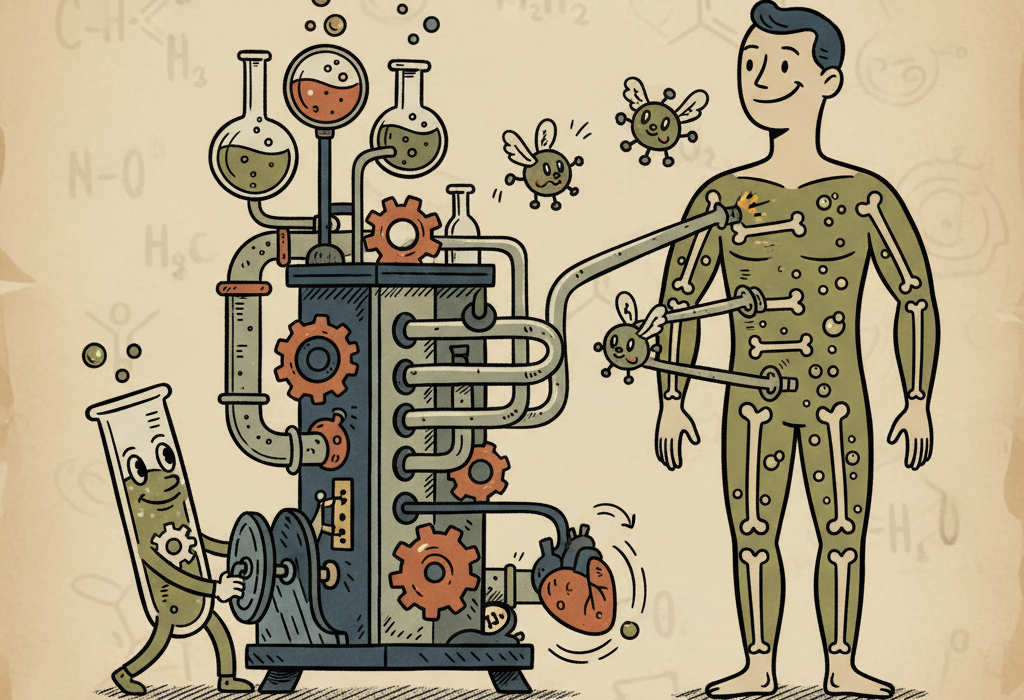
Imagine your body has a built-in postal system. Hormones are the letters, and receptors are the mailboxes. When the right letter lands in the right mailbox, things happen: you grow, you get hungry, your brain cells stay healthy, and your immune system stays in check.
One of the most important “letters” in this system is a hormone called ghrelin (GRELL-in), sometimes called the “hunger hormone.” Ghrelin does a lot more than make your stomach growl before lunch. It talks to a special mailbox called the growth hormone secretagogue receptor, or GHS-R (G-H-S receptor), which lives on cells throughout your body, from your brain to your immune system.
A secretagogue (seh-KREE-tuh-gog) is simply any substance that causes another substance to be released. In this case, growth hormone secretagogues are things that tell your body to release growth hormone (GH), the hormone responsible for helping kids grow taller and helping adults maintain muscle, bone density, and metabolism.
Recent research has looked at this system from three very different angles: how daily growth hormone injections affect children and families, how the ghrelin system may play a role in Alzheimer’s disease, and how ghrelin receptors on immune cells influence inflammation. Together, these studies paint a broader picture of why growth hormone signaling matters across the entire lifespan.
What the Research Shows
The Burden of Daily Growth Hormone Injections in Children
When a child’s body does not make enough growth hormone on its own, the condition is called growth hormone deficiency (GHD). It affects roughly 2 to 3 out of every 10,000 children. The standard treatment is daily injections of synthetic growth hormone, typically given every night until the child reaches adult height.
A 2024 study in the European Journal of Pediatrics explored what this treatment actually feels like for children and their families. Researchers conducted focus groups and phone interviews with 39 children (ages 8 to 12) and 31 parents across Germany, the UK, and the USA. In total, they gathered 73 detailed descriptions of what life with GHD treatment is like.
The findings broke down into three main areas of burden for children:
Physical burden. About 41% of descriptions mentioned injection pain. Bruising at the injection site was reported 21% of the time, and burning or stinging was noted in 19% of cases.
Emotional burden. Fear of injections was reported in 37% of descriptions. Worry (30%), embarrassment (19%), unhappiness about the frequency of shots (18%), and feeling different from other kids (15%) were also common.
Interference with daily life. More than half (56%) of respondents said treatment interfered with sleepovers or travel. About 40% said overnight activities led to missed or delayed doses.
Parents had their own burdens too. Sixty-two percent of parents reported worry, and 38% specifically worried about causing pain to their child. One parent said: “Every day I would make my kid hurt. You do everything you can in your whole life to make your kids not hurt. That’s the tough part.”
However, the picture was not entirely negative. About 44% of descriptions said the child was not particularly bothered by injections, and 32% said the child actively wanted treatment because they could see themselves growing. Over time, many families adapted, with 34% reporting that treatment became routine.
| Treatment Burden Area | % Reporting (Children + Parents) |
|---|---|
| Injection pain | 41% |
| Fear of injections | 37% |
| General dislike of treatment | 34% |
| Worry | 30% |
| Interference with sleepovers/travel | 56% |
| Missed/deferred doses due to travel | 40% |
| Child not bothered by injections | 44% |
| Child wants/likes treatment | 32% |
This study matters because it highlights a real problem: the treatment itself creates a significant burden that can reduce adherence. If a child skips injections because of fear or inconvenience, the treatment does not work as well. This is one reason researchers are working on long-acting growth hormone formulations and non-injection delivery methods.
Ghrelin and the Brain: A Possible Link to Alzheimer’s Disease
Ghrelin is best known for making you feel hungry, but it also has effects in the brain. It signals through the GHS-R (growth hormone secretagogue receptor), which is found in brain regions involved in memory, learning, and mood.
A 2023 review in Current Opinion in Neurobiology examined the growing body of evidence connecting the ghrelin system to Alzheimer’s disease (AL-tshy-merz), the most common form of dementia in older adults.
Here is the basic idea. For ghrelin to work, it first needs to be “activated” by an enzyme called GOAT (ghrelin O-acyltransferase, pronounced “goat”). Once activated, ghrelin binds to GHS-R receptors in the brain, triggering a cascade of protective effects. These include:
- Supporting the survival of brain cells
- Reducing harmful inflammation in the brain
- Helping with synaptic plasticity (sih-NAP-tik plas-TIS-ih-tee), which is the brain’s ability to form and strengthen connections between nerve cells (this is the foundation of learning and memory)
The review noted that in Alzheimer’s disease, this ghrelin signaling system appears to go wrong. The receptor (GHS-R) may not function properly, the ghrelin itself may not be adequately activated, or the downstream signals may be disrupted. When this happens, the brain loses some of its natural protective mechanisms.
The researchers discussed the therapeutic potential of targeting ghrelin signaling as a treatment strategy for Alzheimer’s. This could involve developing drugs that mimic ghrelin’s effects on the brain or that help restore normal GHS-R function. However, this work is still in early stages, and no ghrelin-based Alzheimer’s treatment has been approved for use in humans.
It is important to note that this was a review paper, meaning the authors summarized existing studies rather than conducting new experiments. The connection between ghrelin dysfunction and Alzheimer’s is an association observed across multiple studies, not a proven cause-and-effect relationship.
Ghrelin Receptors on Immune Cells: Controlling Inflammation
The third piece of this puzzle involves the immune system. Your immune cells are the body’s defense force, but when they stay activated for too long, they can cause chronic, low-grade inflammation. This type of lingering inflammation is sometimes called meta-inflammation (MET-uh-in-fluh-MAY-shun), and it is closely linked to obesity, type 2 diabetes, and other metabolic diseases.
A 2022 review in Experimental Biology and Medicine gathered the latest findings on how the ghrelin receptor (GHS-R) works on different types of immune cells.
The key takeaway: GHS-R is expressed on many types of immune cells, and when ghrelin binds to these receptors, it generally has an anti-inflammatory effect. In simpler terms, ghrelin appears to act like a “calm down” signal for the immune system.
This matters because metabolic diseases often come with both hormonal imbalances and chronic inflammation. If ghrelin can help reduce inflammation through direct action on immune cells, it opens the door to potential treatments that address both metabolism and immunity at the same time.
However, the researchers were clear that much remains unknown. The exact molecular pathways are still being mapped out, and the evidence so far comes mainly from lab studies and animal models, not large human trials.
How These Three Angles Connect
At first glance, childhood growth hormone shots, Alzheimer’s disease, and immune cell inflammation might seem unrelated. But they all revolve around the same core system: growth hormone secretagogue signaling.
| Aspect | Children with GHD | Alzheimer’s Disease | Immune/Metabolic Health |
|---|---|---|---|
| Key problem | Not enough growth hormone | Disrupted ghrelin signaling in the brain | Chronic low-grade inflammation |
| Role of GHS-R | Target for GH-releasing therapies | Protective receptor that may malfunction | Anti-inflammatory receptor on immune cells |
| Current treatment | Daily GH injections | No ghrelin-based treatment approved | No ghrelin-based treatment approved |
| Stage of research | Established treatment, improving delivery | Early-stage, mostly animal and review data | Early-stage, mostly lab and animal data |
Who This Information Is Most Relevant For
Families of children with growth hormone deficiency
The treatment burden research is directly relevant if your child receives daily GH injections. Understanding that the emotional and logistical challenges are common and well-documented can help families feel less alone. It can also encourage conversations with your child’s doctor about strategies to reduce burden.
Older adults and caregivers concerned about cognitive decline
The ghrelin-Alzheimer’s connection is still being studied. There is no action to take based on this research alone, but it is worth knowing that scientists are exploring new angles beyond the traditional amyloid-focused approaches to Alzheimer’s.
People with metabolic conditions
If you have obesity, type 2 diabetes, or related conditions, the finding that ghrelin receptors influence immune cell behavior may eventually lead to new therapies. For now, this is basic science that has not yet translated into treatments.
Who should be careful
Anyone considering growth hormone secretagogue supplements marketed online should exercise caution. The research discussed here involves either established medical treatments under doctor supervision or early-stage science. Over-the-counter “GH secretagogue” supplements are not the same as the compounds studied in these papers, and their safety and effectiveness are generally not well established.
How to Use This Information
If your child is on growth hormone therapy
- Talk about the hard parts. The research shows that many children experience fear, worry, and embarrassment. Open conversations can help normalize these feelings.
- Create a routine. About a third of families found that treatment became easier once it was built into a consistent daily schedule.
- Plan ahead for travel. Since sleepovers and trips are the number one source of missed doses, having a travel plan (cooler bag, pre-filled pens, talking to the host family) can help.
- Ask about new options. Long-acting growth hormone formulations that require less frequent injections are in development or recently approved in some countries. Ask your endocrinologist if these might be appropriate.
- Track progress together. Children who could see that they were growing tended to accept treatment more readily. Marking height on a wall chart or reviewing growth curves together can help.
If you are interested in brain health
- Maintain a healthy lifestyle. While we cannot yet target ghrelin signaling with drugs for Alzheimer’s, the same lifestyle factors that support ghrelin function also support brain health: regular physical activity, adequate sleep, and balanced nutrition.
- Stay informed but skeptical. The ghrelin-Alzheimer’s connection is an area of active research. Results from animal models do not always translate to humans.
If you have metabolic concerns
- Focus on what is proven. Regular exercise, a balanced diet, and maintaining a healthy weight are still the most effective ways to reduce chronic inflammation.
- Watch this space. The role of ghrelin in immune regulation is a growing field that may eventually produce new treatment options.
The Bottom Line
What we know
- Growth hormone deficiency in children is effectively treated with GH injections, but the daily injection routine creates real physical, emotional, and logistical burdens for children and their families.
- The ghrelin system (ghrelin, GOAT, and GHS-R) plays roles far beyond hunger, including brain protection and immune regulation.
- Disrupted ghrelin signaling has been associated with Alzheimer’s disease pathology in research studies.
- GHS-R is expressed on immune cells and appears to have anti-inflammatory effects.
What we do not know
- Whether targeting ghrelin signaling can prevent or treat Alzheimer’s disease in humans.
- The full molecular details of how GHS-R works on different immune cell types.
- Whether new delivery methods for growth hormone (like long-acting formulations or oral secretagogues) will meaningfully reduce treatment burden for children in real-world settings.
- Whether ghrelin-based therapies for inflammation will prove safe and effective in human clinical trials.
What is conflicting or uncertain
The brain health research is still largely based on animal models and review-level evidence. The immune research is similarly early-stage. While the basic science is promising, it has not yet produced approved treatments for Alzheimer’s or metabolic inflammation. The children’s treatment burden study, while well-conducted, was qualitative and may not generalize to all families.
Quick Reference: Key Studies
| Study Focus | Key Finding | Source |
|---|---|---|
| Treatment burden of GH injections in children with GHD | Daily injections create substantial physical, emotional, and lifestyle burdens for children and parents; 56% report interference with travel/sleepovers; burden decreases over time for many | PMID 37831302 |
| Ghrelin system and Alzheimer’s disease | Disrupted ghrelin signaling (via GHS-R) is associated with loss of neuroprotective effects in AD; targeting this system may have therapeutic potential | PMID 36527939 |
| GHS-R expression and function in immune cells | GHS-R is found on various immune cells; ghrelin signaling generally has anti-inflammatory effects, relevant to metabolic diseases | PMID 36151745 |
Last updated: June 2025
This article synthesizes findings from peer-reviewed research. It is for educational purposes only and does not constitute medical advice. Consult a healthcare provider before starting any new regimen.

Leave a Reply