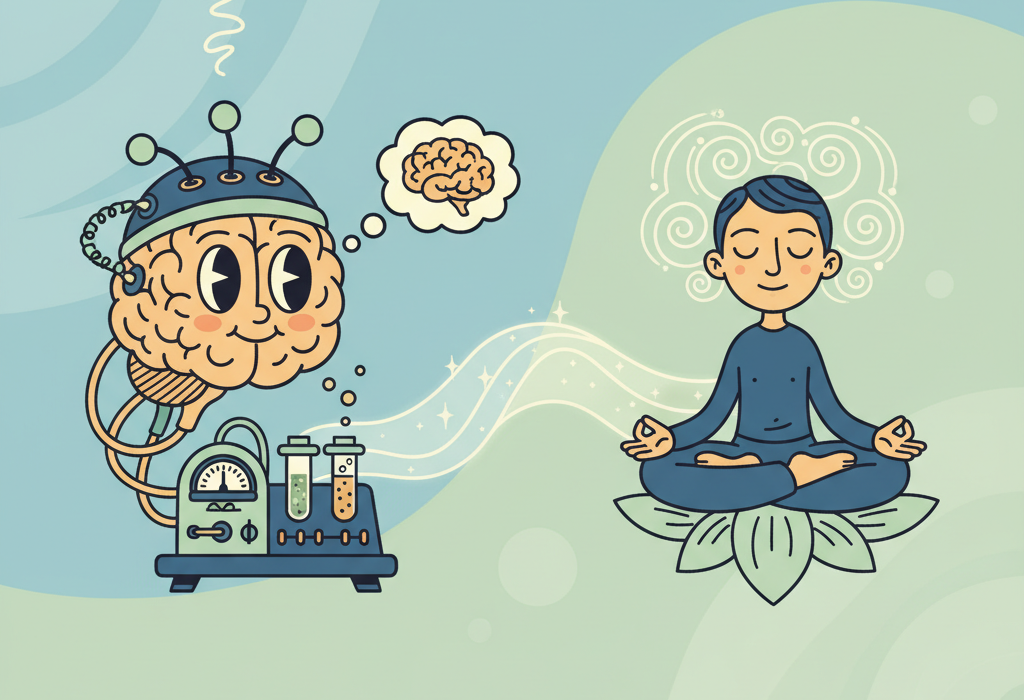
Mindfulness meditation is a proven way to reduce stress, but learning to meditate can be frustrating. For many beginners, the mind constantly wanders. To solve this problem, technology companies and researchers have developed mindfulness-based neurofeedback. This approach combines traditional meditation with real-time brainwave monitoring. While consumer devices claim to accelerate meditation learning by playing sounds that reflect your brain state, current scientific research shows mixed results. Studies indicate it may offer modest, short-term stress relief, but there is not yet strong evidence that it deepens meditation better than traditional practice alone.
Here is a closer look at how neurofeedback works, what happens in the brain, and what the latest clinical trials actually say about its effectiveness.
How This Might Work: The Brain on Neurofeedback
To understand mindfulness-based neurofeedback, it helps to understand two key terms:
- Mindfulness (MIND-ful-ness): a mental state achieved by focusing your awareness on the present moment, while calmly acknowledging and accepting your feelings and thoughts.
- Neurofeedback (NUR-oh-feed-bak): a type of biofeedback that measures brain activity and plays it back to you in real time, usually through sound or visual cues.
Most neurofeedback used in meditation relies on Electroencephalography (eh-LEK-tro-en-sef-uh-LOG-ruh-fee), commonly known as EEG. EEG uses small sensors placed on the scalp to measure the electrical activity of the brain.
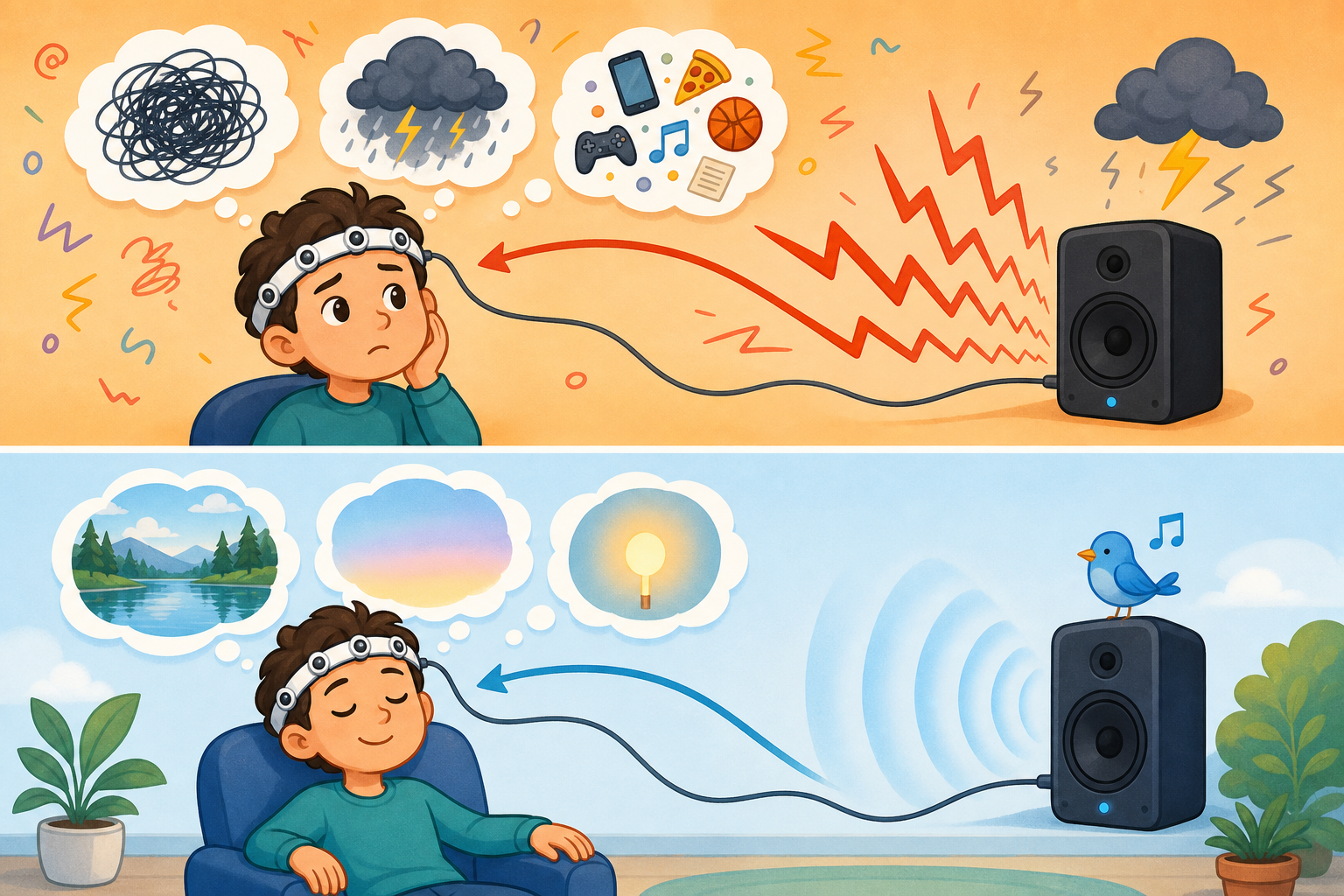
During a typical session, a person wears an EEG headband and listens to an audio track. When the sensors detect brainwaves associated with a wandering mind, the audio might become chaotic, like the sound of a heavy rainstorm. When the sensors detect brainwaves associated with calm focus, the audio becomes peaceful, perhaps sounding like gentle rain or chirping birds.
This creates a “closed-loop system.” The brain receives instant feedback about its own state, allowing the person to realize their mind has wandered and gently bring their focus back to their breath. The theory is that this instant feedback acts like a mirror for the mind, helping people learn the skill of meditation faster.
Targeting the Wandering Mind
Researchers using advanced brain imaging have identified specific networks in the brain that are active during meditation. The most important of these is the Default Mode Network (dee-FAULT mode NET-work), or DMN.
The DMN is the brain’s “screensaver” mode. It becomes highly active when we are not focused on the outside world, such as when we are daydreaming, ruminating on the past, or worrying about the future. A 2024 systematic review in Imaging Neuroscience found that many neurofeedback studies focus on helping people lower the activity in their DMN, which correlates with feeling more present and focused.

What the Research Shows
Over the last decade, researchers have tested neurofeedback in various populations to see if it improves mental health, cognitive function, or physical symptoms. The results are complex and often depend on the specific condition being studied.
Short-Term Stress and Anxiety Relief
Some research suggests that neurofeedback can help reduce stress, but the benefits may not last long.
A 2025 trial in the Journal of Medical Internet Research studied 147 nursing students facing high academic pressure. The students were split into groups receiving either neurofeedback-assisted online mindfulness, conventional online mindfulness, or general mental health education.
Immediately after the six-week program, the neurofeedback group showed significantly better improvements in depression and anxiety symptoms compared to the conventional mindfulness group. However, when researchers checked back one month and three months later, those extra benefits had faded. Both mindfulness groups ultimately had similar long-term outcomes.
Consumer Headbands and General Well-Being
Many people use consumer-grade EEG headbands at home. To see if these devices live up to their claims, a 2025 meta-analysis combined data from 16 randomized controlled trials involving 763 participants.
The researchers found a modest decrease in psychological distress among people using the devices compared to control groups. However, the analysis found no significant improvements in cognitive function. More importantly, the data did not support the claim that consumer-grade neurofeedback helps people achieve a “deeper” state of mindfulness than they would achieve with normal meditation.
Smartphone Addiction and Nomophobia
Researchers have also tested neurofeedback as a tool to break bad habits, such as problematic smartphone use and “nomophobia” (the fear of being without a mobile phone).
A 2025 clinical trial in Spain assigned 40 young adults to either a neurofeedback-assisted mindfulness program or a control group that only received a workshop on responsible technology use. After three months, the researchers found no statistically significant differences between the two groups. The neurofeedback program did not produce meaningful improvements in anxiety, mobile phone addiction, or sleep quality compared to the basic educational workshop.
Migraines and Pain Management
Because traditional mindfulness can help people cope with chronic pain, researchers are exploring if neurofeedback can enhance this effect.
A 2025 study in the Journal of Clinical Neuroscience followed 101 adults with migraines. Participants practiced 10 minutes of daily neurofeedback meditation or listened to an audiobook for eight weeks. Both groups saw slight improvements in headache disability and anxiety. The only unique benefit for the neurofeedback group was an increase in “headache management self-efficacy.” This means the participants felt more confident in their ability to handle their migraines, even though the actual severity of the migraines did not decrease more than in the control group.
Related: What Science Actually Says About Meditation and Mindfulness
Where The Science Is Still Uncertain
While neurofeedback is an intriguing tool, scientists urge caution when interpreting the results of current studies. There are two major limitations in the current research.
First, there is the problem of “neurosuggestion.” This is a form of the placebo effect. When people put on a high-tech headband and are told it will read their brainwaves to help them relax, their expectations are raised. The belief that the technology will work can actually cause a reduction in stress, regardless of what the brainwaves are doing.

Second, many clinical trials lack proper “sham” controls. In a high-quality medication trial, the control group receives a sugar pill so they do not know if they are getting the real treatment. In neurofeedback, a proper sham control involves giving the user fake audio feedback that is not actually connected to their brainwaves. According to systematic reviews of the literature, very few studies use these strict sham controls. Without them, it is difficult to prove that the brainwave monitoring itself is causing the benefits, rather than just the act of sitting quietly and listening to nature sounds.
How It Compares To Alternatives
For individuals dealing with specific mental health or neurodevelopmental conditions, neurofeedback is often compared to traditional therapies.
For example, in the treatment of Attention Deficit Hyperactivity Disorder (ADHD), a 2025 comprehensive review in The Lancet Psychiatry analyzed 113 trials. The review concluded that mindfulness and neurofeedback were not as effective as standard medications for reducing core ADHD symptoms based on self-reported measures. While non-pharmacological therapies are helpful for building coping skills, current clinical guidelines do not recommend neurofeedback as a standalone replacement for established ADHD treatments.
Interestingly, some research suggests neurofeedback might work best when combined with physical activity. A 2022 study in Frontiers in Human Neuroscience found that combining aerobic exercise (running) with neurofeedback training resulted in healthier brain network synchronization than either activity alone. This suggests that lifestyle interventions might have a synergistic effect when used together.
Common Questions About Neurofeedback and Mindfulness
Do consumer EEG headbands actually read my mind?
No. Consumer EEG devices measure general electrical activity on the surface of your scalp. They can detect broad states of arousal, such as whether you are highly alert or deeply relaxed, but they cannot read specific thoughts, emotions, or memories.
Can neurofeedback cure anxiety or depression?
Neurofeedback is not a cure for mental health conditions. While some studies show it can provide temporary relief from daily stress and mild anxiety, it is generally viewed as a complementary tool rather than a replacement for professional therapy or prescribed medication.
Do I need a device to learn mindfulness?
No. Humans have practiced mindfulness meditation for thousands of years without technology. While a device might provide helpful audio cues to keep you on track, the core skill of mindfulness is simply noticing when your attention wanders and choosing to bring it back to the present moment.
The Bottom Line
Mindfulness-based neurofeedback is a fascinating intersection of ancient contemplative practices and modern neuroscience. Based on the current body of research, here is what we know:
- It can be a helpful training wheel. For beginners who struggle to know if they are “doing it right,” real-time audio feedback can help them recognize when their mind has wandered.
- The benefits are often short-term. While neurofeedback can reduce immediate feelings of stress or anxiety, studies show these extra benefits often fade after a few months.
- It does not outperform traditional methods. Current data does not support the idea that consumer neurofeedback devices lead to a “deeper” meditative state or better long-term mental health outcomes than practicing traditional meditation without a device.
- More rigorous science is needed. Until more studies use “sham” feedback to rule out the placebo effect, scientists cannot say for sure how much of the benefit comes from the brainwave monitoring itself.
If you are interested in trying neurofeedback, it is generally considered safe and may offer a fun, engaging way to build a meditation habit. However, it is not a magic shortcut to a calm mind.
Quick Reference: Key Studies
| Study Focus | Key Finding | Source |
|---|---|---|
| Consumer-grade neurofeedback | Meta-analysis found modest short-term distress relief but no proof it deepens meditation better than normal practice. | PMID 40246295 |
| Nursing student anxiety | Neurofeedback improved short-term anxiety and depression better than regular mindfulness, but long-term results were the same. | PMID 40408764 |
| Smartphone addiction | A 3-month neurofeedback program showed no significant improvement in nomophobia or anxiety compared to an educational workshop. | PMID 41409706 |
| Migraine management | Neurofeedback improved patients’ confidence in managing headaches but did not significantly reduce actual migraine severity. | PMID 41101279 |
| ADHD treatments | Network meta-analysis found neurofeedback and mindfulness are less effective than standard medications for core ADHD symptoms. | PMID 39701638 |
| Exercise and neurofeedback | Combining aerobic exercise with neurofeedback resulted in better brain network synchronization than either intervention alone. | PMID 35774480 |
Last updated: September 2026
This article synthesizes findings from peer-reviewed research. It is for educational purposes only and does not constitute medical advice. Consult a healthcare provider before starting any new regimen.



Leave a Reply