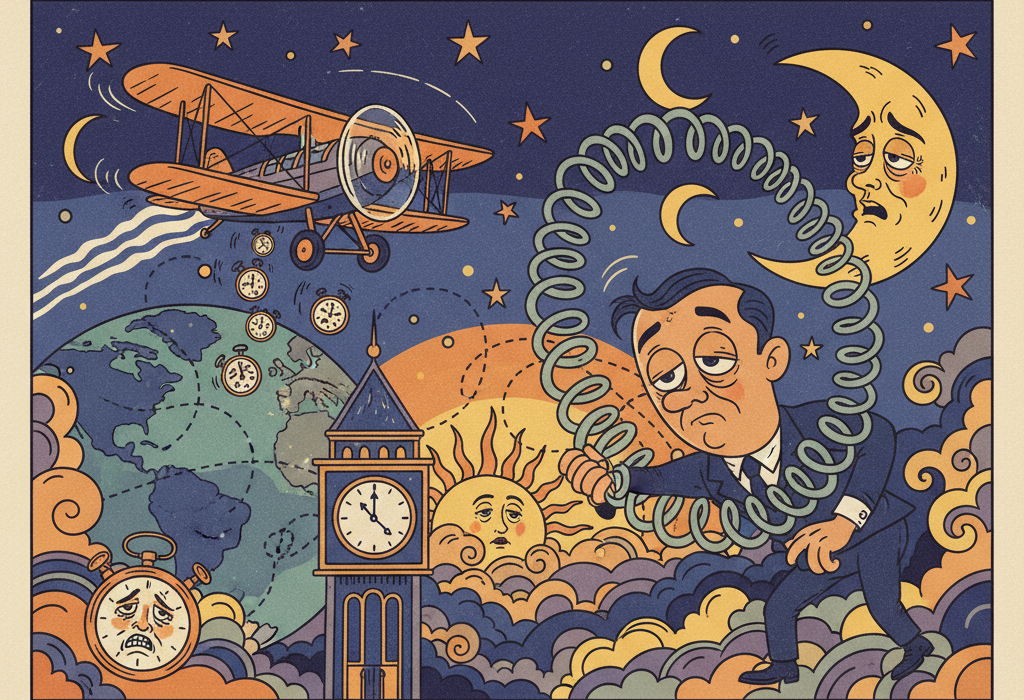
Anyone who has taken a long international flight knows the familiar fog of jet lag. You find yourself wide awake at 3:00 a.m., exhausted by noon, and struggling to concentrate. But what is actually happening inside your body when you cross multiple time zones?
At its core, jet lag is a temporary mismatch between your internal body clock and the external environment. Your body expects it to be night, but the sun is shining. However, recent scientific research reveals that jet lag is not just a sleep issue. It is a full-body event that temporarily alters your digestion, hormone levels, physical performance, and even your mood.
This article explains the biological mechanisms behind jet lag, how it affects different systems in your body, and what peer-reviewed science actually suggests for resetting your clock more efficiently.
How This Might Work: The Biology of the Body Clock
To understand jet lag, we first have to understand how the body keeps time. Almost every tissue and organ in your body operates on a roughly 24-hour cycle known as a circadian rhythm (ser-KAY-dee-un).
These rhythms are coordinated by a master clock in the brain called the suprachiasmatic nucleus (soo-prah-kye-az-MAT-ik NOO-klee-us), or SCN. Think of the SCN as the conductor of an orchestra. It uses signals from the environment, primarily light, to tell the rest of the body what time it is, ensuring that all your organs play their parts at the right moment.

When light enters your eyes, it signals the SCN to suppress the production of melatonin (mel-uh-TOE-nin), a hormone that promotes sleep. When it gets dark, melatonin levels rise, signaling to your body that it is time to rest.
Related: How Your Circadian Rhythm Controls Sleep (And What Science Says About Fixing It)
When you fly across time zones, you suddenly expose your SCN to light at the “wrong” time. The conductor becomes confused, and the orchestra falls out of sync. It takes time for the master clock to adjust to the new light-dark cycle, and even longer for peripheral clocks in your liver, muscles, and gut to catch up.

What the Research Shows: The Hidden Effects of Jet Lag
Most people associate jet lag with insomnia and daytime fatigue. However, research shows that circadian disruption impacts several other major bodily systems.
Metabolism and Gut Health
Your digestive system operates on a strict schedule. A 2020 review in Sleep Medicine Reviews highlights that up to 60% of our gut microbiome composition fluctuates rhythmically throughout the day.
When we experience jet lag, these microbial rhythms are thrown off balance. Animal studies have shown that persistent jet lag alters the gut microbiome in ways that promote weight gain and blood sugar imbalances. Interestingly, researchers found that shifting feeding times can help rescue these microbial rhythms, suggesting that meal timing is a powerful tool for resetting the gut’s clock.
Furthermore, a 2024 study in Science discovered that the liver communicates directly with the brain to regulate food intake rhythms. When the liver’s clock is disrupted by shift work or jet lag, it alters eating patterns and can contribute to metabolic issues.
Sex Differences in Chronic Jet Lag
Interestingly, chronic circadian disruption may affect men and women differently. A 2024 study in Biology of Sex Differences subjected male and female mice to chronic jet lag. The researchers found that male mice gained significant weight and developed glucose intolerance (a precursor to diabetes). Female mice, on the other hand, actually gained less weight than normal but experienced more severe disruptions to their core body temperature rhythms. The study identified testosterone as a key factor in why males experienced worse metabolic outcomes under jet lag conditions.
Mood and Mental Health
There is a well-documented bidirectional relationship between circadian rhythms and mental health. A 2020 review in Translational Psychiatry notes that disruption of circadian rhythms via jet lag or shift work can precipitate or exacerbate mood disorders like anxiety and depression in susceptible individuals.
This occurs partly because the same brain pathways that process light information also project to areas of the brain involved in mood regulation. When sleep and melatonin rhythms are disrupted, it can temporarily alter neurotransmitter balance, leading to irritability, brain fog, and low mood.
Athletic Performance
Athletes are particularly sensitive to jet lag because physical performance naturally peaks in the late afternoon (when core body temperature is highest) and dips in the early morning. A 2012 review in Sports Medicine notes that transmeridian travel disrupts this cycle, leading to measurable decreases in sprint speed, muscle strength, and cognitive coordination.
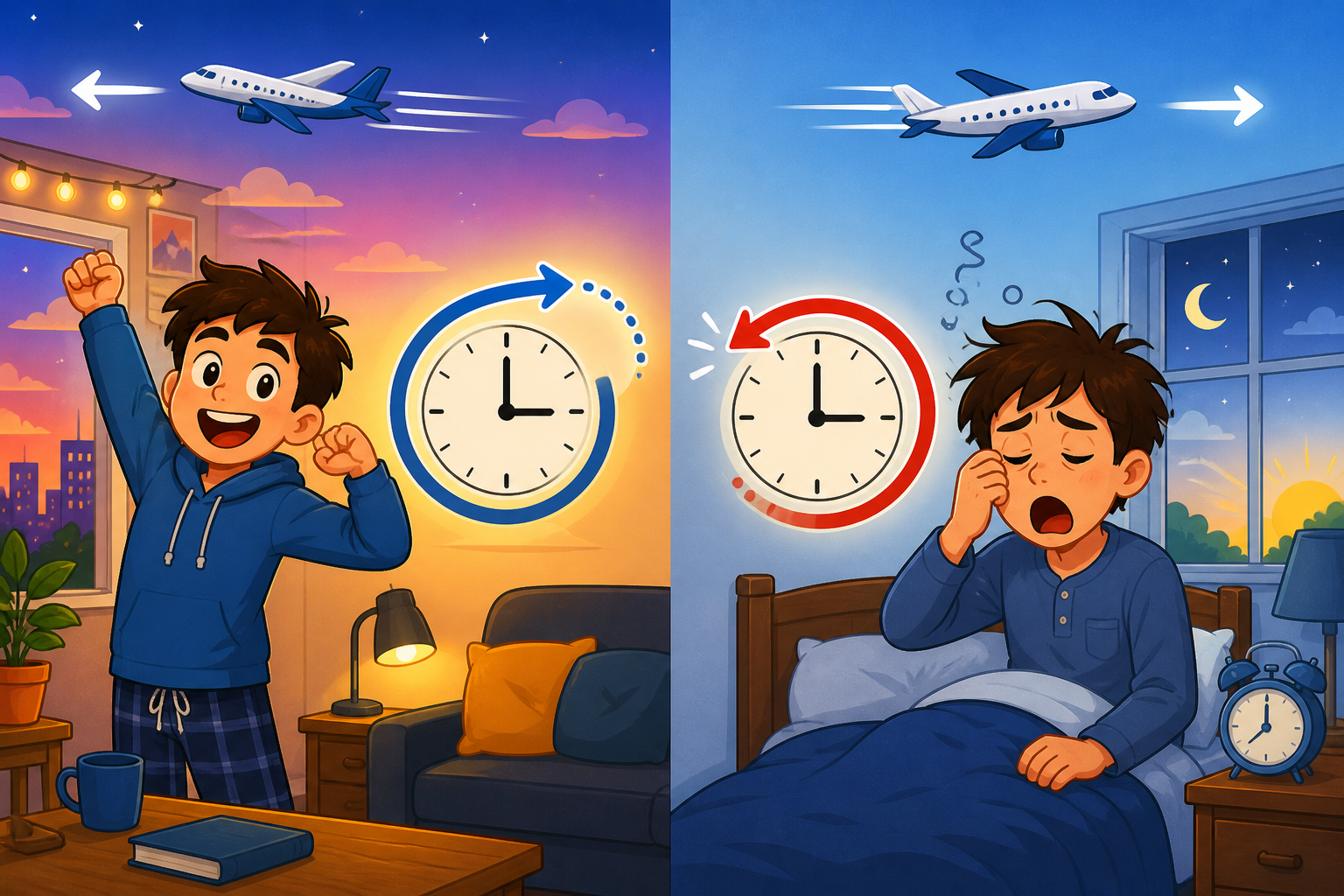
Furthermore, a 2020 review in Current Sports Medicine Reports confirms what many frequent travelers suspect: flying east takes a greater toll on performance than flying west. This is because the body’s natural clock is slightly longer than 24 hours, making it biologically easier to stay up late (delay the clock) than to wake up early (advance the clock).
Practical Guidance: Science-Backed Ways to Reset Your Clock
The body naturally adjusts to a new time zone at a rate of about one hour per day. However, research outlines several ways to speed up this process using environmental and behavioral cues.
1. Strategic Light Exposure
Light is the most powerful tool for resetting the SCN. However, timing is everything. The body’s response to light follows a “phase-response curve.”
If you travel East (advancing the clock): You want to expose yourself to bright light in the morning* of your new time zone and avoid bright light in the late evening.
If you travel West (delaying the clock): You want to seek out bright light in the evening* of your new time zone to help you stay awake, and avoid bright light too early in the morning.
A 2009 review in Travel Medicine and Infectious Disease confirms that strategically timed light exposure is one of the most effective, non-pharmacological ways to shift the circadian rhythm.
2. Melatonin Supplementation
Melatonin is widely considered a chronobiotic (kro-no-by-AHT-ik), a substance that adjusts the timing of internal biological rhythms.
A 2008 review evaluated multiple studies on melatonin and jet lag. The evidence shows that taking 0.5mg to 5mg of melatonin close to the target bedtime at your destination can significantly reduce jet lag symptoms, particularly for eastward flights crossing five or more time zones. Taking it too early in the day, however, can accidentally shift your clock in the wrong direction.
3. Chrono-nutrition (Meal Timing)
Because the digestive system has its own clock, meal timing can help synchronize your peripheral organs. A 2022 review in the Journal of Nutritional Science and Vitaminology highlights the emerging field of chrono-nutrition.
Research suggests that eating meals according to the local time at your destination, and avoiding heavy meals in the middle of the biological night, helps entrain the liver and gut clocks. Fasting during the flight and eating a high-protein breakfast upon arrival at your destination may also help signal to your body that a new day has begun.
Related: The Science of Meal and Exercise Timing: What Actually Works
4. Exercise Timing
Physical activity is another cue that tells the body it is time to be awake. The 2012 Sports Medicine review notes that light-to-moderate exercise performed outdoors (combining activity with sunlight) in the morning or afternoon of the new time zone can accelerate adaptation.
| Strategy | Traveling East (Losing Time) | Traveling West (Gaining Time) |
|---|---|---|
| Light Exposure | Seek morning light; avoid evening light. | Seek evening light; avoid early morning light. |
| Melatonin | Take at local bedtime (e.g., 10 PM) at destination. | Usually less necessary, but can be taken at local bedtime. |
| Sleep Schedule | Go to bed earlier a few days before the trip. | Stay up later a few days before the trip. |
Who Benefits Or Needs Caution
- Older Adults: The circadian system weakens slightly with age, meaning older adults may experience more severe jet lag symptoms and take longer to adapt to new time zones.
- Athletes: Competitive athletes should aim to arrive at their destination several days prior to an event (roughly one day of recovery per time zone crossed) to ensure their physical and cognitive peaks align with competition times.
- Shift Workers: While shift workers do not cross physical time zones, they experience “social jet lag.” The same principles of light management and melatonin timing apply to helping shift workers adapt to night schedules.
Common Questions About Jet Lag
Why is flying east worse than flying west?
Our internal body clock naturally runs slightly longer than 24 hours (around 24.2 hours). Because of this, it is biologically easier for the body to stay awake later (which happens when flying west) than it is to force the body to fall asleep and wake up earlier than usual (which happens when flying east).
Do sleeping pills cure jet lag?
No. While prescription or over-the-counter sleep aids can help you sleep on a plane or during your first night in a new location, they do not shift your underlying circadian rhythm. They treat the symptom (insomnia) but do not reset the body clock.
The Bottom Line / Takeaways
Jet lag is a complex physiological event that causes the brain, liver, gut, and muscles to temporarily fall out of sync. While fatigue is the most obvious symptom, jet lag also impacts digestion, metabolism, mood, and physical performance.
Currently, there is no instant “cure” for jet lag. However, the scientific consensus supports a multi-pronged approach to speed up adaptation. Strategically timing your exposure to sunlight, adjusting your meal times to the new local schedule, and using low-dose melatonin at the target bedtime are the most evidence-based ways to help your body clock catch up to your travel itinerary.
Quick Reference: Key Studies
| Study Focus | Key Finding | Source |
|---|---|---|
| Jet Lag & Gut Health | Persistent jet lag disrupts the gut microbiome, which can promote metabolic issues. Time-restricted feeding helps rescue these rhythms. | PMID 32668369 |
| Sex Differences in Jet Lag | Chronic jet lag causes weight gain and glucose intolerance in male mice, while female mice experience greater temperature rhythm disruptions. | PMID 39639385 |
| Jet Lag & Mental Health | Circadian disruption from jet lag and shift work is strongly linked to the exacerbation of mood disorders like anxiety and depression. | PMID 32066704 |
| Athletic Performance | Eastward travel has a more detrimental effect on sleep, fatigue, and team sport performance than westward travel. | PMID 31913914 |
| Melatonin Efficacy | Melatonin (0.5 to 5mg) taken at the destination’s bedtime is highly effective at reducing jet lag symptoms, especially for flights crossing 5+ time zones. | PMID 18342269 |
| Chrono-nutrition | Meal timing influences peripheral body clocks; aligning meals with local time can assist in circadian adaptation. | PMID 36437004 |
Last updated: October 2026
This article synthesizes findings from peer-reviewed research. It is for educational purposes only and does not constitute medical advice. Consult a healthcare provider before starting any new regimen or taking supplements like melatonin.



Leave a Reply