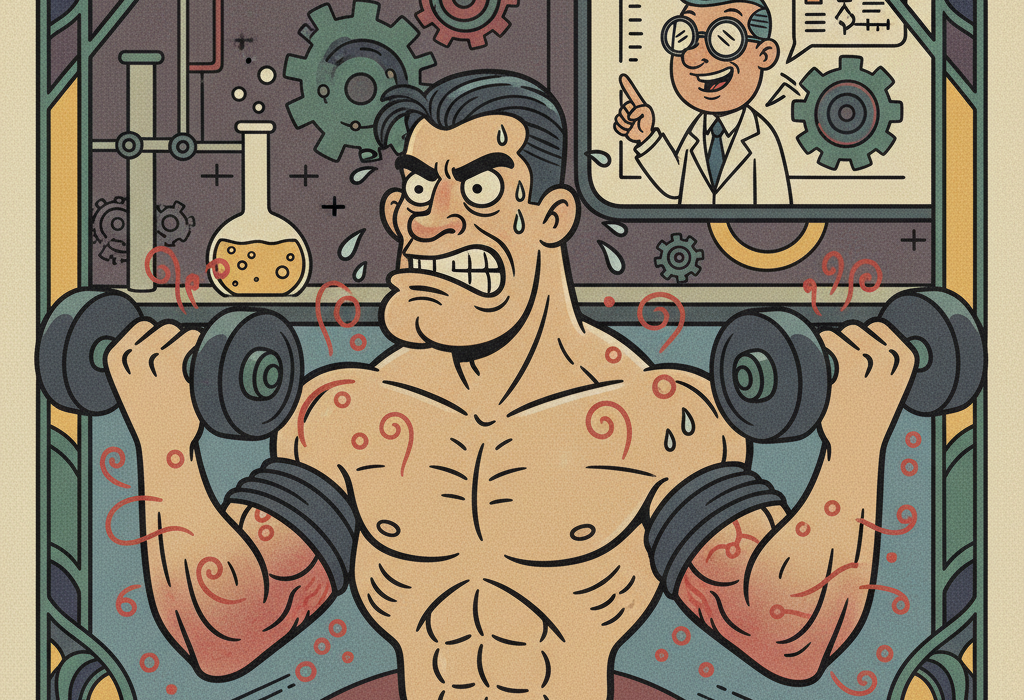
What Is Blood Flow Restriction Training?
Imagine pinching a garden hose so the water slows down but doesn’t completely stop. That is roughly what happens during blood flow restriction training (BFR, sometimes called BFRT). You wear a specialized inflatable cuff, similar to a blood pressure cuff, on the upper part of your arm or leg. The cuff is tightened enough to slow blood flowing back through your veins while still allowing fresh blood to flow in through your arteries.
Then you exercise with very light weights, typically only 20% to 30% of the heaviest load you could lift once. Under normal conditions, lifting that light would not do much for muscle size or strength. But the restricted blood flow changes the environment inside the muscle. Waste products like lactate build up faster, oxygen drops, and muscle fibers that normally sit idle get called into action sooner. The result, at least in theory, is a muscle-building stimulus that is closer to what you would get from heavy lifting, but without the heavy load on your joints.
Here are a few terms you will see throughout this article:
- Blood flow restriction (BFR) – using a cuff to partially reduce blood flow to a working muscle during exercise
- One-repetition maximum (1RM) (wun-rep MAX) – the heaviest weight you can lift one time with good form
- Sarcopenia (sar-koh-PEE-nee-uh) – the age-related loss of muscle mass, strength, and physical performance
- ACL reconstruction (ACLR) – surgery to replace a torn anterior cruciate ligament in the knee
- Limb occlusion pressure (LOP) – the minimum cuff pressure needed to completely block blood flow; BFR typically uses 40% to 80% of this number
BFR has become popular in physical therapy clinics, rehab settings, and some gyms. But popularity and proof are two different things. Let’s look at what recent studies actually found.
What the Research Shows
Four recent papers, spanning from 2023 to 2025, give us a window into how well BFR works and where it falls short. The research covers two main groups: people recovering from ACL knee surgery and older adults dealing with sarcopenia.
BFR After ACL Surgery
After ACL reconstruction, the quadriceps (the big muscle on the front of your thigh) tend to shrink and weaken quickly. Getting that muscle back to full strength is one of the biggest challenges in rehab. Because joints are often sore and swollen, heavy lifting is off the table early on. That is why BFR, with its promise of muscle gains from light loads, has attracted so much attention in this space.
A 2025 double-blind clinical trial in Medicine and Science in Sports and Exercise put that idea to a rigorous test. Researchers randomly assigned 48 athletes to one of two groups: one group did low-load exercises with a real BFR cuff, while the other group did the same standard rehab exercises with a sham (fake) cuff that looked identical but did not actually restrict blood flow. Both groups followed the same rehabilitation program starting one month before surgery and continuing four to five months after. The researchers measured quadriceps strength, muscle size via MRI, muscle fiber characteristics from biopsies, and how participants walked.
The result? No significant differences between the groups on any measure. The BFR group did not come out ahead on strength, muscle cross-sectional area, fiber type, or walking mechanics. The authors concluded that adding BFR to a standard rehab program was “no more effective than standard rehabilitation” and suggested clinicians weigh the cost, time, and patient discomfort of BFR against these findings.
Two systematic reviews paint a slightly more nuanced picture. A 2024 systematic review in Sports Health looked at six randomized trials (152 total participants) and found that BFR combined with low loads improved pain, strength, functionality, and muscle size within the BFR groups over time. However, when compared head-to-head with high-load exercise, BFR showed no advantage for muscle size or strength. Where BFR did stand out was in knee pain and function: participants using BFR reported less pain and better knee function than those doing heavy lifting or those who were immobilized.
Similarly, a 2023 systematic review in Sports Health examined six studies and found that effect sizes ranged from trivial to large in favor of BFR for muscle size and strength, but the confidence intervals all crossed zero, meaning the differences could easily be due to chance. The authors rated the evidence as “grade B,” which translates to inconsistent and limited-quality evidence.
| Outcome | BFR vs. Standard Rehab | BFR vs. Heavy Lifting |
|---|---|---|
| Muscle strength | Similar results | Similar results |
| Muscle size | Similar results | Similar results |
| Knee pain | May be better with BFR | BFR may cause less pain |
| Knee function | Similar or slightly better | Similar or slightly better |
BFR for Older Adults With Sarcopenia
A 2024 randomized controlled trial in Scientific Reports tackled a different question: Can BFR help older adults who have already been diagnosed with sarcopenia? Twenty-one people aged 65 and older were split into two groups. One group did light resistance exercises (20% to 30% of their max) with BFR cuffs. The other group did conventional heavy resistance training (60% to 70% of their max) without cuffs. Both groups trained three times a week for 12 weeks.
Both groups improved in several areas:
| Measure | BFR Group (Light Load) | Heavy Lifting Group |
|---|---|---|
| Knee extension strength | Improved significantly | Improved significantly |
| Body weight | Decreased | Decreased |
| Body fat percentage | Decreased | Decreased |
| Blood pressure (systolic) | Decreased | Decreased |
| Triglycerides | Decreased | Decreased |
| HDL cholesterol | Increased | Increased |
| Growth hormone | Increased | Increased |
| Quality of life | Improved | Improved |
Here is where the two groups differed slightly. The heavy lifting group was the only one to show a significant increase in appendicular skeletal muscle mass index (ASMI), which is a measure of how much muscle you carry on your arms and legs relative to your height. The BFR group did not gain significant muscle mass. On the other hand, the BFR group was the only one to show a significant drop in resting heart rate, which hints at a possible cardiovascular benefit.
Importantly, no significant between-group differences were found on any outcome. That means, statistically, neither approach was clearly better than the other overall. The study was also very small (21 people total), so it may not have had enough statistical power to detect real differences.
No adverse events were reported during the 12-week program, which is reassuring for the safety of BFR in this older, more fragile population.
Who Might Benefit and Who Should Be Careful
Who Might Benefit
Based on the current evidence, BFR training appears most useful as an alternative when heavy lifting is not an option. It does not seem to be better than heavy lifting. But it may produce similar results with much lighter loads. That matters for specific groups:
- People in early post-surgery rehab. After ACL reconstruction or other knee surgeries, joints are often too tender for heavy weights. BFR with light loads may help maintain some muscle stimulus while staying within pain limits. The 2024 systematic review noted that BFR was associated with less knee pain than heavy lifting.
- Older adults who cannot tolerate heavy exercise. The 2024 sarcopenia trial showed that light-load BFR produced similar strength gains and cardiovascular improvements as conventional heavy training, with no adverse events.
- People managing chronic joint pain. If heavy loads aggravate your joints, BFR could let you train muscles without loading the joint as much.
Who Should Be Careful
BFR is not risk-free. Because it involves partially blocking blood flow, certain people should avoid it or only try it under medical supervision:
| Condition | Concern |
|---|---|
| Deep vein thrombosis (DVT) or history of blood clots | Cuff pressure could worsen clotting risk |
| Uncontrolled high blood pressure | BFR can temporarily spike blood pressure during exercise |
| Peripheral vascular disease | Already impaired blood flow could be worsened |
| Blood clotting disorders or anticoagulant use | Higher risk of bruising or bleeding |
| Active infection or open wounds on the limb | Cuff application is not appropriate |
| Pregnancy | Not enough safety data |
The sarcopenia trial specifically excluded people with uncontrolled hypertension, heart failure, and blood clotting disorders. This is a good indication that researchers consider these conditions too risky for BFR.
Practical Guidance
If you are interested in trying BFR, here are some evidence-based pointers drawn from the research.
Get the Right Equipment
The studies reviewed here used medical-grade pneumatic cuffs that can be inflated to a precise pressure. These are different from the cheap elastic “BFR bands” sold online. Medical-grade cuffs allow you to set the pressure based on your individual limb occlusion pressure (LOP), which is the pressure needed to completely stop blood flow. Researchers in the sarcopenia study used Doppler ultrasound to find each person’s LOP and then set the cuff to 50% of that number.
If you use generic straps without knowing your LOP, you risk applying too much or too little pressure.
Typical BFR Protocol
Based on the studies reviewed:
| Parameter | Typical Range |
|---|---|
| Load (weight) | 20% to 30% of 1RM |
| Cuff pressure | 40% to 80% of LOP (50% used in the sarcopenia study) |
| Sets and reps | 1 set of 30 reps, then 2 to 3 sets of 15 reps |
| Rest between sets | 20 to 60 seconds |
| Frequency | 2 to 3 sessions per week |
| Duration | At least 8 to 12 weeks |
Work With a Professional
Every study reviewed here used supervised training sessions with a certified physical therapist or exercise professional. This is not a technique to figure out alone from a YouTube video. A trained clinician can:
- Measure your LOP accurately
- Set the cuff pressure appropriately
- Monitor you for signs of numbness, excessive pain, or skin color changes
- Adjust the program as you progress
Manage Expectations
The research is consistent on one point: BFR with light loads tends to produce results that are similar to but not better than standard rehabilitation or conventional heavy lifting. The 2025 ACL trial found no added benefit from BFR over standard rehab. The sarcopenia trial found comparable outcomes between BFR and heavy lifting.
So BFR is best thought of as a tool for situations where heavier loading is not possible or not well tolerated. It is not a shortcut to faster or bigger gains.
The Bottom Line
What We Know
- BFR training with light loads (20% to 30% of max) can improve muscle strength, reduce body fat, and enhance cardiovascular markers in certain populations.
- In post-ACL surgery patients, BFR does not appear to offer significant advantages over standard rehabilitation for muscle size or strength.
- BFR may help reduce knee pain and improve joint function compared with heavy lifting or immobilization during ACL rehab.
- In older adults with sarcopenia, BFR produced similar improvements in strength, body composition, and blood markers as conventional heavy resistance training.
- No serious adverse events have been reported in the supervised studies reviewed here.
What We Don’t Know
- Whether BFR provides meaningful benefits over standard care in large-scale studies. Most studies so far have been small (21 to 152 participants).
- The optimal cuff pressure, session frequency, and program duration for different populations.
- Long-term effects. The longest study reviewed here was about five months.
- How BFR compares to moderate-load training (not just heavy lifting).
- Whether results in controlled research settings translate to typical gym or home settings.
The Honest Take
BFR training is a reasonable option when heavy lifting is off the table. It is not a magic method. The best evidence suggests it works about as well as conventional training for building strength, and it may be more comfortable for people with joint pain or surgical limitations. But it comes with added cost (specialized cuffs), added complexity (finding your LOP, setting pressures), and some discomfort from the cuff itself. If you can lift heavier weights comfortably and safely, the current evidence does not suggest you need BFR.
Quick Reference: Key Studies
| Study Focus | Population | Key Finding | Source |
|---|---|---|---|
| BFR vs. sham during ACL rehab | 48 athletes, pre- and post-surgery | No significant differences in quadriceps strength, size, or gait | PMID 39350350 |
| Systematic review of BFR after ACL surgery (2024) | 152 participants across 6 trials | BFR improved pain and function vs. heavy loads or immobilization; no advantage for muscle size or strength | PMID 37946502 |
| BFR vs. heavy lifting in older adults with sarcopenia | 21 adults aged 65+ | Both groups improved similarly; heavy lifting slightly better for muscle mass; BFR slightly better for heart rate | PMID 39558011 |
| Systematic review of BFR after ACL surgery (2023) | 6 studies reviewed | Grade B evidence; effect sizes trivial to large but inconsistent | PMID 35130790 |
Last updated: June 2025
This article synthesizes findings from peer-reviewed research. It is for educational purposes only and does not constitute medical advice. Consult a healthcare provider before starting any new regimen.



Leave a Reply