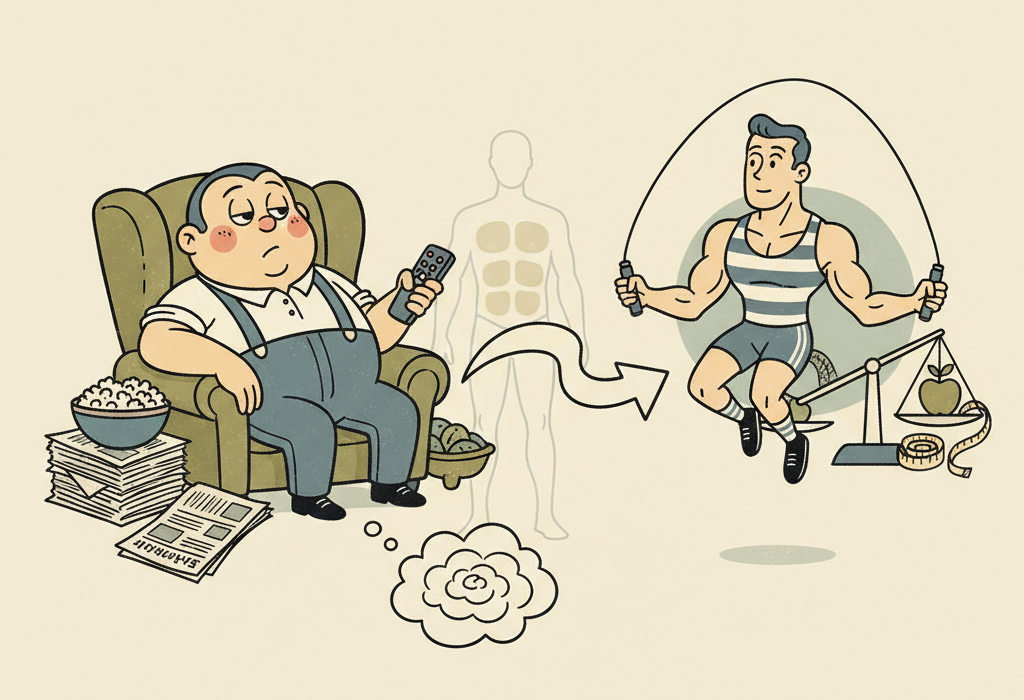
Modern life involves a lot of sitting. Whether we are driving, working at a desk, or relaxing in front of a screen, we spend a massive portion of our day off our feet. We often hear that this lack of movement is bad for our health.
But a common question remains: Does sitting actually change your body shape, or is it just the lack of exercise that causes problems?
To understand this, scientists study sedentary behavior (SED-en-tair-ee bee-HAYV-yer). This refers to waking activities done while sitting or lying down that use very little energy. They look at how this behavior impacts body composition (BAH-dee kom-puh-ZISH-un), which is the proportion of fat, muscle, and bone in your body.
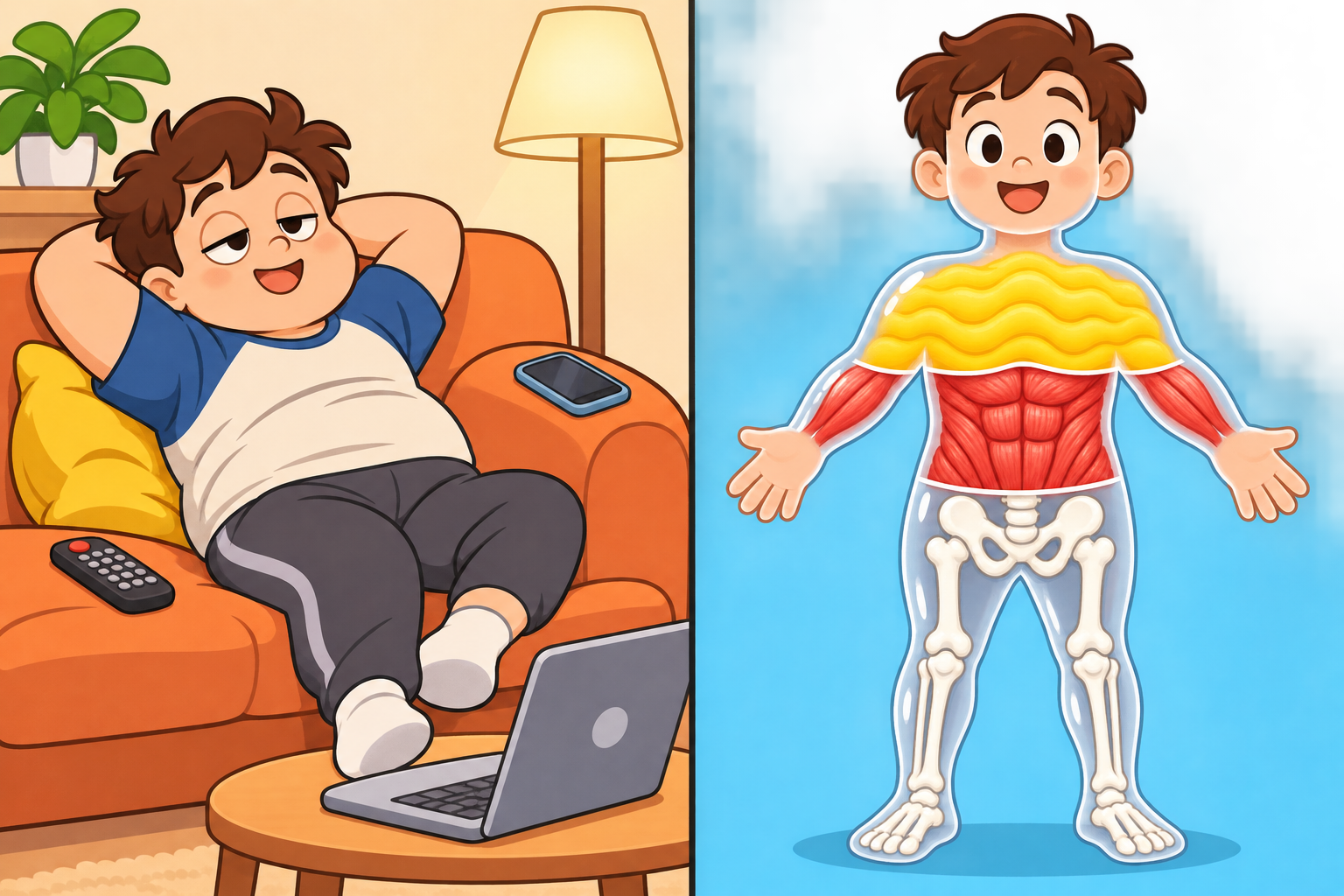
The core tension in the research is surprising. While it seems obvious that sitting would directly lead to fat gain, the scientific data is actually quite mixed. Some studies show a clear link between sitting and increased body fat, while others show a very weak connection.
Let us explore what the latest peer-reviewed research actually shows about sitting, screen time, and your body.
Does Sitting Actually Increase Body Fat in Adults?
If you ask the average person, they will likely say that sitting all day directly causes weight gain. However, large-scale research on adults paints a more complicated picture.
A 2018 meta-analysis in Sports Medicine looked at 23 prospective studies to see how sedentary behavior affected adult body weight over time. The researchers found that sitting was associated with a higher risk of eventually becoming overweight. However, when they looked at the actual amount of weight gained, the numbers were incredibly small. For every extra hour of daily sitting over a five-year period, waist circumference only increased by a fraction of a millimeter, and overall weight gain was not statistically significant.
This suggests something important: The well-known harms of sitting on your heart and metabolic health might not be caused directly by gaining body fat. Instead, sitting may harm your body in other ways, such as changing how your cells process sugar and fats.
Furthermore, the impact of sitting can differ between men and women. A 2020 study in Brazil looked at 524 adults and found that for men, moderate to vigorous physical activity was the main factor associated with a smaller waistline. For women, however, the amount of time spent sitting was the primary factor linked to a larger waistline, regardless of how much they exercised.
Why Children and Teens Are Different
While the data on adults is mixed, the research on children and adolescents is much clearer. For growing bodies, sitting too much is strongly linked to unfavorable body composition.
Related: The Hidden Dangers of Sedentary Behavior (Even If You Exercise)
A 2011 systematic review in The International Journal of Behavioral Nutrition and Physical Activity analyzed 232 studies involving nearly one million young people. The researchers found a clear dose-response relationship. Watching television for more than two hours per day was consistently associated with unfavorable body composition, decreased fitness, and even lowered self-esteem.
This was updated by a 2016 review in Applied Physiology, Nutrition, and Metabolism, which confirmed that higher amounts of screen time were linked to higher body fat and lower fitness levels in youth aged 5 to 17.
A 2022 study in South African schoolchildren further supported this. Using devices to track movement, researchers found that higher sedentary behavior was linked to a higher likelihood of obesity, more body fat, and lower muscle mass. Conversely, children who met the daily recommendation of 60 minutes of physical activity had better body composition across the board.
The “Active Couch Potato”: When Exercise Is Not Enough
Many people believe that if they exercise for an hour a day, it cancels out the eight hours they spend sitting at a desk. Scientists call this the “active couch potato” phenomenon.

Surprisingly, this applies even to highly trained athletes. A 2022 study in the European Journal of Sport Science examined 135 competitive athletes who trained an average of 12 hours per week. Despite their intense training, the athletes spent a lot of their recovery time sitting.
The researchers found that total sedentary time, and specifically screen time, was positively associated with more trunk fat and less fat-free muscle mass. Notably, time spent looking at a cell phone had the strongest link to increased body fat percentage. This shows that even if you are highly active, what you do during your resting hours still matters for your body composition.
Not All Sitting Is Equal: Screens vs. Reading
When we talk about sedentary behavior, we usually group all sitting together. But the brain and body react differently depending on what you are doing while seated.
Research consistently points to television and screen time as the most harmful types of sitting. This is likely because screen time is often paired with mindless snacking and lower brain engagement.
For example, a 2023 study in older adults looked at how different types of sitting affected cognitive function. They found that increasing television time over three years was linked to lower cognitive scores. However, sitting down to read was actually associated with higher cognitive scores.
Similarly, in children, sitting to do homework or read is often associated with better academic achievement, whereas sitting to watch TV or play video games is linked to worse behavioral conduct and higher body fat.
How Sitting Changes Your Muscles
Body composition is not just about fat; it is also about muscle. When you sit for long periods, your muscles are not contracting. Over time, this can lead to a loss of both muscle mass and muscle strength.
Interestingly, muscle strength might be more important for your long-term survival than muscle mass. A 2018 study in Medicine and Science in Sports and Exercise followed over 4,400 older adults. They found that low muscle strength was a strong, independent predictor of a shorter lifespan, regardless of how much muscle mass the person had, and regardless of how much time they spent sitting.
However, sitting still plays a role. A 2022 study on older adults in Brazil grouped people by their habits. They found that “all-day sitters” who also had low handgrip strength had significantly more fat mass than “active sitters.” This suggests that maintaining muscle strength through resistance training can help protect your body against the negative effects of sitting.
Practical Guidance: How to Counteract Sitting
If you have a job that requires sitting, you might feel discouraged. Fortunately, research provides clear, actionable ways to protect your body composition.
Related: How Exercise and Diet Actually Change Your Body Composition
1. Try “Exercise Snacks”
Instead of trying to fit all your movement into one long gym session, break it up. A 2025 randomized controlled trial in the Endocrine Journal tested the concept of “exercise snacks” on sedentary, obese adults.
The participants did not do a traditional workout. Instead, they quickly climbed four flights of stairs, six times a day, four days a week. After 12 weeks, this simple intervention significantly reduced their visceral fat (VISS-er-ul fat), which is the dangerous fat stored deep inside the belly. It also positively altered their blood chemistry.

2. Swap Sitting for Movement
Researchers use a mathematical model called “isotemporal substitution” to predict what happens when you trade one behavior for another.
A 2022 study in New Zealand women used this model to see what would happen if women swapped 30 minutes of sitting for 30 minutes of moderate to vigorous physical activity. The model predicted significant improvements in body fat percentage, waist circumference, and insulin levels.
3. Break Up Prolonged Sitting
A 2020 overview of systematic reviews concluded that simply breaking up long periods of sitting with brief moments of standing or light walking can benefit body composition and markers of heart health. You do not have to sweat to see benefits; just standing up every 30 minutes to stretch your legs helps keep your metabolism active.
Where The Science Is Still Uncertain
While the general advice is to sit less and move more, science is rarely perfectly clean. Some studies yield confusing or unexpected results.
For example, a 2023 longitudinal study following adolescents into early adulthood found something counterintuitive. They discovered that more sedentary time at age 16 was actually associated with a lower body mass index (BMI) and smaller waist circumference at age 23. The researchers noted the effect sizes were very small and suggested this might be due to unmeasured factors like diet or sleep, highlighting that sitting alone does not dictate your body shape.
Additionally, sitting might not affect everyone the same way. A 2024 study on people with Multiple Sclerosis (MS) found no significant correlation between sedentary time and body fat percentage. For populations with specific health conditions, other biological factors may override the effects of sitting.
The Bottom Line
Here is what we currently know based on the scientific evidence:
- For kids and teens: Sitting too much, especially in front of a screen, is strongly linked to higher body fat and lower muscle mass.
- For adults: The direct link between sitting and gaining body fat is surprisingly small. However, sitting still increases your risk of metabolic issues and heart disease in other ways.
- Type matters: Screen time (TV, phones) is consistently worse for your body and brain than reading or doing homework.
- You can fight back: You do not need to quit your desk job. Taking short “exercise snacks” (like climbing stairs) and swapping 30 minutes of sitting for 30 minutes of movement can significantly improve your body composition.
While sitting less is always a good goal, focusing on moving more often throughout the day is the best way to protect your long-term health.
Quick Reference: Key Studies
| Study Focus | Key Finding | Source |
|---|---|---|
| Exercise Snacks | Brief stair-climbing 6 times a day reduced visceral fat in sedentary adults. | PMID 39537176 |
| Adult Weight Gain | Meta-analysis showed sitting has very small, non-significant direct links to weight gain, but increases overall obesity risk. | PMID 29189928 |
| Kids and Screen Time | >2 hours of daily TV is consistently linked to unfavorable body composition and lower fitness in youth. | PMID 21936895 |
| Athletes and Sitting | Even in highly trained athletes, excessive cell phone screen time is linked to higher body fat. | PMID 33416024 |
| Muscle Strength | Low muscle strength predicts mortality more strongly than low muscle mass or sedentary time alone. | PMID 28991040 |
| Swapping Behaviors | Replacing 30 minutes of sitting with moderate activity improves fat percentage and insulin levels. | PMID 35886612 |
Last updated: November 2026
This article synthesizes findings from peer-reviewed research. It is for educational purposes only and does not constitute medical advice. Consult a healthcare provider before starting any new regimen.


Leave a Reply