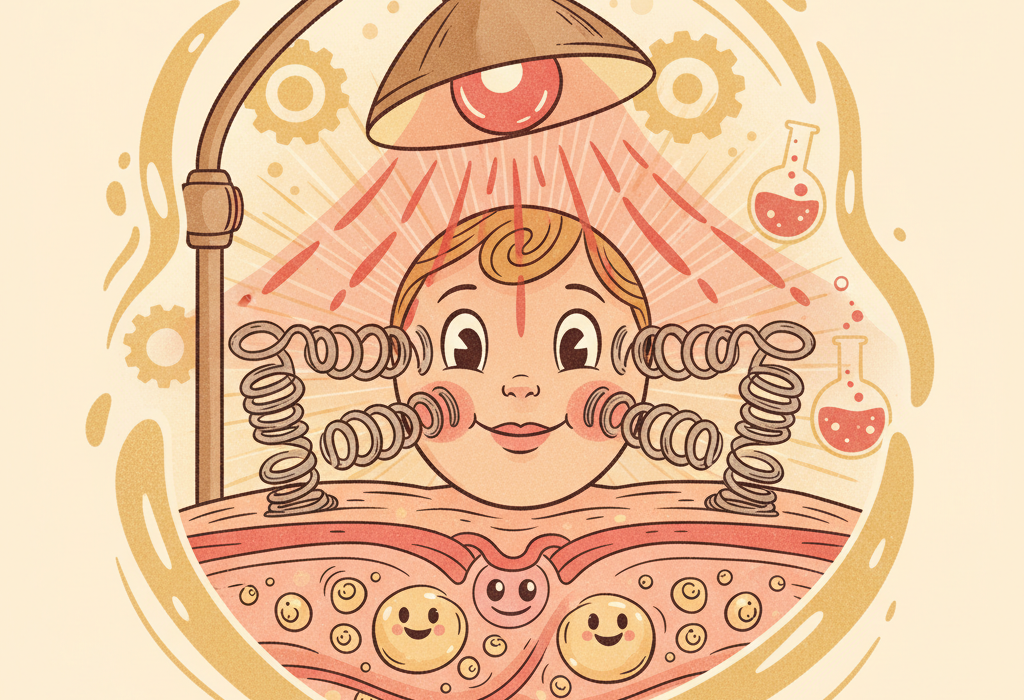
If you have scrolled through social media recently, you have likely seen people wearing glowing red masks. Red light therapy is heavily marketed as a way to erase wrinkles, heal wounds, and restore youthful skin by boosting collagen.
But does shining a red light on your face actually change your biology?
The short answer is yes. Research shows that specific wavelengths of red light can penetrate the skin and stimulate the cells that produce collagen. However, the science is much more nuanced than the marketing suggests. While low doses of red light can help build collagen to fight aging, high doses actually do the exact opposite, stopping collagen production to prevent thick scars.
Here is a look at what peer-reviewed research actually says about red light therapy, how it works, and where the marketing claims stretch the truth.
Common Questions About Red Light and Collagen
Does red light therapy really build collagen?
Yes. Studies show that low doses of red light stimulate skin cells to produce more collagen, which can mildly improve skin texture and reduce fine lines over time.
How long does it take to see results?
Scientific trials typically measure results after 4 to 12 weeks of consistent use (usually 10 to 12 minutes, twice a week). It is a gradual process, not a quick fix.
Can I use any red light bulb?
No. The light must be at a very specific wavelength (usually between 630 and 660 nanometers) to penetrate the skin and be absorbed by your cells.
How Red Light Changes Your Cells
To understand how light can change your skin, we have to look at a process called photobiomodulation (FOE-toe-bye-oh-mod-you-LAY-shun). This is simply the scientific term for using light to alter how cells behave.
When light hits your skin, most of it bounces off or is absorbed by the very top layers. But red light, specifically in the 630 to 660 nanometer range, penetrates deeper into the dermis. This is the layer of skin where your collagen lives.
Once the red light reaches the dermis, it interacts with your cells’ mitochondria. Mitochondria are often called the power plants of the cell. Inside these power plants is a specific enzyme called cytochrome c oxidase (SIGH-toe-krome see OX-ih-daze). This enzyme acts like a solar panel. It absorbs the red light particles and uses them to boost energy production.
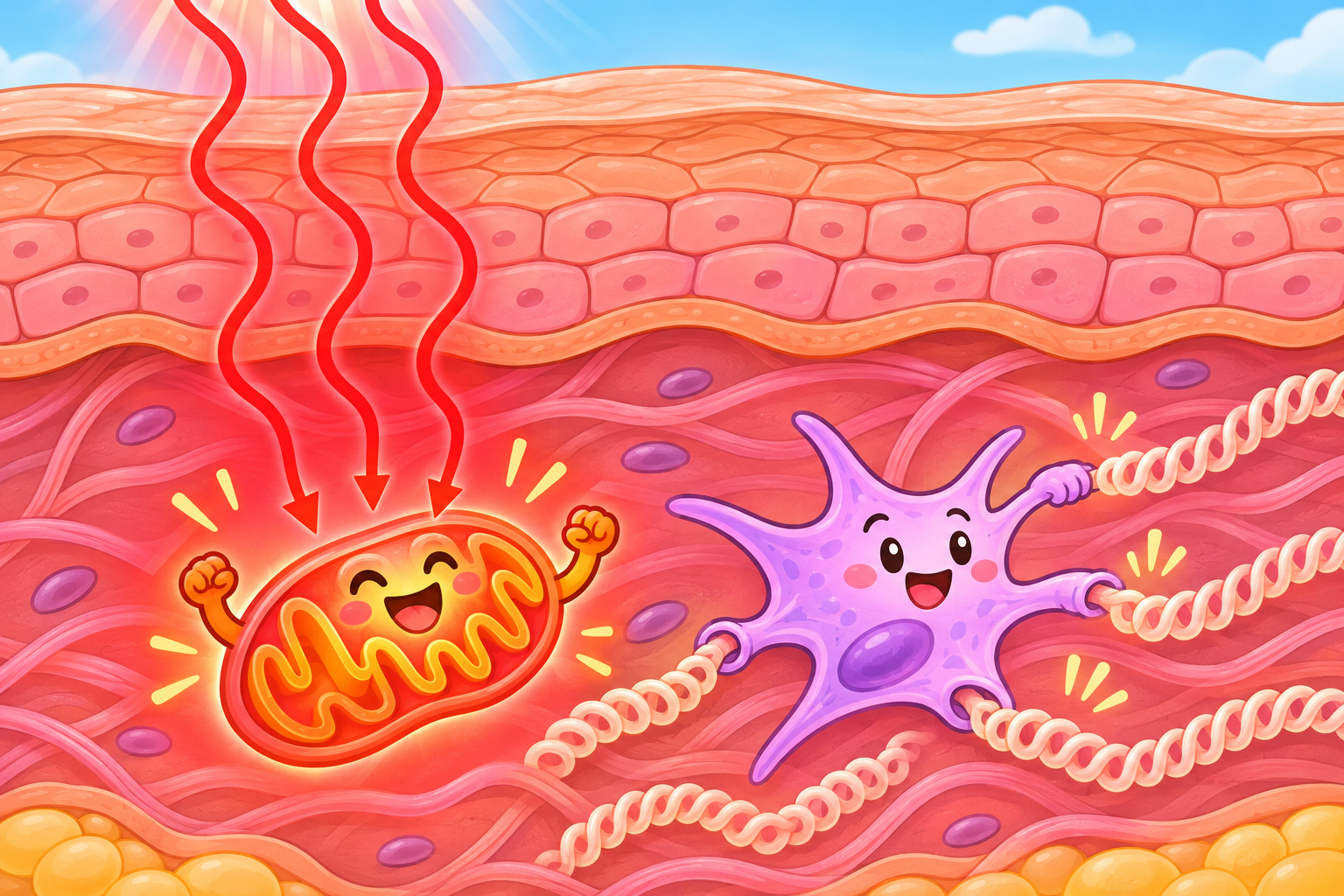
When the mitochondria absorb this light, several things happen:
- More Energy: The cell produces more ATP (adenosine triphosphate), which is the fuel cells use to function.
- Mild Stress Signals: The light creates a tiny, temporary burst of reactive oxygen species (ROS). In large amounts, ROS causes damage, but in tiny amounts, it acts as an alarm bell that wakes up the cell’s repair systems.
- Increased Blood Flow: The light triggers the release of nitric oxide, which opens up local blood vessels and improves circulation.
Together, these signals wake up your fibroblasts (FYE-bro-blasts). Fibroblasts are the cellular factories responsible for spinning new collagen fibers. When fibroblasts have more energy and receive repair signals, they start pumping out more collagen and elastin.
Related: Does Collagen Actually Reverse Skin Aging? What the Latest Science Shows
What the Research Shows: Anti-Aging and Healing
There is a solid foundation of laboratory and clinical research showing that red light therapy can encourage collagen production for anti-aging and wound healing.
A 2026 review in Cureus examined the mechanisms behind red light therapy. The researchers noted that red light at 630 to 660 nanometers successfully targets the mitochondria to stimulate collagen synthesis. They found that clinical trials consistently demonstrate short-term improvements in skin texture, collagen density, and wrinkle reduction.
Animal studies help us see this happening at a microscopic level. A 2025 study in Zoological Research looked at naturally aging mice. The researchers found that red light exposure led to a pronounced thickening of the dermis. The light activated specific genetic pathways (like TGF-beta) that directly instructed the fibroblasts to accumulate type I collagen, which is the strong, structural collagen that gives skin its firmness.
Red light may also help protect the collagen you already have. A 2024 mouse study in Current Issues in Molecular Biology tested whether red light could protect skin from ultraviolet (UV) damage. Mice treated with red light before being exposed to UVB rays retained much better collagen and elastin density compared to mice that only received UV exposure. The red light appeared to boost the skin’s natural antioxidant defenses.
Related: How UV Rays Actually Damage Skin (And What Science Says Protects It)
Marketing Claims vs. Scientific Reality
While the biology is sound, the way red light therapy is sold to consumers often stretches the truth.
A 2026 review in the Journal of Drugs in Dermatology specifically compared the scientific evidence of red light therapy against the marketing claims made by device manufacturers.
The researchers concluded that red light therapy is a safe, biologically plausible tool for mild photoaging and wound healing. However, they found that commercial marketing frequently exaggerates the speed, magnitude, and durability of the results.
In the scientific literature, improvements in collagen and skin texture are described as “modest” and “gradual.” It takes weeks of consistent use to see changes, and you have to keep using the device to maintain the results. In contrast, marketing materials often portray red light as a rapid, transformative solution that can replace other skincare interventions.
Related: The Science of Anti-Aging Skincare: What Actually Works
The Dosage Paradox: Building vs. Stopping Collagen
One of the most fascinating aspects of red light therapy is a concept called the biphasic dose response. This means that a little bit of light does one thing, but a lot of light does the exact opposite.

While low doses of red light stimulate fibroblasts to build collagen, high doses of red light actually tell fibroblasts to stop making collagen.
Why would doctors want to stop collagen production? To treat fibrosis (fye-BRO-sis). Fibrosis is the medical term for severe scarring. When you get a deep cut or undergo surgery, your fibroblasts can sometimes go into overdrive, pumping out too much collagen. This creates thick, raised, and painful scars (like keloids).
Researchers are now testing high-dose red light as a way to prevent these thick scars from forming.
- A 2018 study in Dermatologic Surgery found that high-fluence (high-dose) red light decreased the production of TGF-beta 1 in human skin cells. TGF-beta 1 is a primary driver of collagen production. By lowering it, the red light stopped the cells from overproducing scar tissue.
- A 2016 study in the Journal of Biophotonics showed that high-dose red light inhibited fibroblast proliferation and slowed down their migration speed, effectively calming down the aggressive healing response that causes raised scars.
- Scientists are even testing combinations of high-dose light and plant compounds. A 2017 study in Dermatologic Surgery found that combining high-dose red light with resveratrol (an antioxidant found in grapes) synergistically stopped fibroblasts from producing excess collagen.
This paradox is now moving into human trials. A 2019 clinical trial protocol published in Trials outlined a study using high-dose red light on patients undergoing facelift surgery. The goal is to see if exposing the surgical incisions to high doses of red light will prevent thick surgical scars from forming.
This biphasic response is why following the instructions on a cosmetic red light mask is so important. Leaving a mask on for an hour will not give you better anti-aging results than leaving it on for 10 minutes. In fact, too much light might cancel out the collagen-building benefits entirely.
Practical Guidance: What to Look for in a Device
If you decide to try red light therapy for collagen support, the research suggests keeping a few things in mind:
- Wavelengths Matter: Look for devices that explicitly state they use red light in the 630 to 660 nanometer range. Some devices also include near-infrared light (830 to 850 nanometers), which penetrates even deeper to reduce inflammation.
- Regulatory Clearance: Look for devices that are cleared by the FDA (or your local regulatory body). While this does not guarantee a miracle cure, it does mean the device has been tested for safety and actually emits the light it claims to emit.
- Consistency over Intensity: The science shows that short, frequent sessions (e.g., 10 minutes, a few times a week) are better than long, infrequent sessions.
The Bottom Line
Red light therapy is not just a social media trend. There is real, documented science showing that specific wavelengths of red light can alter how your cells behave.
For anti-aging, low doses of red light can stimulate fibroblasts to produce more collagen, leading to modest, gradual improvements in skin texture and firmness. However, it is not a magic wand. The results require weeks of consistent use, and the effects are generally mild compared to more invasive cosmetic procedures.
Interestingly, the science also shows that high doses of red light can do the opposite, inhibiting collagen production to help prevent severe scarring. This highlights just how powerful light can be as a biological tool, provided the dosage is correct.
*
Quick Reference: Key Studies
| Study Focus | Key Finding | Source |
|---|---|---|
| Red Light Mechanisms | Red light at 630-660 nm targets mitochondria to stimulate ATP and collagen synthesis, but dosing is critical. | PMID 42005232 |
| Marketing vs. Evidence | Red light provides modest, gradual skin improvements, but commercial marketing frequently exaggerates the speed and magnitude of results. | PMID 42696344 |
| Aging Skin & Collagen | Red light increased dermal thickness and type I collagen production in aging mice via specific cellular signaling pathways. | PMID 40808593 |
| UV Protection | Pre-treating skin with red light helped protect collagen and elastin from subsequent ultraviolet radiation damage. | PMID 38921009 |
| Scar Prevention (Fibrosis) | High-dose red light decreases collagen production and slows fibroblast activity, offering a potential treatment to prevent thick scars. | PMID 29846344 |
*
Last updated: November 2026
This article synthesizes findings from peer-reviewed research. It is for educational purposes only and does not constitute medical advice. Consult a healthcare provider before starting any new regimen.

Leave a Reply