
When you get a routine blood test, your doctor usually looks at a standard lipid panel. This panel includes your total cholesterol, LDL (often called “bad” cholesterol), HDL (often called “good” cholesterol), and your triglycerides. While LDL cholesterol often gets the most attention, science is revealing that triglycerides are just as important for understanding your long-term health.
To understand why, it helps to think of your bloodstream as a highway. Cholesterol acts like the building materials being transported to repair cells. Triglycerides (try-GLIS-er-ides), on the other hand, are the actual fuel. They are the main form of stored fat in your body. When you eat more calories than you need, your body packages those extra calories into triglycerides and stores them in fat cells for later use. Related: Understanding Fat Metabolism: How Your Body Actually Stores and Burns Fat

For decades, doctors simply looked at a single fasting triglyceride number to assess risk. However, recent research shows that how we test and interpret triglycerides is changing. Scientists are discovering that combining triglyceride numbers with other basic blood markers can provide a highly accurate window into your metabolic health, insulin resistance, and heart disease risk.
What the Research Shows
Recent scientific studies have shifted how we view triglyceride testing. Instead of just looking at raw numbers, researchers are using triglycerides as part of larger formulas to predict health outcomes.
The Rise of the TyG Index
One of the most significant developments in metabolic testing is the Triglyceride-Glucose index, commonly called the TyG index. This is a simple mathematical formula that combines your fasting triglyceride levels with your fasting blood sugar (glucose) levels.
A 2025 review in Nutrition, Metabolism, and Cardiovascular Diseases highlights that the TyG index is a highly effective, low-cost tool for identifying Insulin resistance (IN-suh-lin ree-ZIS-tuhns). Insulin resistance happens when your cells stop responding properly to the hormone insulin, forcing your body to produce more of it to keep blood sugar stable. Because traditional tests for insulin resistance are expensive and complex, the TyG index offers a practical alternative for everyday clinical use.

Research consistently links a high TyG index to poor cardiovascular outcomes:
- A 2025 study of European adults found that people with a higher TyG index had thicker carotid arteries (the main blood vessels in the neck). Thicker arteries are a known early warning sign of heart disease.
- A 2025 study in BMC Cardiovascular Disorders followed patients who had recently suffered a severe heart attack. The researchers found that a higher TyG index accurately predicted who was most likely to experience another major cardiovascular event within 30 days.
Adding Waist Size and Inflammation to the Mix
Scientists are also combining the TyG index with other health measurements to make it even more accurate.
For example, a 2025 study in Scientific Reports looked at patients with Type 2 diabetes. Researchers combined the TyG index with a measurement of the patient’s waist size (called the TyG-WWI index). They found that this combined score was a strong predictor of future heart failure and major coronary events.
Other researchers are combining the TyG index with markers of inflammation. C-reactive protein (SEE-ree-AK-tiv PRO-teen), or CRP, is a protein made by your liver when there is inflammation in your body. When scientists combine CRP with the TyG index, they get the CTI score. Related: What Blood Tests for Inflammation Actually Tell Us About Your Health
- A 2025 national cohort study in China followed over 5,700 people and found that a higher CTI score was linearly associated with a higher risk of stroke, particularly in people who already had early signs of metabolic issues.
- Similarly, a 2025 study using machine learning found that the CTI score was one of the strongest predictors of severe, three-vessel coronary artery disease.
Fasting vs. Non-Fasting Tests
Traditionally, patients are told to fast for 8 to 12 hours before a cholesterol test. However, a 2019 review in Current Opinion in Endocrinology, Diabetes, and Obesity notes that non-fasting triglyceride levels might actually be better predictors of cardiovascular events.
Since we spend most of our waking hours in a fed state, measuring triglycerides after a meal provides a more realistic picture of how the body handles fat in everyday life. When you eat, your body experiences Postprandial lipemia (post-PRAN-dee-ul lih-PEE-mee-uh), which is the natural temporary spike in blood fats. How quickly your body clears these fats from the bloodstream is a strong indicator of your metabolic health.
How Genetics Shape Your Levels
While diet and lifestyle play massive roles in triglyceride levels, genetics dictate how your body responds to the food you eat.
A 2020 study in PLoS One analyzed data from 97 different published papers to understand how genetics affect triglyceride spikes after eating. The researcher found evidence of a concept called “quantile-dependent expressivity.” In simple terms, this means that if you have genetic variants linked to high triglycerides (like mutations in the APOA5 or LPL genes), those genes will exert a much stronger negative effect if your baseline triglyceride levels are already high.
If your baseline triglycerides are low, your “bad” genes stay relatively quiet. But if your baseline levels rise due to poor diet or weight gain, those same genes amplify the problem, causing massive spikes in blood fat after every meal.
Severe Genetic Hypertriglyceridemia
In some cases, genetics cause extreme triglyceride elevations. A 2026 clinical review in The Journal of Clinical Endocrinology and Metabolism outlines the approach to Chylomicronemia (ky-lo-my-kro-NEE-mee-uh). This is a condition where fasting triglycerides exceed 885 mg/dL.
When levels get this high, the blood can physically become thick and milky. Patients with this condition are at a very high risk for acute pancreatitis, a painful and potentially life-threatening inflammation of the pancreas. A 2022 study in Arteriosclerosis, Thrombosis, and Vascular Biology showed that genetic testing can help identify which patients with severe hypertriglyceridemia are at the absolute highest risk for developing pancreatitis, allowing doctors to intervene earlier.
How This Might Work
Why exactly do high triglycerides cause heart disease? For a long time, scientists debated whether triglycerides directly damaged blood vessels or if they were just innocent bystanders traveling alongside “bad” LDL cholesterol.
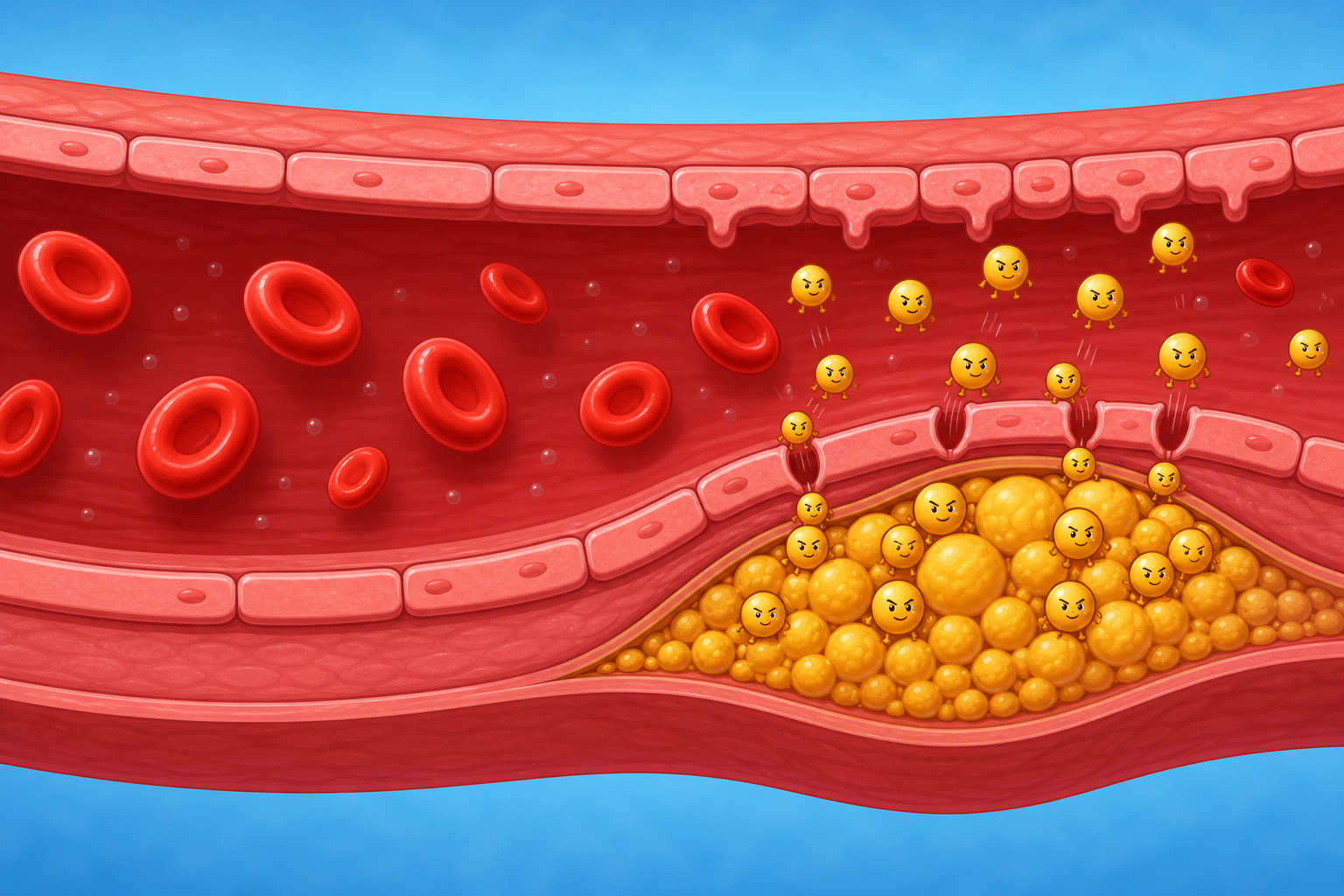
Current research points to the danger of “remnant cholesterol.” When your body uses the fuel from triglyceride-rich particles, what is left behind is a smaller, denser particle called a remnant. These remnants are small enough to penetrate the walls of your blood vessels. Once inside the vessel wall, they become trapped, trigger inflammation, and contribute to Atherosclerosis (ath-er-o-skluh-RO-sis), the buildup of plaque that leads to heart attacks and strokes.
Furthermore, high triglycerides are heavily linked to fat accumulating where it does not belong. A 2021 study in the Journal of Magnetic Resonance Imaging demonstrated that specialized MRI scans can accurately measure triglyceride buildup directly inside the muscle tissue of the human heart. This buildup of fat inside the heart muscle can eventually impact how well the heart pumps.
Practical Guidance and Treatments
When lifestyle changes like diet and exercise are not enough to lower triglycerides, doctors may turn to medications. However, the science on which medications actually prevent heart attacks is complex.
A 2024 review in Current Opinion in Cardiology summarized the latest clinical trials on triglyceride-lowering therapies:
- Omega-3 Fatty Acids: Not all fish oil supplements are equal. A highly purified form of the omega-3 fatty acid EPA (known as icosapent ethyl) has been shown in major trials to reduce the risk of cardiovascular death, heart attacks, and strokes by 25% in high-risk patients with elevated triglycerides. However, trials using mixed EPA and DHA supplements failed to show the same heart benefits.
- Fibrates: Medications known as fibrates (like pemafibrate) are very effective at lowering triglyceride numbers on a blood test. However, large clinical trials showed that despite lowering the numbers, they did not reduce the risk of heart attacks or strokes in patients with Type 2 diabetes. They did, however, show promise in reducing fat buildup in the liver.
For patients with extremely high triglycerides (over 500 mg/dL), the primary medical goal is preventing pancreatitis. A 2023 review in Current Opinion in Gastroenterology emphasizes that early intervention with strict dietary fat restriction and medications is required to keep levels safely below the 500 mg/dL threshold.
Common Questions About Triglyceride Testing
What is considered a normal triglyceride level?
Generally, a fasting triglyceride level under 150 mg/dL is considered normal. Levels between 150 and 199 mg/dL are borderline high, 200 to 499 mg/dL are high, and anything over 500 mg/dL is considered very high and carries a risk of pancreatitis.
Should I fast before my cholesterol test?
Historically, fasting for 8 to 12 hours was required. Today, many medical guidelines suggest that non-fasting tests are acceptable and sometimes even more useful for predicting heart risk. You should always follow the specific instructions provided by your doctor for your individual test.
Can losing weight lower my triglycerides?
Yes. Because triglycerides are stored energy, losing even 5% to 10% of your body weight can significantly reduce triglyceride levels in your blood.
The Bottom Line
Triglyceride testing is evolving rapidly. While the standard fasting number remains a core part of routine checkups, science shows that combining this number with blood sugar levels (the TyG index) or inflammation markers (the CTI score) provides a much clearer picture of your metabolic health and heart disease risk.
We know that high triglycerides contribute to blood vessel damage through remnant cholesterol, and that genetics play a major role in how your body handles fat after a meal. While lowering severe triglyceride levels is crucial for preventing pancreatitis, the best approach for protecting your heart involves a comprehensive look at your overall metabolic health, rather than just treating a single number on a lab report.
Quick Reference: Key Studies
| Study Focus | Key Finding | Source |
|---|---|---|
| TyG Index & Heart Attacks | A higher TyG index accurately predicted short-term adverse cardiovascular events in patients recovering from severe heart attacks. | PMID 40325387 |
| CTI Score & Stroke | Combining CRP (inflammation) with the TyG index (CTI score) strongly predicted stroke risk in adults with metabolic syndrome. | PMID 40859123 |
| TyG Index & Carotid Arteries | Higher TyG index scores correlated with thicker carotid arteries, an early sign of cardiovascular disease. | PMID 39806381 |
| Genetics & Post-Meal Spikes | Genetic variants affecting triglycerides have a much stronger negative effect when a person’s baseline triglyceride levels are already high. | PMID 32101585 |
| Triglyceride Treatments | Purified EPA omega-3s reduce heart disease risk, while fibrates lower triglycerides but fail to reduce cardiovascular events. | PMID 38482842 |
| Severe Hypertriglyceridemia | Genetic testing can help identify patients at the highest risk for developing acute pancreatitis due to high triglycerides. | PMID 36325899 |
Last updated: June 2026
This article synthesizes findings from peer-reviewed research. It is for educational purposes only and does not constitute medical advice. Consult a healthcare provider before starting any new regimen.



Leave a Reply