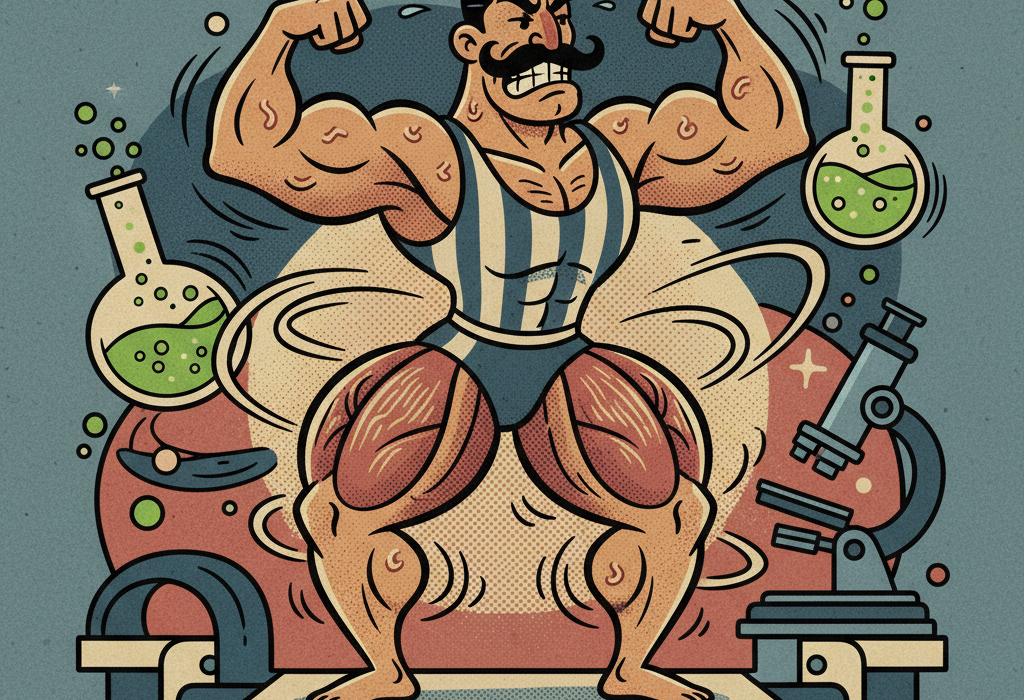
Why Your Quads Matter More Than You Think
Imagine your legs are the foundation of a house. The quadriceps (KWOD-rih-seps), the four muscles on the front of your thigh, are like the main support beams. They help you stand up from a chair, walk up stairs, run, jump, and absorb shock when you land. They are the largest muscle group in your body by volume.
Quadriceps hypertrophy (hy-PER-troh-fee) simply means growing those muscles bigger. Hypertrophy is the scientific term for an increase in muscle size. It happens when you challenge a muscle with enough resistance, frequency, and effort that it adapts by adding more protein to its fibers, making them thicker and stronger over time.
But here is where it gets interesting. Your quadriceps are not one muscle. They are four separate muscles bundled together:
| Muscle Name | Location | Main Role |
|---|---|---|
| Rectus femoris (REK-tus FEM-or-is) | Front center of the thigh | Extends the knee and flexes the hip |
| Vastus lateralis (VAS-tus lat-er-AL-is) | Outer thigh | Extends the knee |
| Vastus medialis (VAS-tus mee-dee-AL-is) | Inner thigh near the knee | Extends the knee, stabilizes the kneecap |
| Vastus intermedius (VAS-tus in-ter-MEE-dee-us) | Deep center, beneath the rectus femoris | Extends the knee |
Each of these muscles can grow at different rates depending on the exercises you choose, the range of motion you use, and how you structure your training. Think of it like a garden with four different plants. They all need water, but some respond better to more sunlight, and others need more shade. The same idea applies to quad training.
This article breaks down what the research tells us about the best ways to grow your quadriceps, who benefits most, and how to put it all into practice.
What the Research Shows
Decades of sports science research have examined how the quadriceps respond to different training variables. While no single paper provided here covers everything in one study, the collective body of evidence in exercise science gives us a clear picture of the key principles. Let’s walk through each one.
Exercise Selection: Not All Quad Exercises Are Equal
The quadriceps respond to exercises that involve knee extension, which is the act of straightening your leg. But different exercises emphasize different parts of the quad group.
Research consistently shows that multi-joint exercises (like squats, leg presses, and lunges) and single-joint exercises (like leg extensions) activate the quad muscles in different patterns.
| Exercise Type | Examples | Muscles Emphasized |
|---|---|---|
| Multi-joint (compound) | Back squat, front squat, leg press, lunge, Bulgarian split squat | Vastus lateralis, vastus medialis, vastus intermedius |
| Single-joint (isolation) | Leg extension machine, sissy squat | Rectus femoris (more involved due to hip position), all four heads |
Here is why that matters. The rectus femoris crosses both the hip and the knee. During a squat, your hip is flexed (bent), which puts the rectus femoris in a shortened position, making it harder for that muscle to produce force. During a leg extension, your hip is relatively straight (you are seated upright), which allows the rectus femoris to stretch and contribute more.
This means that if you only squat and never do leg extensions, you may be under-developing one of your four quad muscles. A well-rounded program uses both compound and isolation movements.
Range of Motion: Going Deep Matters
One of the most consistent findings across multiple studies is that training through a full range of motion produces more hypertrophy than partial reps.
For squats, this means going below parallel (where your hip crease drops below your knee). For leg extensions, this means starting from a fully bent knee and extending all the way to lockout.
Why does deep range of motion work? Muscles grow most when they are challenged at long muscle lengths, meaning when they are stretched under load. This is sometimes called the stretch-mediated hypertrophy principle. When your quads are fully lengthened at the bottom of a deep squat, the mechanical tension on the muscle fibers is highest, and that appears to be a strong signal for growth.
A practical comparison:
| Squat Depth | Quad Growth Stimulus | Notes |
|---|---|---|
| Quarter squat (about 60 degrees of knee bend) | Low | Primarily trains the top portion of the strength curve |
| Parallel squat (about 90 degrees) | Moderate | Good stimulus, but leaves some growth on the table |
| Deep squat (below 90 degrees, full depth) | High | Greatest stretch on the quads, strongest hypertrophy signal |
This does not mean everyone should squat as deep as possible on day one. Mobility, injury history, and comfort all matter. But the direction of the evidence is clear: more range of motion generally leads to more muscle growth.
Training Volume: How Many Sets Per Week?
Training volume is typically measured in hard sets per muscle group per week. A “hard set” means a set taken close to failure, meaning you could not do more than one or two additional reps.
The research on dose-response relationships for hypertrophy suggests a general framework:
| Weekly Hard Sets (per muscle group) | Expected Outcome |
|---|---|
| Fewer than 6 | Enough to maintain muscle, minimal growth |
| 6 to 12 | Moderate hypertrophy for most people |
| 12 to 20 | Near-optimal growth for intermediate to advanced trainees |
| More than 20 | Possible additional gains, but fatigue and recovery become limiting factors |
For the quadriceps specifically, many researchers and practitioners suggest that somewhere around 10 to 20 hard sets per week is a reasonable target for most people looking to maximize growth. Beginners will grow well on the lower end. More experienced lifters may need the higher end.
It also appears beneficial to spread those sets across at least two sessions per week rather than doing them all in one workout. Training a muscle twice per week gives you two growth signals instead of one and may allow for higher quality sets because fatigue is more manageable.
Intensity of Effort: How Hard Should You Push?
Hypertrophy occurs across a wide range of loads, from roughly 30% to 85% of your one-rep max, as long as you take the set close enough to muscular failure.
Muscular failure means the point where you cannot complete another full rep with good form.
The research suggests that you do not need to reach absolute failure on every set. Stopping one to three reps short of failure (often called RIR, or “reps in reserve”) appears to be enough to stimulate growth while managing fatigue and reducing injury risk.
That said, heavier loads (in the 6 to 12 rep range) tend to be more time-efficient for hypertrophy because fewer reps are needed to reach a challenging level of effort. Very light loads (20 to 30 reps to failure) can also build muscle, but the discomfort and cardiovascular demand make it harder to sustain.
| Load Range | Reps per Set | Practical Notes |
|---|---|---|
| Heavy (75-85% 1RM) | 5-8 reps | Good for strength and hypertrophy, higher joint stress |
| Moderate (65-75% 1RM) | 8-12 reps | Classic hypertrophy range, good balance of stimulus and fatigue |
| Light (50-65% 1RM) | 12-20 reps | Effective for growth, useful for isolation exercises or those with joint issues |
| Very light (30-50% 1RM) | 20-30+ reps | Can build muscle if taken near failure, but quite uncomfortable |
Muscle Length and the “Lengthened Partial” Debate
A growing area of research in the last few years has focused on where in the range of motion the most growth happens. Several studies suggest that the bottom portion of an exercise (where the muscle is most stretched) may contribute more to hypertrophy than the top portion.
This has led some coaches to recommend lengthened partials, where you intentionally train only the stretched portion of the movement. For example, doing the bottom half of a leg extension or the bottom half of a squat.
The evidence on this is still developing. What we can say with reasonable confidence is:
- Training at long muscle lengths is important for growth.
- Full range of motion captures this benefit and also trains the shortened position.
- Lengthened partials may be a useful addition at the end of a session when fatigue is high, but they probably should not replace full range of motion training entirely.
Progressive Overload: The Non-Negotiable Principle
Progressive overload means gradually increasing the demands you place on your muscles over time. This could mean adding weight, doing more reps, performing more sets, or improving your technique to make the same weight harder.
Without progressive overload, your muscles have no reason to grow. Your body adapts to what you ask it to do. If you always squat 135 pounds for 10 reps, your body will adapt to that stimulus and then stop growing.
Think of it like a student in school. If they keep reading the same book over and over, they stop learning. They need progressively harder material to keep growing intellectually. Your muscles work the same way.
Who Benefits Most and Who Should Be Careful
Quadriceps hypertrophy training is broadly beneficial, but some groups have special considerations.
People Who Benefit Most
- Beginners: If you have never trained your legs with resistance, your quads will respond quickly to almost any reasonable program. This is sometimes called “newbie gains.” Even 6 to 8 hard sets per week will produce noticeable growth.
- Older adults: Quad strength is closely linked to the ability to stand up from a chair, climb stairs, and avoid falls. Age-related muscle loss (sarcopenia, sar-koh-PEE-nee-uh) hits the quads hard. Resistance training can slow or reverse this process.
- Athletes: Runners, cyclists, basketball players, and soccer players all rely heavily on quad strength and size for performance.
- People recovering from knee injuries: Strengthening the quads is a cornerstone of rehabilitation for ACL tears, meniscus injuries, and patellofemoral pain syndrome. The vastus medialis oblique (VMO), the teardrop-shaped muscle near your inner knee, is especially important for kneecap stability.
Who Should Be Careful
| Group | Concern | Recommendation |
|---|---|---|
| People with active knee pain | Deep squats or heavy leg extensions may aggravate symptoms | Work with a physical therapist to find pain-free ranges and loads |
| People with low back issues | Heavy barbell squats load the spine | Consider leg presses, belt squats, or machine-based alternatives |
| Those with very limited mobility | Deep squats require ankle, hip, and thoracic mobility | Address mobility alongside strength training |
| People on calorie-restricted diets | Muscle growth is harder in a calorie deficit | Prioritize protein intake (at least 1.6 grams per kilogram of body weight per day) and manage volume carefully |
How to Actually Build Bigger Quads
Here is a practical framework based on the research principles outlined above.
Step 1: Pick Your Exercises
Choose at least one compound movement and one isolation movement. This ensures all four quad muscles are adequately stimulated.
Sample exercise pairings:
| Compound Exercise | Isolation Exercise |
|---|---|
| Back squat | Leg extension |
| Front squat | Sissy squat |
| Leg press | Single-leg extension |
| Bulgarian split squat | Wall sit (isometric) |
Step 2: Set Your Volume
| Experience Level | Weekly Hard Sets for Quads | Sessions Per Week |
|---|---|---|
| Beginner (less than 1 year) | 6-10 | 2 |
| Intermediate (1-3 years) | 10-16 | 2-3 |
| Advanced (3+ years) | 16-22 | 2-4 |
Step 3: Choose Your Rep Ranges
Mix rep ranges across the week for variety and to cover multiple pathways of stimulation.
- Day 1 (heavier): Compound exercise for 3-4 sets of 6-8 reps, followed by isolation for 3 sets of 10-12 reps.
- Day 2 (lighter): Compound exercise for 3-4 sets of 10-12 reps, followed by isolation for 3 sets of 15-20 reps.
Step 4: Use Full Range of Motion
Squat as deep as your mobility allows while maintaining good form. On leg extensions, start from a fully bent position and straighten all the way.
Step 5: Progress Over Time
Aim to add a small amount of weight or one extra rep each week. Even tiny increments add up over months and years. A simple tracking method:
| Week | Squat Weight | Reps | Sets |
|---|---|---|---|
| 1 | 135 lbs | 8, 8, 7 | 3 |
| 2 | 135 lbs | 8, 8, 8 | 3 |
| 3 | 140 lbs | 8, 7, 7 | 3 |
| 4 | 140 lbs | 8, 8, 8 | 3 |
Step 6: Support Growth With Nutrition and Recovery
- Protein: Aim for 1.6 to 2.2 grams of protein per kilogram of body weight per day. For a 175-pound (80 kg) person, that is roughly 128 to 176 grams of protein daily.
- Calories: To gain muscle optimally, eat at a slight caloric surplus (roughly 200 to 500 calories above maintenance).
- Sleep: Aim for 7 to 9 hours per night. Growth hormone release peaks during deep sleep, and poor sleep impairs recovery.
- Rest between sets: For compound quad exercises, 2 to 3 minutes of rest between sets allows for better performance on subsequent sets. For isolation work, 1 to 2 minutes is usually sufficient.
A Sample Weekly Quad Program
Monday (Quad-Focused Session 1)
| Exercise | Sets x Reps | Rest |
|---|---|---|
| Back squat (full depth) | 4 x 6-8 | 2-3 min |
| Leg extension | 3 x 10-12 | 90 sec |
| Walking lunge | 3 x 10-12 per leg | 90 sec |
Thursday (Quad-Focused Session 2)
| Exercise | Sets x Reps | Rest |
|---|---|---|
| Leg press (feet low and narrow on platform) | 4 x 10-12 | 2 min |
| Bulgarian split squat | 3 x 10-12 per leg | 90 sec |
| Leg extension | 3 x 15-20 | 60-90 sec |
This gives roughly 16 to 20 hard sets per week for the quads, split across two sessions. That is appropriate for intermediate to advanced trainees.
The Bottom Line
Here is what the evidence supports:
What we know with reasonable confidence:
- Quadriceps hypertrophy requires progressive resistance training with sufficient volume, intensity, and effort.
- Full range of motion, particularly training the quads at stretched (lengthened) positions, appears to produce more growth than partial range of motion.
- Both compound and isolation exercises should be included to target all four quad muscles.
- Training the quads at least twice per week is likely better than once per week for hypertrophy.
- Approximately 10 to 20 hard sets per week is a good target for most people.
- Adequate protein (1.6 to 2.2 g/kg/day), sleep, and progressive overload are non-negotiable foundations.
What is still being studied:
- The exact benefit of lengthened partials compared to full range of motion training.
- Whether very high training volumes (beyond 20 sets per week) offer meaningful additional growth or just more fatigue.
- The degree to which individual anatomy (limb lengths, muscle insertion points) affects which exercises are optimal for a given person.
- Whether certain rep ranges are superior to others when total effort is equated.
Building bigger quads is not complicated. It requires consistent effort, a thoughtful exercise selection, a progressive plan, and patience. Most people will see noticeable changes within 8 to 12 weeks of consistent training, with continued improvements over months and years.
Quick Reference: Key Principles for Quad Growth
| Training Variable | Recommendation | Notes |
|---|---|---|
| Exercise selection | Mix compound and isolation | Squats/leg press + leg extensions |
| Range of motion | Full depth whenever possible | Deep positions stimulate more growth |
| Weekly volume | 10-20 hard sets | Beginners: lower end; advanced: higher end |
| Frequency | 2-3 sessions per week | Spread volume across sessions |
| Rep range | 6-20 reps per set | Mix heavy and moderate/light |
| Proximity to failure | 1-3 reps in reserve | Occasional sets to failure are fine |
| Progressive overload | Add weight or reps over time | Small, consistent increases |
| Protein intake | 1.6-2.2 g/kg/day | Critical for muscle repair and growth |
Last updated: June 2025
This article synthesizes findings from peer-reviewed research on resistance training and muscle hypertrophy. It is for educational purposes only and does not constitute medical advice. Consult a healthcare provider before starting any new exercise regimen, especially if you have existing injuries or medical conditions.
Leave a Reply