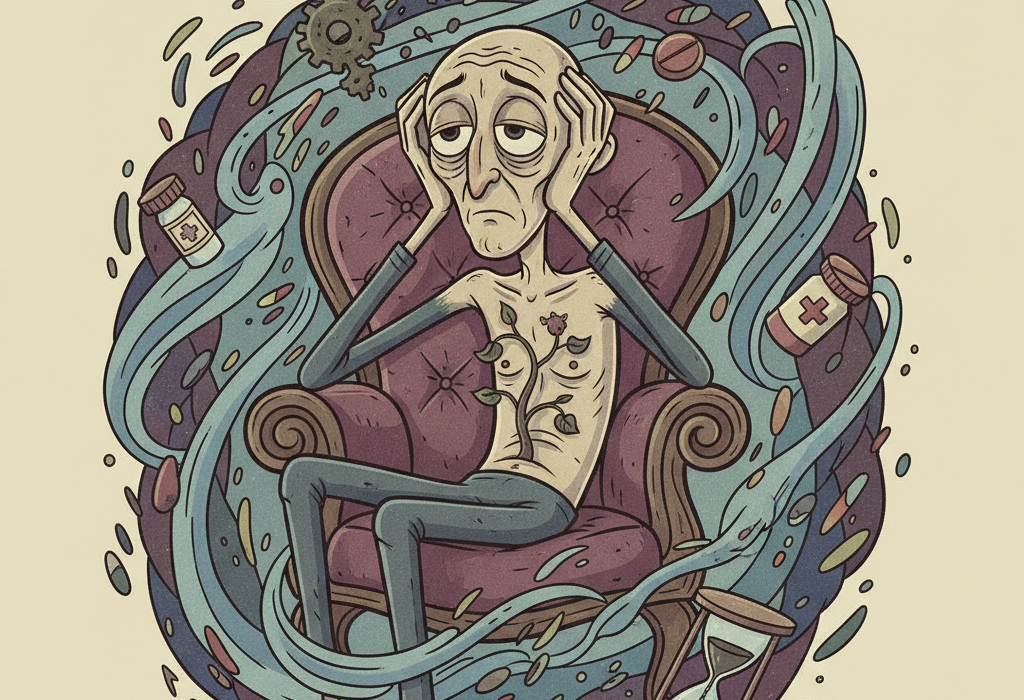
A Drug That Keeps Working After You Stop Taking It
Imagine you hire a contractor to fix one thing in your house, like patching a leaky roof. They do the job, but in the process they quietly rewire some of your electrical, mess with the plumbing, and change a few locks. Even after you fire them, the house still doesn’t work right.
That’s a rough analogy for what some men say happens when they take finasteride (fih-NAS-ter-ide), a widely prescribed pill for male-pattern hair loss and enlarged prostate. The drug works by blocking an enzyme that converts testosterone into a stronger hormone called dihydrotestosterone (dy-HY-dro-teh-STOS-ter-own), or DHT for short. Less DHT means less hair loss. It also means a smaller prostate.
For most men, finasteride works as intended, with side effects that go away after stopping the drug. But a small number of men report that certain side effects, especially sexual and psychological ones, stick around for months or even years after they stop taking it. This cluster of lingering symptoms has been called post-finasteride syndrome (PFS).
PFS is not yet recognized as an official diagnosis in medical classification systems. Some doctors question whether it is a distinct condition at all. Others believe it represents a real and underappreciated risk. Several recent studies have looked at PFS from different angles, including genetics, metabolic effects, mental health reporting data, and patient selection. Let’s walk through what they found.
What the Research Shows
The Symptoms Are Real, Even If the Mechanism Isn’t Clear
A 2025 case report in the International Journal of Impotence Research studied three young Chinese men (ages 20 to 30) who reported persistent symptoms after stopping finasteride. All three had used the drug intermittently for 1.5 to 2 years to treat hair loss. After stopping, they experienced:
- Erectile dysfunction (all three)
- Anxiety (all three)
- Insomnia (all three)
- Feelings of isolation (all three)
- Depression (one of the three)
- Suicidal thoughts (one of the three)
Two of the three men had noticeably shrunken testicles on physical exam. One had low total testosterone after stopping finasteride for seven months.
The researchers tried treating these patients with various medications, including testosterone-boosting drugs and erectile dysfunction pills. Some physical symptoms improved with treatment, but libido, psychological symptoms, and neurological issues were much harder to address.
| Symptom Category | Case 1 | Case 2 | Case 3 |
|---|---|---|---|
| Erectile dysfunction | Yes | Yes | Yes |
| Anxiety | Yes | Yes | Yes |
| Insomnia | Yes | Yes | Yes |
| Depression | Yes | No | No |
| Low libido | Yes | No | No |
| Testicular shrinkage | Yes | Yes | No |
| Memory/cognitive changes | Yes | No | Yes |
| Suicidal ideation | Yes | No | No |
This was a very small study (only three patients), so it cannot tell us how common PFS is. But it does provide detailed clinical documentation of the kinds of symptoms affected men report.
Genetics May Play a Role
The same case report also performed next-generation sequencing (NGS), a type of advanced genetic testing, on the three PFS patients and one healthy control. The researchers found variants in five genes: CA8, VSIG10L2, HLA-B, KRT38, and HLA-DRB1. Some of these genes are involved in immune function, cell connections, and inflammation.
However, the researchers were careful to note several limitations:
- The sample was extremely small (three patients)
- There was no comparison group of men who used finasteride without side effects
- The genetic variants may have existed before finasteride use, not because of it
- A prospective study (following people over time) would be needed to draw firmer conclusions
Still, this early-stage finding raises an interesting possibility: some men may be genetically more vulnerable to finasteride’s effects. If future research confirms this, genetic screening before prescribing finasteride could become a practical step.
The Drug May Create a Hidden Type of Androgen Deficiency
A 2025 review article in the International Journal of Impotence Research laid out a broader theory for why finasteride (and a related drug, dutasteride) might cause lasting problems. The review argues that blocking DHT production creates a form of androgen deficiency (AN-droh-jen deh-FISH-en-see), which means the body doesn’t have enough of certain male hormones to function normally, even when total testosterone levels look fine on a blood test.
Here’s why that matters. DHT binds to androgen receptors (AN-droh-jen ree-SEP-tors) about 10 times more strongly than regular testosterone. Think of testosterone as a regular key and DHT as a master key. Both open the same lock (the androgen receptor), but the master key turns more smoothly and stays in longer. When you take away the master key by blocking its production, the regular key can’t fully compensate in every tissue.
The review highlighted evidence from animal and human studies suggesting that blocking DHT production may contribute to problems in several body systems:
| Body System | Proposed Effect | Evidence Type |
|---|---|---|
| Liver | Fat accumulation, potential fatty liver disease | Animal studies + some human data |
| Pancreas/metabolism | Insulin resistance, increased diabetes risk | Animal studies + population studies |
| Eyes | Dry eye disease, inflammation of tear glands | Animal studies |
| Kidneys | Reduced androgen receptor expression, potential fibrosis | Animal studies |
| Sexual function | Erectile dysfunction, reduced libido | Clinical trials + animal studies |
| Brain/mood | Depression, anxiety (via reduced neurosteroids) | Clinical observations + biochemistry |
It is important to note that much of this evidence comes from animal models or observational studies, not randomized controlled trials designed to test these specific outcomes. One population-based study found a modestly higher risk of type 2 diabetes in men taking finasteride or dutasteride compared with men taking tamsulosin (a different prostate drug). But a separate nationwide study found the opposite, with lower diabetes rates in the treatment group. When studies directly contradict each other like this, we can’t draw firm conclusions.
The review authors themselves acknowledged that many clinical trials of finasteride never measured metabolic outcomes like blood sugar, liver fat, or insulin resistance as part of their study design. This means the absence of evidence in those trials is not evidence of absence.
Depression and Suicide Reports Increased, But the Timing Raises Questions
A 2025 study in the Journal of Cosmetic Dermatology took a different approach. Instead of studying individual patients, the researchers analyzed the FDA’s adverse event reporting database (called FAERS) to look for patterns in reports of depression, suicidal thoughts, suicidal behavior, suicide attempts, and completed suicide among finasteride users.
They split the data into three time periods:
- 2006 to 2011 (before PFS gained public attention)
- 2013 to 2018 (after the Post-Finasteride Syndrome Foundation was established in 2012)
- 2019 to 2023 (more recent reports)
Here’s what they found:
| Adverse Event | 2006-2011 | 2013-2018 | 2019-2023 |
|---|---|---|---|
| Completed suicide | No signal | No signal | Signal detected |
| Depression suicidal | No signal | Signal detected | Signal detected |
| Suicidal behavior | No signal | No signal | Signal detected |
| Suicidal ideation | No signal | Signal detected (ROR = 2.8) | Signal detected (ROR = 5.0) |
| Suicide attempt | No signal | No signal | Signal detected |
A “signal” here means that the rate of reporting a particular adverse event was statistically higher for finasteride users than for users of other drugs in the database.
The pattern is striking: no signals at all from 2006 to 2011, then increasing signals after 2012. The researchers suggest this could reflect the nocebo effect (noh-SEE-boh), which is when people develop symptoms because they expect to develop symptoms, perhaps after reading about PFS online. In other words, the increase in reports might be driven at least partly by heightened awareness rather than by the drug itself.
However, there’s another possible explanation: the reports could also reflect genuine side effects that were simply underreported before 2012 because patients and doctors didn’t know to look for them.
Interestingly, dutasteride (a similar drug that blocks even more types of the same enzyme) showed no signals for any of these adverse events across all three time periods. This is puzzling, because if the mechanism of blocking DHT were solely responsible, you might expect dutasteride to show similar or even stronger signals. The absence of dutasteride signals could point toward a nocebo effect specific to finasteride. Or it could simply reflect the fact that dutasteride is prescribed less often for hair loss, so fewer young men take it, and reporting patterns differ.
Pre-Existing Vulnerability May Matter
A 2025 commentary in the Journal of Cosmetic Dermatology raises another important consideration: many men who develop PFS symptoms may have had pre-existing vulnerabilities, such as anxiety disorders, depression, or other psychological conditions, before they started finasteride. The article suggests that better patient screening and selection before prescribing the drug could help reduce the incidence of PFS.
This is consistent with the case report findings, where none of the three patients had baseline psychiatric evaluations before starting finasteride. Without that baseline data, it is difficult to know whether their psychological symptoms were truly caused by the drug or whether the drug worsened pre-existing conditions.
Who Should Pay Attention
Who May Be Most at Risk
| Group | Risk Level | Reasoning |
|---|---|---|
| Young men (under 30) taking finasteride for hair loss | Higher concern | Most PFS case reports involve this group; longer expected treatment duration |
| Men with pre-existing depression or anxiety | Higher concern | May be more vulnerable to psychological side effects |
| Men with family history of metabolic disease | Worth monitoring | Some evidence of metabolic effects from long-term use |
| Older men taking finasteride for enlarged prostate | Lower concern (for PFS specifically) | Most clinical trials in this group show favorable safety profiles, though metabolic monitoring may still be warranted |
Who Should Be Cautious
- Men considering finasteride for cosmetic reasons (hair loss) should weigh the benefits against potential risks more carefully than men using it for a medical condition like BPH
- Anyone with a history of depression, anxiety, or suicidal thoughts should discuss this openly with their doctor before starting finasteride
- Men already experiencing sexual dysfunction should consider alternative treatments
What You Can Do in Practice
If you’re currently taking finasteride or considering it, here are some evidence-based steps:
Before Starting Finasteride
- Get a baseline mental health check. A simple screening questionnaire for depression and anxiety can establish where you stand before treatment. This was recommended by multiple studies reviewed here.
- Talk openly with your doctor about sexual function, mood, and any history of psychological conditions.
- Understand the realistic odds. Most men who take finasteride do not develop PFS. In clinical trials, sexual side effects affect a small percentage of users, and most resolve after stopping the drug. But “most” is not “all.”
While Taking Finasteride
- Pay attention to changes in mood, sleep, sexual function, or energy levels. If you notice persistent changes, bring them up with your doctor sooner rather than later.
- Don’t dismiss early warning signs. If you develop significant anxiety, depression, or sexual dysfunction, these are worth discussing rather than ignoring.
If You’ve Stopped and Symptoms Persist
- See a doctor who takes your concerns seriously. PFS may not be in the ICD, but the symptoms are real and treatable.
- Consider a hormonal workup. Blood tests for testosterone, estradiol, LH, FSH, and prolactin can identify correctable imbalances.
- Seek mental health support. If depression, anxiety, or suicidal thoughts are present, cognitive behavioral therapy and/or psychiatric medication can help, regardless of the underlying cause.
- Be patient but persistent. Some studies show symptoms can improve over time, but the timeline varies greatly from person to person.
What Doesn’t Help
- Self-diagnosing based on internet forums. While patient communities provide support, they can also amplify anxiety through the nocebo effect.
- Stopping finasteride abruptly without medical guidance.
- Assuming all symptoms are caused by finasteride. A thorough medical evaluation can identify other contributing factors.
The Bottom Line
What We Know
- Finasteride is effective for hair loss and enlarged prostate in most men.
- A small subset of men report persistent sexual, psychological, and physical symptoms after stopping the drug.
- These symptoms are well-documented in case reports and patient surveys, even though the underlying mechanisms remain unclear.
- There is a plausible biological explanation: blocking DHT may create a form of tissue-specific androgen deficiency that affects the brain, liver, eyes, kidneys, and sexual organs.
- Reports of depression and suicidal thoughts associated with finasteride increased significantly after 2012, which may reflect genuine underreporting before that date, a nocebo effect, or a combination of both.
What We Don’t Know
- How common PFS truly is. Without large, well-controlled prospective studies, the incidence remains uncertain.
- Whether genetics determine who is vulnerable. Early findings are interesting but based on only three patients.
- Whether the nocebo effect plays a significant role in symptom reporting.
- Why dutasteride (which blocks even more DHT) doesn’t show the same pattern of adverse event reports for depression and suicidality.
- How to effectively treat PFS once it develops. Current approaches are trial-and-error.
The Honest Assessment
PFS sits in a frustrating gray zone. The symptoms are clearly real for the men who experience them. But the science hasn’t yet caught up to explain why it happens to some people and not others, or to confirm a single clear causal pathway. What’s needed are large prospective studies that follow men from before they start finasteride, track their hormones, mental health, metabolic markers, and genetics over time, and compare outcomes with men who don’t take the drug.
Until then, informed consent is the best tool we have. Men considering finasteride deserve to know that persistent side effects are possible, even if they are uncommon. And doctors should screen for pre-existing risk factors before writing the prescription.
Quick Reference: Key Studies
| Study Focus | Key Finding | Source |
|---|---|---|
| Clinical features and genetics of PFS in 3 young men | All had erectile dysfunction, anxiety, insomnia; 5 potential risk genes identified via genetic sequencing | PMID 39953145 |
| Metabolic health risks of long-term finasteride/dutasteride use | Blocking DHT may cause tissue-specific androgen deficiency linked to liver disease, insulin resistance, dry eye, and kidney changes | PMID 37697052 |
| Pre-existing vulnerability in PFS patients | Suggests better patient screening could reduce PFS by identifying those with prior psychological conditions | PMID 40369941 |
| Depression and suicide reports in FDA database | No signals for depression/suicide before 2012; significant signals emerged after PFS gained public awareness; no signals found for dutasteride | PMID 40082195 |
Last updated: June 2025
This article synthesizes findings from peer-reviewed research. It is for educational purposes only and does not constitute medical advice. Consult a healthcare provider before starting any new regimen.
Leave a Reply