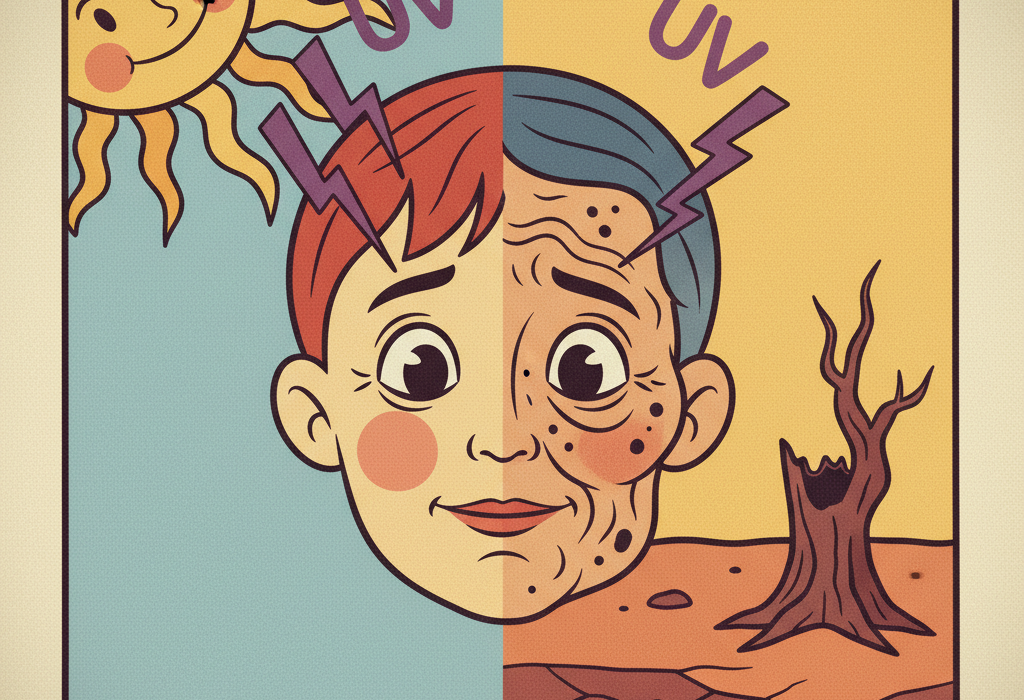
If you leave a piece of paper in the sun for a few weeks, it will gradually turn yellow, stiffen, and become brittle. Human skin undergoes a very similar process over the course of decades.
While chronological aging is a natural process dictated by time and genetics, the physical changes we most closely associate with getting older, such as deep wrinkles, sun spots, and loss of elasticity, are primarily driven by our environment. Scientists call this process photoaging (fo-toe-A-jing), which refers to premature skin aging caused by repeated exposure to light.
A 2002 study in the Archives of Dermatology established that while natural aging and photoaging share similar biological pathways, photoaging is highly dependent on the degree of sun exposure. In fact, research estimates that up to 80 percent of visible facial aging is directly tied to ultraviolet (UV) radiation.
But how does light actually change the physical structure of our skin? And what does the latest science say about preventing or reversing this damage? By looking at cellular biology, we can understand exactly what happens when sunlight meets the skin.
How Ultraviolet Light Actually Changes Your Skin
Sunlight contains different types of radiation, but two specific types of ultraviolet light are the primary culprits behind skin damage: UVA and UVB.
UVB rays have shorter wavelengths. They primarily affect the outer layer of the skin (the epidermis) and are the main cause of sunburns. UVA rays have longer wavelengths. They penetrate much deeper into the skin (the dermis), where they cause long-term structural damage.
When these rays hit the skin, they trigger a chain reaction of cellular events. A 2021 review in the Journal of Cosmetic Dermatology outlines the three main ways UV light damages skin cells:
1. DNA Damage: UV radiation directly damages the genetic material inside skin cells. While our bodies have built-in repair mechanisms, chronic exposure overwhelms this system, leading to permanent mutations.
2. Oxidative Stress: UV light causes the formation of reactive oxygen species (ree-AK-tiv OX-ee-jen SPEE-sheez), or ROS. These are highly unstable molecules that bounce around inside cells, damaging fats, proteins, and DNA in their path.
3. Collagen Breakdown: In response to oxidative stress, the skin produces enzymes called matrix metalloproteinases (MAY-trix meh-TAL-oh-PRO-tee-in-ay-zez), or MMPs. While MMPs normally help clear away old tissue during wound healing, UV exposure causes them to become overactive and break down healthy collagen and elastin.
Over time, this continuous cycle of damage and incomplete repair leaves the skin structurally weaker, resulting in wrinkles and sagging.
The Energy Crisis in Skin Cells
Skin cells require a massive amount of energy to constantly repair themselves. This energy is produced by mitochondria (my-toe-KON-dree-uh), which act as the microscopic power plants inside our cells.
A 2020 study in Cell Death & Disease highlights that mitochondria are particularly vulnerable to UV damage. When UV rays penetrate the skin, they damage mitochondrial DNA. This causes the mitochondria to become dysfunctional, producing less energy and even more reactive oxygen species. This creates a destructive feedback loop where the damaged energy factories actively contribute to further skin aging.
The Surprising Link Between Sugar and Sun Damage
Sunlight is not the only factor that degrades collagen. The sugar we consume also plays a direct role in skin aging, and UV light makes this process significantly worse.
When we have excess sugar in our bloodstream, the sugar molecules can attach themselves to proteins like collagen and elastin. This non-enzymatic reaction forms complex molecules called advanced glycation end products (ad-VANST gly-KAY-shun END prod-ukts), or AGEs.
A 2022 review in Nutrients explains that when collagen becomes glycated, it turns stiff and brittle. Worse, AGEs accumulate in the skin over time. When UV light hits skin that is already loaded with AGEs, the damage is amplified. The combination of UVA radiation and AGEs creates massive amounts of oxidative stress, making the collagen completely resistant to the body’s natural repair processes.
What the Latest Research Shows About Protection
For decades, the standard advice for preventing photoaging was simply to wear sunscreen to block UVB rays. Today, research shows that comprehensive protection requires a multi-layered approach.
Broad-Spectrum and Visible Light Protection
A 2025 review in the American Journal of Clinical Dermatology notes a shift in how dermatologists view sun protection. We now know that visible light and infrared light also contribute to skin aging and hyperpigmentation (dark spots).
Standard chemical sunscreens do not block visible light. To protect against this, researchers point to tinted sunscreens containing iron oxides, which physically block visible light from penetrating the skin. Related: The Science of Sunscreen: Safety, Vitamin D, and Skin Health
Topical Antioxidants
Because no sunscreen blocks 100 percent of UV rays, some reactive oxygen species will always form in the skin. This is where antioxidants come in. Antioxidants neutralize reactive oxygen species before they can damage collagen or DNA.
Vitamin C is the most abundant antioxidant naturally found in the skin. A 2025 review in the South African Family Practice journal confirms that Vitamin C not only provides antioxidant protection against solar damage but also actively promotes the production of new collagen and reduces excess melanin (pigment) synthesis. However, Vitamin C is notoriously unstable in skincare products, leading researchers to constantly develop new, more stable derivatives.
Dietary Defenses
What you eat also influences how your skin handles UV exposure. A 2024 meta-analysis in Critical Reviews in Food Science and Nutrition looked at 21 intervention trials regarding tomatoes and lycopene (the antioxidant that gives tomatoes their red color).
The researchers found that supplementing with lycopene significantly reduced UV-induced skin redness, decreased the enzymes that break down collagen (MMPs), and improved overall skin density. While eating tomatoes is not a replacement for sunscreen, the research suggests that dietary antioxidants act as an internal defense mechanism against photoaging.
Emerging Technologies in Skin Repair
Scientists are currently exploring advanced methods to actively reverse photoaging at the cellular level. While many of these are still in the early stages of research, the results are notable.
- Plant-Derived Exosomes: Exosomes are tiny cellular messengers that carry proteins and genetic material. A 2025 study in the International Journal of Nanomedicine successfully extracted exosomes from Aloe vera and applied them to UV-damaged skin cells. The researchers found that these nanoparticles promoted antioxidant pathways, reduced DNA damage, and delayed skin photoaging in mice.
- Microneedle Delivery: Getting protective compounds deep into the skin is a major challenge. A 2025 study in the Journal of Nanobiotechnology used dissolving microneedles to deliver human stem cell exosomes and green tea extract (EGCG) directly into UV-damaged skin. This combination synergistically reduced oxidative stress, lowered inflammation, and promoted tissue regeneration.
Related: Anti-Aging Skincare and Procedures: What Science Actually Shows
Common Questions About UV Damage and Skin Aging
Does UV light damage skin through windows?
Yes. While most glass blocks UVB rays (the ones that cause sunburn), standard glass allows UVA rays to pass through. Because UVA rays penetrate deeper and cause structural aging, sitting by a sunny window still contributes to photoaging.
Can skin recover from sun damage?
The skin has a remarkable ability to repair itself, but this ability decreases with age and chronic exposure. While you cannot erase all genetic mutations caused by past sunburns, using sun protection and antioxidants can halt further damage and allow the skin’s natural collagen production to slowly rebuild tissue.
Do people with darker skin need to worry about photoaging?
Yes. While more melanin provides a higher natural protection against UVB-induced sunburns and skin cancer, UVA rays and visible light still penetrate darker skin. In skin of color, photoaging often presents as uneven pigmentation, dark spots, and structural sagging rather than fine wrinkles.
Practical Guidance
Based on the current scientific consensus, a comprehensive approach to protecting skin from photoaging includes:
- Daily Sunscreen: Use a broad-spectrum sunscreen (SPF 30 or higher) every day, regardless of the weather.
- Visible Light Protection: If you struggle with hyperpigmentation or melasma, consider a tinted sunscreen containing iron oxides to block visible light.
- Topical Antioxidants: Applying a formulated Vitamin C serum in the morning can neutralize the free radicals that bypass your sunscreen.
- Dietary Support: Consuming a diet rich in antioxidants (like lycopene from cooked tomatoes) provides a baseline of internal defense against oxidative stress.
Where The Science Is Still Uncertain
While the mechanisms of UV damage are well understood, the efficacy of newer reversal treatments remains under investigation. Technologies like stem-cell exosomes and advanced microneedle delivery systems show excellent results in isolated cell cultures and animal models. However, large-scale, long-term human trials are still needed to determine standard dosing, safety, and precise clinical outcomes for humans.
Additionally, while we know that systemic antioxidants (like those from diet) correlate with better skin resilience, researchers are still determining exactly how much of an ingested nutrient actually makes it to the outer layers of the skin during active sun exposure.
The Bottom Line
Skin aging is not just a matter of passing time; it is largely a physical reaction to environmental light and oxidative stress. Ultraviolet radiation damages cellular DNA, cripples the skin’s energy-producing mitochondria, and triggers enzymes that actively dismantle collagen. This damage is further complicated by dietary factors like excess sugar, which stiffens the skin’s structural proteins.
However, the science is clear that this process can be slowed. By combining broad-spectrum physical protection with topical and dietary antioxidants, it is possible to defend the skin at a cellular level, preserving its function and structure for decades to come.
Quick Reference: Key Studies
| Study Focus | Key Finding | Source |
|---|---|---|
| Photoaging vs. Chronological Aging | UV irradiation is the primary environmental factor causing skin aging; photoaging and chronological aging share fundamental molecular pathways. | PMID 12437452 |
| UV Impact on Skin Cells | UV radiation changes cell metabolism, induces oxidative stress, and increases enzymes (MMPs) that degrade collagen. | PMID 33655657 |
| Mitochondria and Skin Aging | UV exposure damages mitochondrial DNA, causing an energy crisis that accelerates skin aging and wrinkling. | PMID 32518230 |
| Skin Glycation | Sugar forms advanced glycation end products (AGEs) that crosslink collagen; UV light amplifies this damage. | PMID 36364850 |
| Vitamin C and Skin | Vitamin C acts as a vital antioxidant, reducing melanin synthesis and protecting against UV-induced damage. | PMID 40776734 |
| Lycopene and Photoaging | Dietary supplementation with tomato and lycopene reduces skin erythema and enzymes that break down collagen. | PMID 36606553 |
| Sunscreens and Visible Light | Visible and infrared light contribute to photoaging; tinted sunscreens and antioxidant additives offer enhanced protection. | PMID 40072791 |
Last updated: May 2026
This article synthesizes findings from peer-reviewed research. It is for educational purposes only and does not constitute medical advice. Consult a healthcare provider before starting any new regimen.

Leave a Reply