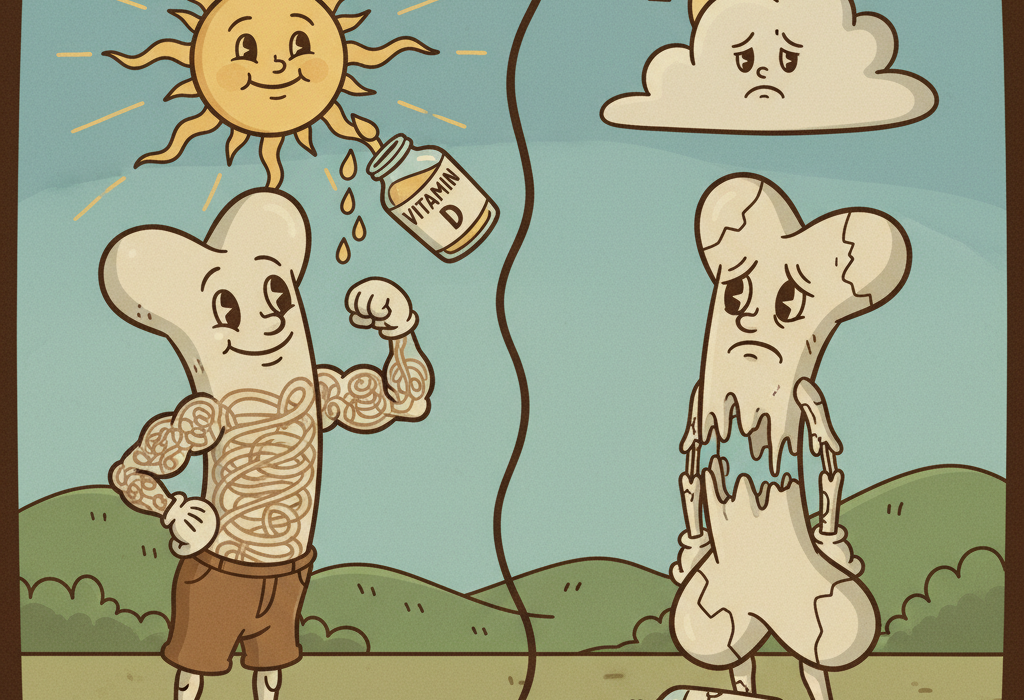
For decades, doctors and health campaigns have promoted vitamin D as a vital supplement for building strong bones and preventing fractures. It is commonly paired with calcium in daily multivitamins and heavily marketed to older adults. But does taking extra vitamin D actually increase your bone mass?
The short answer is: it depends entirely on where your vitamin D levels are right now.
If you are deficient in vitamin D, supplements are highly effective at protecting your skeleton and restoring bone health. However, if your blood levels are already in the normal range, taking extra vitamin D does not build denser bones or offer additional fracture protection.
This article explores what peer-reviewed research actually says about how vitamin D interacts with your bones, who truly benefits from supplementation, and why the relationship between bone density and fracture risk is more complicated than it seems.
How This Might Work: The Calcium Connection
To understand vitamin D, we first have to understand calcium. Your bones are essentially a storage bank for calcium and other minerals. However, calcium is also required for your heart to beat, your blood to clot, and your nerves to send signals. Because these functions are critical for survival, your body prioritizes keeping the calcium levels in your blood tightly regulated.
When you eat calcium-rich foods, your body needs a way to absorb that mineral from your digestive tract into your bloodstream. This is where vitamin D comes in.
Vitamin D acts as a passkey that allows your intestines to absorb calcium efficiently. According to a 2007 review in the Novartis Foundation symposium, without adequate vitamin D, your body simply cannot absorb enough calcium from your diet, no matter how much milk you drink or cheese you eat.

When blood calcium levels drop, your body releases parathyroid hormone (par-uh-THIGH-royd HOR-mohn), which is a chemical messenger that pulls calcium out of your bones to keep your blood levels stable. Over time, this constant withdrawal weakens the skeleton. In severe cases of vitamin D deficiency, this leads to a condition called osteomalacia (os-tee-oh-muh-LAY-shuh), where bones become noticeably soft and weak.
Related: What Science Actually Says About Calcium Supplements
What the Research Shows: The Threshold Effect
For a long time, the medical community assumed that if some vitamin D was good for bones, more must be better. Scientists call this a “dose-response” theory. However, recent large-scale reviews have proven this false. Vitamin D does not act as a magical bone-building tonic. Instead, it acts as a necessary nutrient that fulfills a specific quota.

A major 2014 meta-analysis in Lancet evaluated 23 studies involving over 4,000 adults. The researchers specifically looked at bone mineral density (BOHN MIN-er-ul DEN-si-tee), which is a measurement of how much calcium and other minerals are packed into a segment of bone.
The researchers found that vitamin D supplements provided a small benefit to bone mineral density at the femoral neck (the top of the thigh bone) only in people who had baseline blood levels below 50 nmol/L (a marker of deficiency). For people whose blood levels were already above this threshold, taking vitamin D supplements provided no significant increase in bone density at the spine, hip, forearm, or total body.
This concept was further explained in a 2015 review in the Journal of endocrinological investigation. The author noted that vitamin D is a substrate, meaning it is a raw material the body uses to maintain normal function. Once the body has enough raw material to prevent osteomalacia and keep calcium levels stable, adding more of the material does not stimulate the body to build extra bone.
This pattern holds true for younger populations as well. A 2011 editorial in the BMJ highlighted that healthy children with normal vitamin D levels do not see bone density improvements from supplements. However, children who are deficient do experience clinically useful improvements in bone mineral content when supplemented.
Who Actually Needs Vitamin D Supplements?
Because of the “threshold effect” described above, the people who benefit most from vitamin D supplements are those at high risk for deficiency. Certain medical conditions, lifestyle factors, and life stages can drastically reduce how much vitamin D your body absorbs or produces.
People Who Have Had Bariatric Surgery
Bariatric (weight-loss) surgeries, particularly the Roux-en-Y gastric bypass, alter the digestive tract. The surgery bypasses the upper part of the small intestine, which is the primary site where vitamin D and calcium are absorbed. A 2018 review in the Journal of clinical densitometry found that 60% of severely obese patients already have vitamin D deficiency before surgery, and the malabsorption caused by the procedure worsens the problem. These patients often require highly individualized, larger doses of vitamin D to prevent rapid bone loss.
People with Chronic Liver Disease
The liver plays a mandatory role in processing vitamin D. When your skin makes vitamin D from sunlight, it is in an inactive form. The liver is responsible for converting it into 25-hydroxyvitamin D, the form that circulates in your blood. A 2016 review in the Indian journal of gastroenterology reported that 90% of patients with alcoholic liver cirrhosis have inadequate vitamin D levels. In these patients, bone density loss is common, and correcting nutritional deficiencies is a primary treatment strategy.
Children and Adults on Anti-Epileptic Drugs
Medications used to control seizures can interfere with bone health. A 2010 review in Pediatric neurology explained that certain older anti-epileptic drugs induce enzymes in the liver that break down vitamin D too quickly. This rapid breakdown leads to lower circulating vitamin D, higher parathyroid hormone, and eventually decreased bone density. Patients on chronic anti-epileptic therapy often require routine screening and supplementation.
Pregnant Women and Breastfed Infants
Pregnancy demands a massive amount of calcium to build the fetal skeleton. A 2025 study in Ginekologia polska notes that maternal calcium stores are mobilized during this time, which can decrease the mother’s bone mineral density. Vitamin D deficiency worsens this decline. Furthermore, breast milk is naturally quite low in vitamin D. A 2020 Cochrane review confirmed that supplementing breastfed infants with 400 IU of vitamin D daily prevents insufficiency, though the direct long-term impact on bone density remains hard to measure.
Older Adults Who Spend Time Indoors
As we age, our skin becomes less efficient at producing vitamin D from sunlight. Additionally, older adults often spend less time outdoors. A 2011 study in Nutrition looked at healthy elderly women in Thailand. Despite living in a tropical, sunny climate, nearly 32% of the women had vitamin D insufficiency. The researchers found a positive relationship between adequate vitamin D levels and bone density at the femoral neck, highlighting that age and lifestyle can override geography.
The Paradox: Fractures, Falls, and Bone Density
One of the most confusing aspects of bone research is that bone mineral density does not perfectly predict who will break a bone.
A 2011 meta-regression in Osteoporosis international analyzed 15 trials involving over 47,000 patients taking calcium with or without vitamin D. The researchers looked to see if increases in bone density predicted a lower risk of fractures. Surprisingly, they found no strong evidence of a relationship. The magnitude of the change in spine or hip density did not fully explain the reduction in fracture risk.
How can a supplement reduce fractures if it does not drastically increase bone density?
Science points to a few possibilities. First, vitamin D and calcium might improve the micro-architecture or “quality” of the bone in ways that standard bone scans cannot easily see. Second, vitamin D has receptors in muscle tissue. A 1996 study in Maturitas followed elderly nursing home residents receiving annual mega-doses of vitamin D. While their bone density did not change compared to a control group, previous research showed this treatment reduced fractures. The authors suggested that vitamin D might improve nervous and muscular control, reducing the tendency to fall. Fewer falls naturally equal fewer broken bones.
Related: The Science of Balance Training for Fall Prevention: What Actually Works
Common Questions About Vitamin D and Bones
Can I take too much vitamin D?
Yes. Because vitamin D is fat-soluble, your body stores excess amounts rather than flushing them out in urine. A 2008 review in The American journal of clinical nutrition detailed the pharmacokinetics of vitamin D toxicity. Extremely high levels (usually above 750 nmol/L) can cause hypercalcemia, a dangerous condition where too much calcium builds up in the blood, leading to kidney damage and soft tissue calcification. Experts suggest keeping levels well below 250 nmol/L to maintain a wide margin of safety.
Does genetics or race affect vitamin D needs?
Research shows that the relationship between vitamin D blood levels and bone density can vary by genetics and race. A 2013 study in the Journal of pediatric gastroenterology and nutrition looked at children with Crohn’s disease. They found that African American children had significantly lower vitamin D levels than Caucasian children, yet both groups had similar bone mineral density. Conversely, a 2019 study in Current molecular medicine found that specific genetic variations in the vitamin D receptor gene among healthy Saudi females strongly predicted lower bone density. This means that a “normal” blood level for one person might not be optimal for another.
The Bottom Line / Takeaways
Based on decades of clinical trials and metabolic research, here is what we currently know about vitamin D and bone density:
- It prevents bone loss, but does not build extra bone. Vitamin D is required to absorb calcium. If you are deficient, supplementing will protect your bones. If your levels are already normal, extra vitamin D will not make your bones denser.
- Routine supplementation is not for everyone. For healthy, community-dwelling adults with normal vitamin D levels, high-dose supplements do not reduce fracture risk.
- Certain populations need it. People with malabsorption issues (like bariatric surgery or Crohn’s disease), liver disease, those taking anti-epileptic medications, and elderly adults with low sun exposure are highly likely to benefit from supplements.
- More is not always better. Doses of 400 to 800 IU per day are generally enough to prevent deficiency in healthy adults. Extremely high doses can lead to toxicity without providing additional bone benefits.
Quick Reference: Key Studies
| Study Focus | Key Finding | Source |
|---|---|---|
| Meta-analysis of bone density | Vitamin D supplements do not increase bone density in adults unless baseline levels are deficient (<50 nmol/L). | PMID 24119980 |
| Vitamin D as a substrate | Vitamin D acts to prevent osteomalacia rather than acting as a tonic that continuously builds bone. | PMID 25038903 |
| Bariatric surgery | 60% of severely obese patients have vitamin D deficiency before surgery, which worsens after intestinal bypass. | PMID 28427988 |
| Anti-epileptic drugs | Certain seizure medications accelerate vitamin D metabolism, putting children at risk for poor bone health. | PMID 20472188 |
| Bone density vs fractures | Changes in bone mineral density do not fully explain the fracture-reduction benefits seen in some calcium/vitamin D trials. | PMID 21060990 |
| Vitamin D toxicity | Toxicity generally occurs at blood levels above 750 nmol/L, causing dangerous calcium buildup in the blood. | PMID 18689406 |
| Breastfed infants | Supplementing breastfed infants with 400 IU daily prevents vitamin D insufficiency. | PMID 33305822 |
Last updated: November 2026
This article synthesizes findings from peer-reviewed research. It is for educational purposes only and does not constitute medical advice. Consult a healthcare provider before starting any new regimen.


Leave a Reply