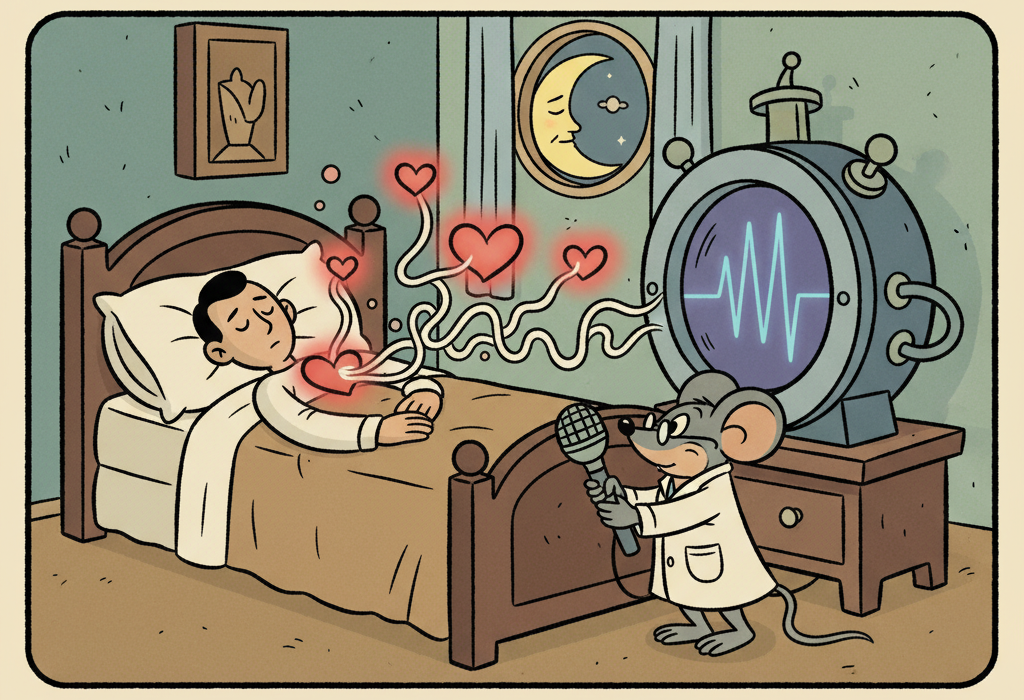
Have you ever woken up suddenly in the middle of the night with your heart racing? For most people, this is an occasional annoyance caused by a bad dream or a sudden noise. But for millions of others, this happens dozens of times a night without them even realizing it.
Sleep is supposed to be a time of rest for your entire body, especially your cardiovascular system. However, conditions that disrupt sleep can force your heart to work overtime. A 2022 review in Advances in experimental medicine and biology estimates that nearly 1 billion adults worldwide suffer from some form of sleep apnea, making it a massive global health issue.
So, what exactly happens to your heart when your sleep is disrupted? Let us look at what the latest science says about sleep, breathing, and your heart rate.
The Connection Between Breathing and Heart Rate
To understand how sleep affects the heart, we first need to understand two key concepts: the autonomic nervous system and heart rate variability.
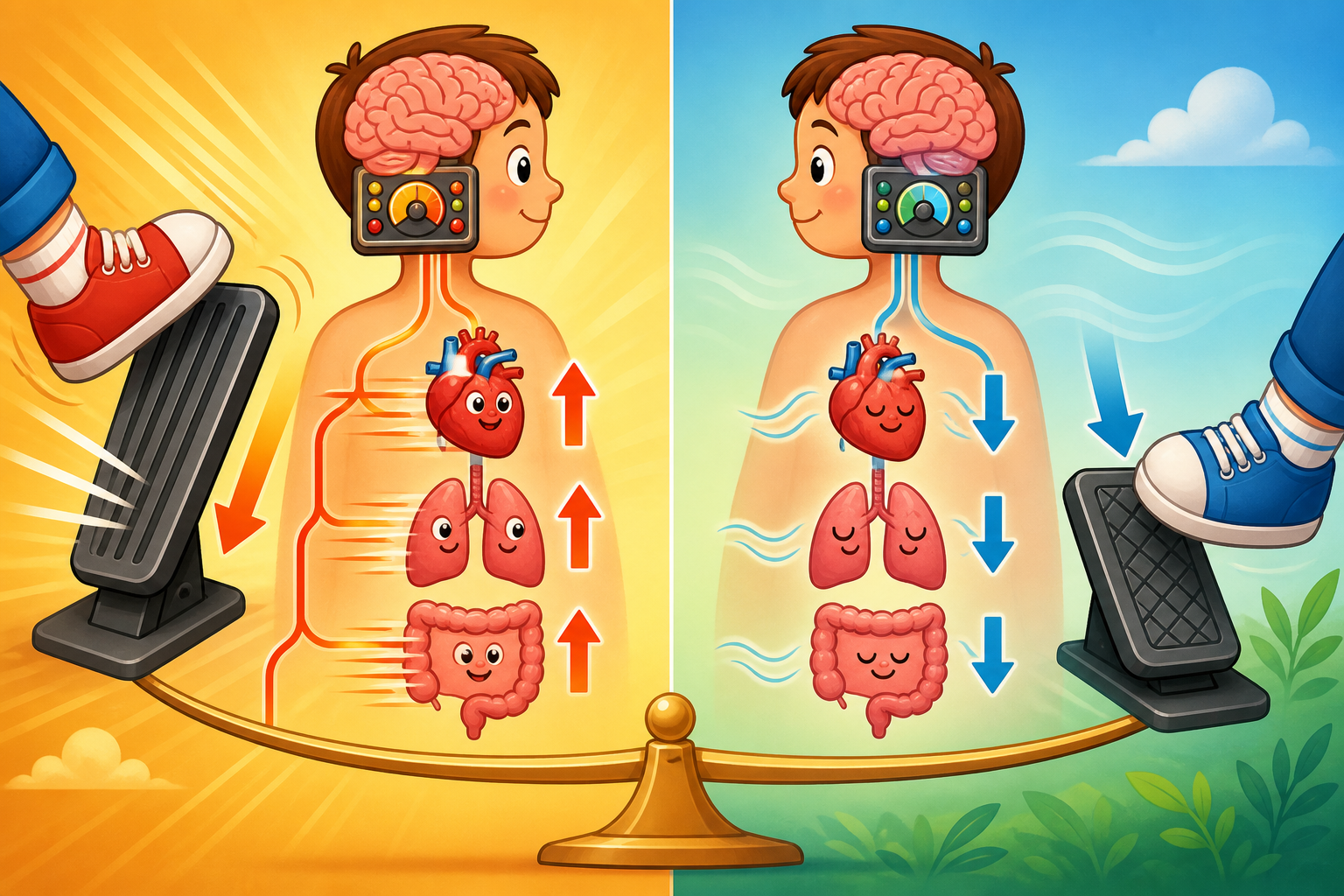
- Autonomic nervous system (aw-tuh-NOM-ik NUR-vus SIS-tum): This is the automatic control center of your body. It manages things you do not have to think about, like breathing, digestion, and your heartbeat. It has two main modes. The sympathetic mode acts like a gas pedal, speeding things up during stress. The parasympathetic mode acts like a brake pedal, slowing things down to rest and digest.
- Heart rate variability (HART rayt vair-ee-uh-BIL-ih-tee) or HRV: This is the measurement of the tiny differences in time between each heartbeat. A healthy heart does not beat like a perfect metronome. Instead, the time between beats constantly changes based on your breathing and environment. High HRV generally means your body is adaptable and healthy.
During normal sleep, your “brake pedal” is engaged. Your heart rate drops, your blood pressure lowers, and your HRV follows a predictable, restorative pattern. But when sleep is interrupted, this delicate balance is thrown off.
Related: How Your Circadian Rhythm Controls Sleep (And What Science Says About Fixing It)
What the Research Shows About Sleep Apnea
The most common sleep breathing disorder is obstructive sleep apnea (ob-STRUK-tiv sleep AP-nee-uh), often called OSA. This happens when the muscles in the back of the throat relax too much, causing the airway to collapse. The person stops breathing for ten seconds or more, their oxygen levels drop, and their brain briefly wakes them up to gasp for air.
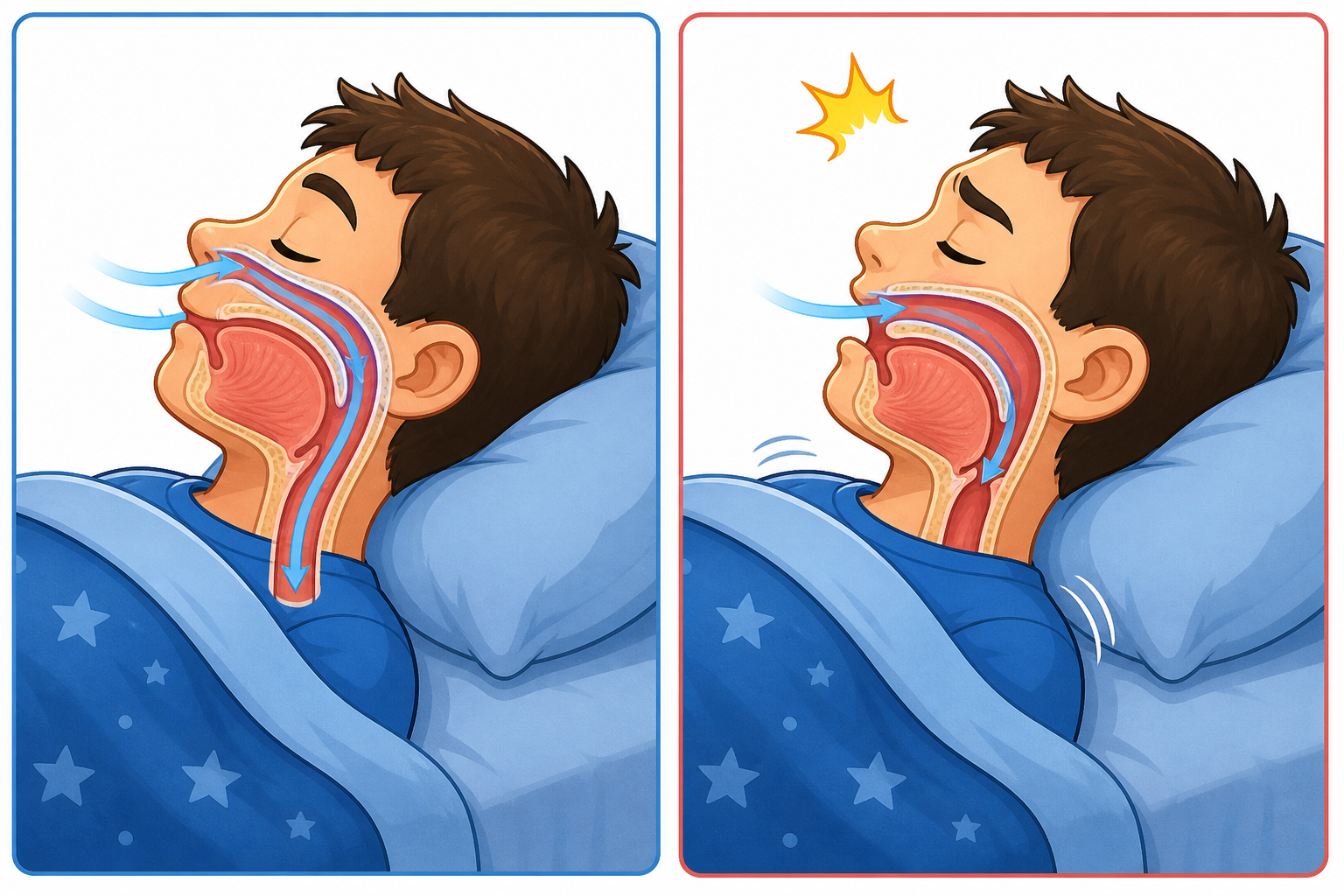
When this happens, the body panics. It slams on the “gas pedal” of the autonomic nervous system.
The Gas and Brake Pedal Effect
Researchers measure these sudden heart rate changes by looking at “acceleration runs” (when the heart speeds up for several beats) and “deceleration runs” (when it slows down).
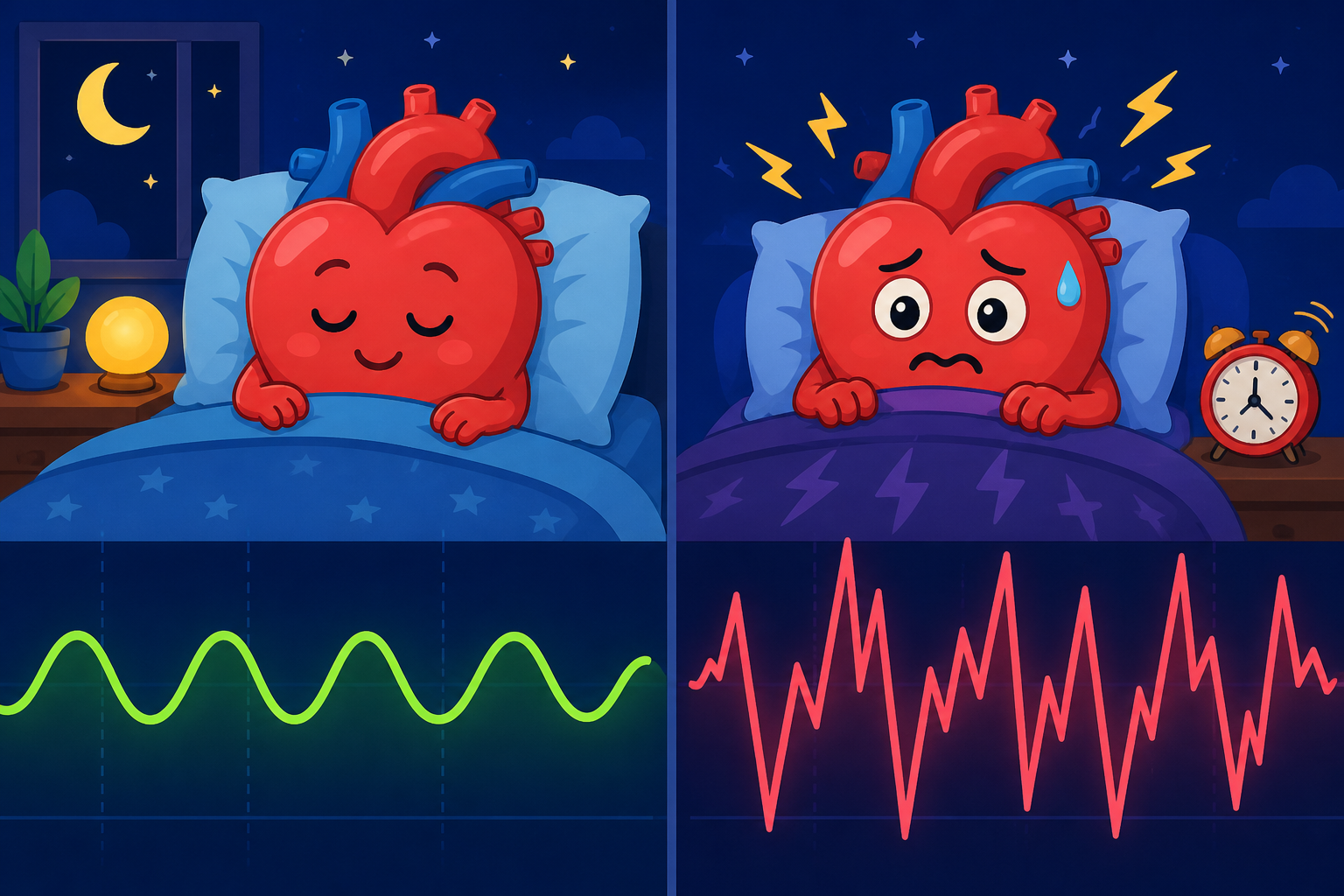
A 2017 study in Sleep & breathing and a 2013 study in Clinical autonomic research both examined these runs in patients with OSA. They found that people with severe sleep apnea experience abnormally long runs of heart rate acceleration followed by long runs of deceleration.
Instead of the gentle, natural variations seen in a healthy sleeping heart, the heart of someone with OSA is constantly speeding up to compensate for the lack of oxygen, then slowing down abruptly. The 2017 study noted that treating the patients with a CPAP machine (a device that keeps the airway open) significantly reduced these unnatural heart rate swings.
Blood Pressure and Arrhythmias
These constant heart rate swings can take a toll on the cardiovascular system over time. A 2024 study in BMC cardiovascular disorders looked at 265 patients who had high blood pressure.
The researchers divided the patients into two groups: those with mild or no sleep apnea, and those with moderate to severe sleep apnea. The patients with more severe sleep apnea had a significantly higher risk of experiencing abnormal heart rhythms, specifically atrial premature beats and atrial tachycardia. They also showed physical changes in the heart, such as an enlarged left atrium.
Related: The Science of Managing High Blood Pressure: What Actually Works
It Is Not Just an Obesity Issue
It is a common belief that sleep apnea only affects people who are overweight. While excess weight is a major risk factor, non-obese individuals can also suffer from OSA and experience the same heart stress.
A 2019 study in Heart and vessels focused entirely on non-obese patients with sleep breathing disorders. The researchers measured “heart rate turbulence”, which is how the heart stabilizes itself after a skipped or extra beat. They found that even in non-obese patients, severe sleep apnea was directly linked to impaired heart rate turbulence. This shows that the breathing disruptions themselves cause heart stress, regardless of the person’s body weight.
Who Needs Extra Caution
While sleep disruptions affect everyone, research highlights specific groups who might need to pay closer attention to their sleep and heart health.
Women and Sleep Restriction
A 2026 study in the American journal of physiology looked at what happens when healthy young adults restrict their sleep to just four hours a night for over a week. The researchers measured how their blood vessels and heart rates reacted to spontaneous wake-ups during the night.
They found that prolonged sleep restriction disrupted normal vascular responses, and this negative effect was much more evident in females than in males. The female participants showed a prolonged reduction in pulse transit time (a marker of blood vessel stiffness) after waking up briefly. This provides a clue as to why chronic short sleep is strongly linked to cardiovascular disease in women.
Children Who Snore
Sleep apnea does not only affect adults. Children with enlarged tonsils or adenoids can also experience airway blockages during sleep.
A 2024 study in the Italian journal of pediatrics monitored children aged 5 to 15 who snored. Using 24-hour heart monitors, they found that children with obstructive sleep apnea showed clear signs of altered heart rate variability compared to children who only snored without breathing pauses.
Fortunately, this is highly treatable. A 2021 study in Pediatric research followed 354 children with sleep apnea. Half received early surgery to remove their tonsils and adenoids, while the other half were put on watchful waiting. The children who had the surgery showed a significant improvement in their nocturnal heart rate patterns, proving that restoring normal breathing quickly helps the cardiovascular system recover.
Common Myths About Sleep Apnea and Heart Medication
Because sleep apnea causes the heart to slow down and speed up dramatically, doctors have historically debated how to safely treat these patients with heart medications.
One common myth is that beta-blockers (medications that lower blood pressure and slow the heart) are dangerous for people with sleep apnea. The fear was that because sleep apnea already causes the heart rate to drop during a breathing pause, a beta-blocker might cause the heart to slow down to a dangerous level.
A 2020 study in the Journal of the American Heart Association tested this theory. They compared sleep apnea patients taking beta-blockers to those not taking them. The results were reassuring. The patients on beta-blockers did not experience more dangerous heart pauses or worse bradycardia (slow heart rate). In fact, the beta-blockers appeared to protect the heart by reducing the extreme amplitude of the heart rate swings caused by the apneas.
Tracking Sleep at Home: The Future of Wearables
Traditionally, diagnosing sleep apnea and heart rate variability required a patient to spend the night in a lab covered in wires, a process known as polysomnography (pol-ee-som-NOG-ruh-fee).
However, scientists are actively testing wearable technology to make this easier.
- A 2022 study in Sensors tested wearable finger sensors (photoplethysmography or PPG) on mountain climbers at high altitudes, where low oxygen mimics the effects of sleep apnea. They found that wearable sensors accurately captured many heart rate variability metrics, though they sometimes struggled with very high-frequency heart changes compared to clinical chest monitors.
- Another 2022 study in Sensors tested an “electrodeless” fabric band worn around the chest. Using smart algorithms, this simple fabric band successfully captured both respiratory rate and heart rate with over 99 percent accuracy, drastically reducing the need for bulky equipment.
While these tools are not yet full replacements for a doctor’s diagnosis, they show that tracking your nighttime heart health is becoming much more accessible.
The Bottom Line / Takeaways
Here is a summary of what the current science tells us about sleep and heart rate:
- We know that: Breathing disruptions during sleep cause severe spikes and drops in your heart rate. Over time, this places immense stress on the cardiovascular system and increases the risk of high blood pressure and abnormal heart rhythms.
- We know that: This stress affects everyone who experiences sleep breathing issues, including children and non-obese adults.
- We are confident that: Treating the root cause of the breathing issue (such as using a CPAP machine for adults or removing tonsils in children) helps the heart return to a normal, healthy rhythm.
- What remains uncertain: While consumer wearables are getting better at tracking sleep and heart rate, there is still debate over how perfectly they match clinical laboratory equipment, especially for very detailed heart rate variability measurements.
Related: Obstructive Sleep Apnea Treatment: What the Latest Science Says
Quick Reference: Key Studies
| Study Focus | Key Finding | Source |
|---|---|---|
| Global OSA Prevalence | An estimated 936 million adults aged 30 to 69 worldwide have mild to severe obstructive sleep apnea. | PMID 36217085 |
| OSA and Hypertension | Hypertensive patients with moderate to severe OSA have a higher risk of atrial arrhythmias and enlarged left atriums. | PMID 38965474 |
| Heart Rate Runs in OSA | Severe OSA causes long, unnatural runs of heart rate acceleration and deceleration. CPAP therapy helps reduce these runs. | PMID 27882500 |
| Beta-Blockers and OSA | Beta-blockers are safe for OSA patients and actually help reduce the extreme heart rate swings caused by breathing pauses. | PMID 33107361 |
| Sleep Restriction in Women | Restricting sleep to four hours a night disrupts vascular responses to waking, with females showing more vulnerability than males. | PMID 42133047 |
| Pediatric OSA Surgery | Removing tonsils/adenoids in children with OSA improves their nocturnal heart rate patterns. | PMID 32392577 |
| Non-Obese OSA | Even in non-obese patients, severe sleep apnea impairs heart rate turbulence and autonomic function. | PMID 31111194 |
| Diabetes and OSA | While diabetes affects heart rate variability, the presence of sleep apnea overrides it, becoming the primary driver of heart rhythm changes. | PMID 28153217 |
Last updated: September 2026
This article synthesizes findings from peer-reviewed research. It is for educational purposes only and does not constitute medical advice. Consult a healthcare provider before starting any new regimen.

Leave a Reply