Walking into a gym for the first time can feel like stepping into a foreign country. Between the complex machines, heavy barbells, and conflicting advice from fitness influencers, it is easy to feel overwhelmed. Many beginners believe they need to lift the heaviest weights possible or follow a strict, punishing schedule to see results.
However, sports science paints a very different picture. Research into biomechanics, injury rates, and exercise psychology reveals that the most effective way for beginners to build strength is actually quite flexible and heavily focused on mastering basic movements.
Whether your goal is to build muscle, protect your joints, or improve your metabolic health, understanding what the science says about beginner weight training can help you start safely and effectively.
Related: The Science of Weight Training: How Resistance Exercise Changes Your Body
How Should Beginners Find Their Starting Weight?
One of the most common questions beginners ask is how much weight they should lift. In sports science, strength is often measured using a metric called the 1-Repetition Maximum (1RM) (one rep MAX-ih-mum), which is the absolute heaviest weight a person can lift for a single repetition of an exercise.
Traditionally, fitness programs are designed using percentages of this 1RM. For example, a program might ask you to lift 70 percent of your 1RM for ten repetitions. But there is a problem: testing your true 1RM is not safe or practical for someone who has never lifted weights before. Pushing a muscle to its absolute limit without established coordination and joint stability increases the risk of injury.
A 2022 study in Sensors (Basel, Switzerland) explored safer ways to estimate this starting point for beginners. Researchers tested 25 women with less than a month of weight training experience. Instead of forcing them to lift heavy weights to failure on a standard barbell bench press, they used a hydraulic fitness machine that adjusts resistance based on how fast the user pushes. By measuring the lifting speed and moderate load weights, the researchers could accurately predict the participants’ 1RM using a mathematical formula.
For the everyday beginner, the takeaway is clear: you do not need to test your absolute limits to figure out your starting weight. Starting with a lighter weight that allows you to move the weight at a steady, controlled speed is sufficient for building a foundation. If the weight moves too quickly and feels effortless, it is too light. If it forces you to slow down significantly or break your form, it is too heavy.

Tech Trackers vs. Human Coaches: What Works Best?
We live in an era of fitness trackers, smart mirrors, and apps that promise to correct your form. But when you are just starting out, is technology better than traditional coaching?
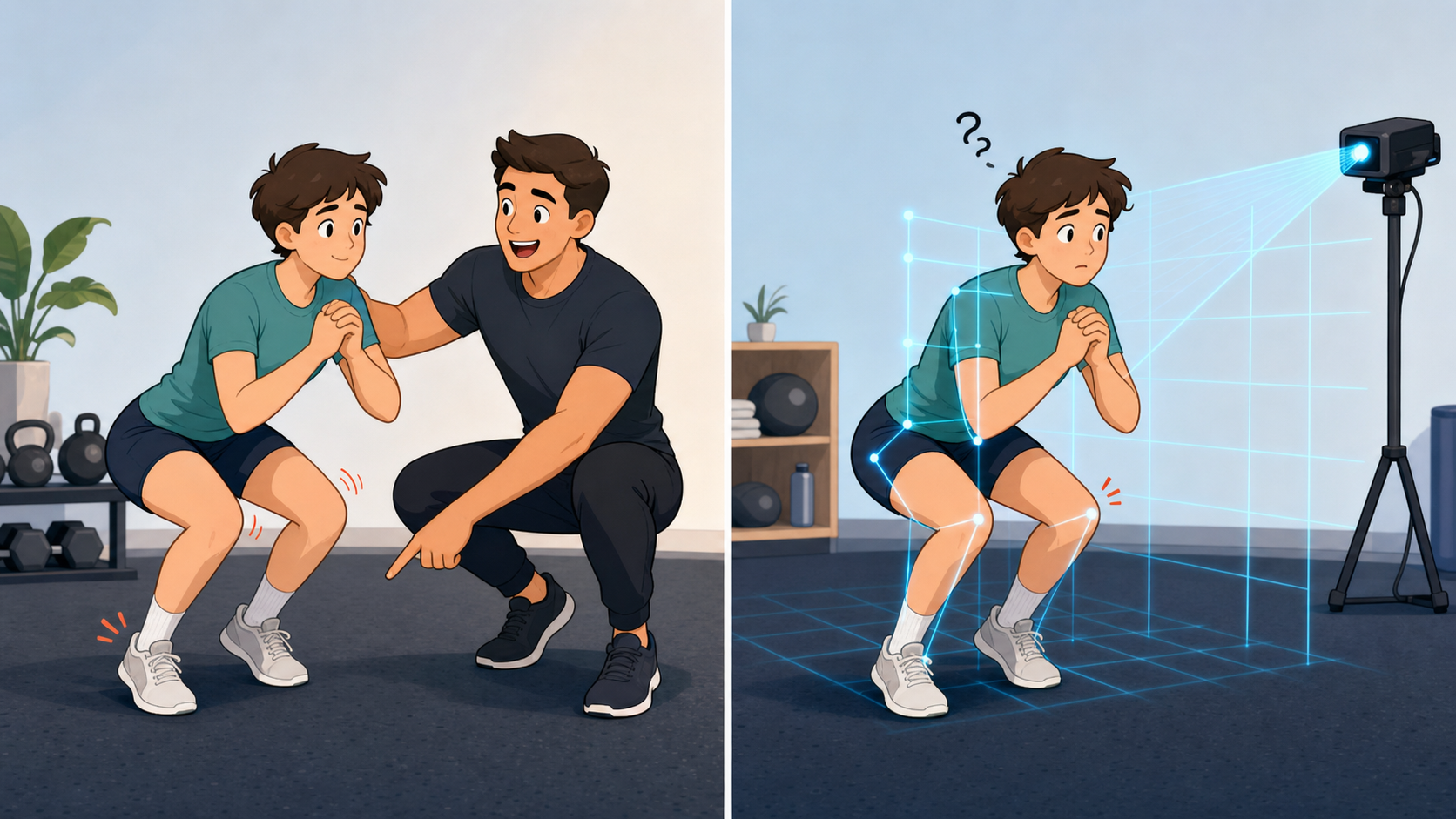
Researchers investigated this in a 2022 study in BMC sports science, medicine & rehabilitation. They took 19 untrained women and put them through a five-week barbell back squat training program. Half the group received “open-ended technological feedback” using a system of laser lights that visually showed them if they were shifting their weight unevenly. The other half received traditional, verbal feedback from an experienced human trainer.
The results were revealing. Both groups successfully increased the amount of weight they could squat. However, only the group receiving traditional verbal feedback improved their overall isometric strength (measured by a mid-thigh pull test) and received higher scores from experts rating their lifting technique.
While visual and technological feedback can be useful, a human coach can read body language, adjust cues based on how you learn, and provide specific instructions like “push equally with both feet” or “engage your core muscles.” For beginners learning complex movements, investing in a few sessions with a qualified professional is highly supported by the evidence.
Does a Strict Workout Schedule Matter?
Many fitness programs demand that you perform specific exercises at specific intensities on exact days. This rigid approach is known as linear periodization. Periodization (peer-ee-uh-dih-ZAY-shun) is simply the scientific term for how a training program is organized over time.
But life is unpredictable. Some days you might feel energetic, while other days you might be exhausted from poor sleep or stress. Can you still make progress if you adjust your workout based on how you feel?
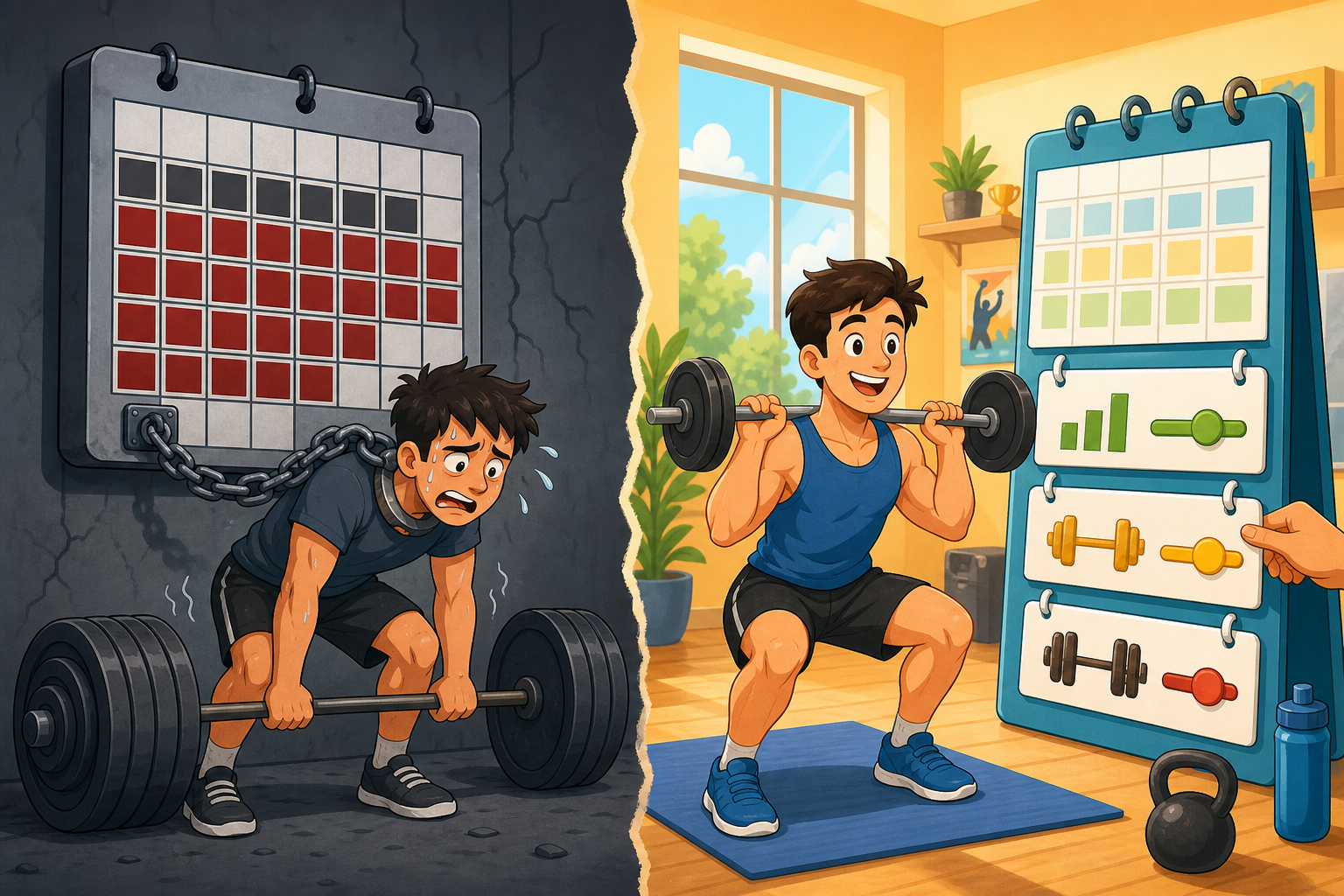
A 2010 study in the Journal of strength and conditioning research tested this exact concept, comparing a strict schedule to a “flexible nonlinear” schedule. Sixteen beginner weight training students were divided into two groups. Both groups were assigned the exact same total workload over 12 weeks, consisting of workouts that required 10, 15, or 20 repetitions.
The strict group was told exactly which workout to do on which day. The flexible group was allowed to choose their workout intensity (heavy, medium, or light) each day based on their personal energy levels and readiness.
The flexible group saw vastly superior results. They increased their leg press strength by an average of 62 kilograms, while the strict group only improved by 16 kilograms. By allowing beginners to match their training intensity to their daily recovery levels, they were able to train more effectively and avoid unnecessary fatigue.
Are Beginners More Likely to Get Injured?
A major barrier preventing people from starting weight training is the fear of injury. High-intensity programs like CrossFit are often viewed as particularly dangerous for novices. However, injury data tells a surprising story.
A 2020 study in Rehabilitation process and outcome surveyed 885 CrossFit athletes to identify injury patterns. The overall injury rate was about 33 percent, with the lower back and shoulders being the most common problem areas. But when researchers broke the data down by experience level, they found that advanced athletes were significantly more likely to get injured than beginners.
Specifically, athletes with more than three years of experience were 3.3 times more likely to report an injury than those with less experience. A similar 2019 study in Clinics (Sao Paulo, Brazil) confirmed this, finding that competitive-level athletes had a five-fold higher probability of injury compared to beginners.
Why do beginners get injured less? The research suggests that beginners are usually focused on learning proper form, establishing basic motor skills, and lifting manageable weights. Advanced athletes, on the other hand, are more likely to push their bodies to the point of fatigue, compromising their technique in order to lift heavier weights or beat a clock. As a beginner, as long as you prioritize form over ego, your statistical risk of injury is relatively low.
Related: How to Prevent Age-Related Muscle Loss: What the Latest Science Says
Circuit Training as a Starting Point
If you are transitioning from a completely sedentary lifestyle, jumping straight into heavy barbell lifting might not be the best approach.
A 2000 study in the Scandinavian journal of medicine & science in sports looked at 90 healthy but sedentary adults. The researchers compared 12 weeks of low-resistance circuit weight training against standard endurance training (like jogging or cycling). The circuit weight training group used air-resistance machines and kept their heart rates moderately elevated for 40 minutes, three days a week.
The researchers found that this low-resistance circuit training improved cardiovascular fitness (VO2 max) just as effectively as the endurance training, while also providing the added benefit of improved muscular fitness. For beginners, circuit training offers a highly efficient way to build a baseline of both heart health and muscle strength simultaneously.
Common Questions About Beginner Weight Training
Do I need to lift heavy weights to see results?
No. Research shows that low-to-moderate resistance training, such as circuit training, is highly effective for beginners to build a baseline of muscular and cardiovascular fitness.
How many days a week should a beginner lift weights?
A consensus statement from the British Association of Sport and Exercise Sciences recommends that all healthy adults perform muscle-strengthening activities on two or more days a week. Beginners should start slowly and gradually work up to this baseline.
Is it normal to feel uncoordinated at first?
Yes. When you first start lifting weights, your nervous system is learning how to recruit muscle fibers efficiently. Studies on lifting kinematics show that beginners naturally have less control during the lowering (eccentric) phase of a lift compared to advanced lifters. This coordination improves rapidly within the first few weeks of consistent practice.
Practical Guidance for Getting Started
Based on the synthesized research, here is how a beginner can safely and effectively start a weight training routine:
- Start with low resistance: Use lighter weights or circuit training to build a foundation of movement and cardiovascular health before attempting heavy lifts.
- Prioritize human feedback: If possible, work with a qualified coach or trainer for the first few weeks. Verbal cues and technique corrections are proven to be more effective than relying on mirrors or technology.
- Be flexible: Do not force yourself through a heavy workout if you are feeling exhausted. Adjusting your workout intensity based on your daily energy levels leads to better long-term strength gains.
- Focus on form, not weight: The data clearly shows that injuries happen when lifters prioritize heavy weights and speed over technique. Keep your movements controlled.
The Bottom Line
The scientific evidence strongly supports weight training as a safe and highly beneficial activity for beginners. While the gym environment can seem intense, the research shows that you do not need to lift to your absolute limit, nor do you need to follow a rigid, punishing schedule to get stronger.
Starting with moderate circuit training, utilizing flexible workout schedules, and getting verbal feedback from a coach are proven methods for building strength safely. Furthermore, beginners who focus on proper technique actually face a lower risk of injury than advanced athletes. The most important step is simply to begin, using manageable weights and a focus on long-term consistency.
Quick Reference: Key Studies
| Study Focus | Key Finding | Source |
|---|---|---|
| Estimating Starting Weight | Hydraulic machines and lifting speed formulas can safely estimate a beginner’s maximum strength without the risk of lifting to failure. | PMID 35062659 |
| Coaching vs. Technology | Traditional verbal feedback from a coach improved squat technique and overall strength better than high-tech visual feedback in untrained women. | PMID 36056403 |
| Workout Scheduling | Beginners who flexibly chose their workout intensity based on daily readiness gained significantly more leg strength than those on a strict schedule. | PMID 19858756 |
| Injury Rates | Advanced athletes are significantly more likely to sustain injuries during high-intensity training than beginners, likely due to pushing past fatigue. | PMID 34497463 |
| Circuit Training | Low-resistance circuit training improves both cardiovascular health and muscular fitness in sedentary adults just as well as traditional cardio. | PMID 10898265 |
Last updated: October 2023
This article synthesizes findings from peer-reviewed research. It is for educational purposes only and does not constitute medical advice. Consult a healthcare provider before starting any new regimen.


Leave a Reply