
Imagine eating a meal, feeling unwell shortly after, and wondering if you have developed a food allergy. You visit a doctor, take a test, and the results suggest you are allergic to a dozen different foods. You clear out your pantry, change your entire diet, and live in fear of hidden ingredients.
But what if those test results were only telling part of the story?
Food allergy testing is one of the most misunderstood areas of medicine. Many people assume that a positive allergy test means they will definitely have an allergic reaction if they eat that food. However, the science of allergy testing is much more complicated. Tests are excellent at telling us what we are not allergic to, but they frequently raise false alarms about foods we can actually eat safely.
This article breaks down how food allergy testing works, what the latest research shows about different testing methods, and how doctors determine what is truly safe for you to eat. If you are a parent managing a child’s diet, you may also find it helpful to read our related guide: Understanding Food Allergies in Children: What the Latest Science Shows.
Understanding the Basics: Sensitization vs. Allergy
To understand why food allergy tests can be confusing, we first need to understand what the tests are looking for.
True food allergies are driven by the immune system. When someone has an allergy, their immune system mistakenly identifies a harmless food protein as a dangerous invader. In response, the body produces a specific type of antibody.
- Immunoglobulin E (im-yoo-noh-GLOB-yoo-lin E) or IgE – the specific type of antibody produced by the immune system that triggers allergic reactions.
Having IgE antibodies against a food is called sensitization (sen-sih-tih-ZAY-shun). Allergy tests are designed to find out if you are sensitized. They look for the presence of these IgE antibodies in your skin or your blood.
However, sensitization is not the same thing as a clinical allergy. A person can have IgE antibodies to peanuts, test positive on an allergy test, and still eat peanut butter sandwiches every day with absolutely no symptoms. An actual allergy means you have the antibodies and you experience physical symptoms when you eat the food.

This is the core tension in food allergy testing. Tests measure sensitization, but doctors and patients care about actual allergic reactions.
What the Research Shows About Skin Prick Testing
Skin prick testing is the most common frontline tool for diagnosing food allergies.
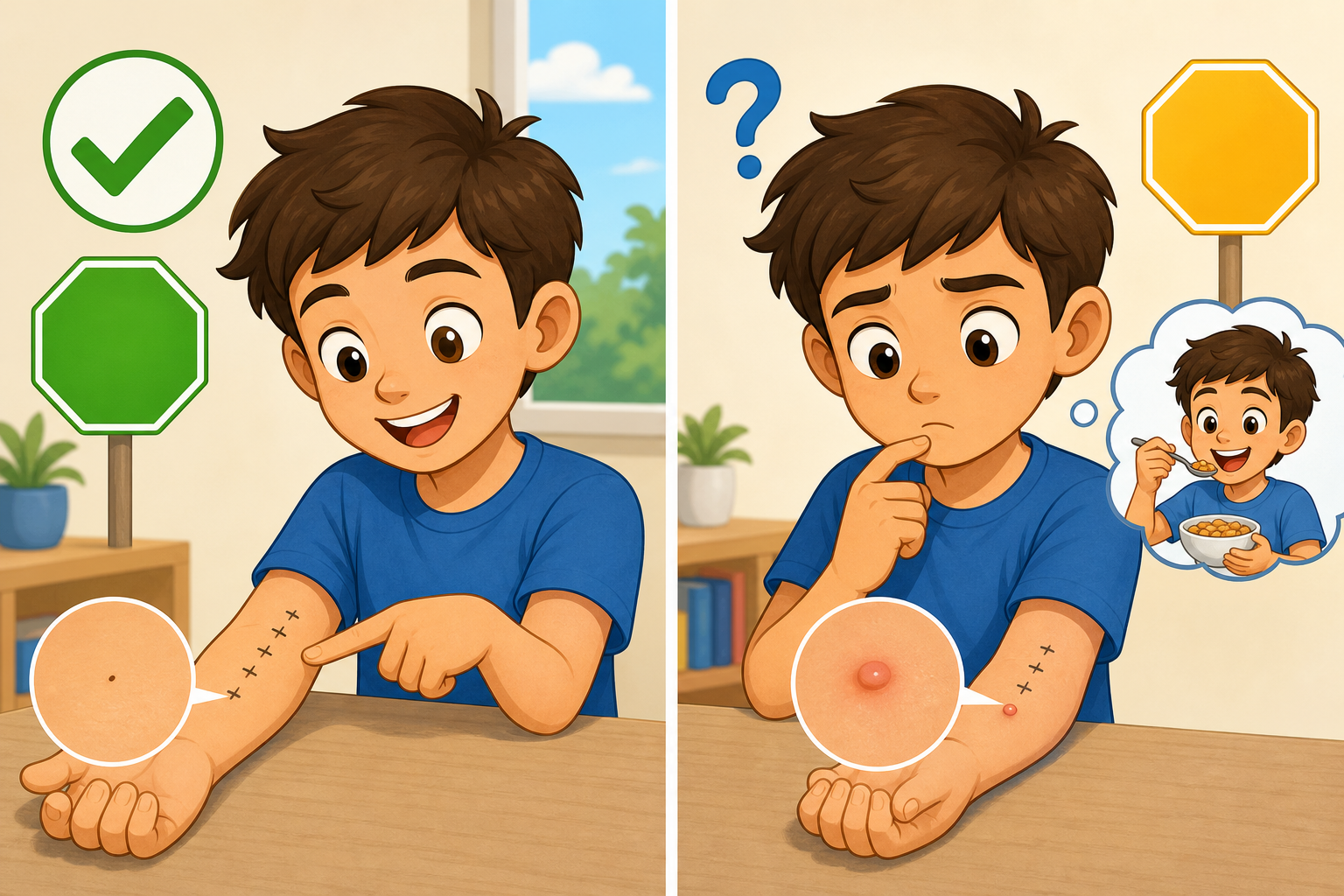
During this test, a doctor places a tiny drop of liquid containing a food protein (like milk, egg, or peanut) on the skin, usually on the forearm or back. They then use a small plastic device to lightly prick the surface of the skin, allowing the liquid to enter. If you have IgE antibodies to that food, immune cells in your skin will react, releasing chemicals like histamine.
This reaction causes a small, raised, itchy bump to form.
- Wheal (weel) – a raised, itchy bump on the skin that appears during an allergic reaction, similar to a mosquito bite.
The Power of a Negative Result
According to a 2001 review in Current Allergy Reports, skin prick tests are incredibly useful for ruling out allergies. If a skin prick test is negative, there is a 95 percent or higher chance that the person can eat the food safely without a severe reaction. In the medical world, this is called having a high “negative predictive value.”
If you are unsure whether a food is safe, a negative skin test provides strong reassurance that you can keep it in your diet.
The Problem with Positive Results
While a negative test is highly reliable, a positive test is much less certain. The same review noted that a positive skin test only accurately predicts a true allergic reaction about 50 to 70 percent of the time. This means that if you test positive for a food you have never eaten, there is a very good chance you might actually be able to tolerate it.
To improve accuracy, doctors measure the exact size of the wheal. Larger wheals generally indicate a higher likelihood of a true allergy. A 2000 study in Clinical and Experimental Allergy looked closely at skin test sizes in children. The researchers found that once a wheal reached a certain diameter, it became 100 percent predictive of an allergic reaction.
For example, they found that a wheal measuring 8 millimeters or larger for cow’s milk or peanuts, and 7 millimeters or larger for eggs, meant the child was virtually guaranteed to react if they ate the food. For children under two years old, those threshold sizes were even smaller.
Can Duplicate Testing Help?
Sometimes, the way the skin is pricked can cause slight variations in the results. A 2019 study in The Journal of Allergy and Clinical Immunology: In Practice examined whether doing the exact same skin prick test twice on the same patient (duplicate testing) could improve accuracy.
The researchers looked at over 7,000 duplicate tests. They found that the two tests disagreed (one was positive, the other was negative) about 13.5 percent of the time. This suggests that performing two skin tests side-by-side might help doctors catch technical errors and make more accurate diagnoses before moving on to riskier tests.
Blood Tests: Measuring Antibodies Directly
If skin testing is not possible (for instance, if a patient has severe eczema or is taking antihistamine medications), doctors use blood tests. These tests measure the exact amount of specific IgE antibodies in the bloodstream.
Just like skin tests, blood tests are excellent at ruling out allergies but struggle with false alarms. Having a high level of IgE antibodies to a food increases the risk of a reaction, but it does not guarantee one.
Furthermore, different laboratories use different methods to measure these antibodies, which can lead to confusing results. A 2018 review in Current Opinion in Allergy and Clinical Immunology highlighted that different testing machines can produce different “cutoff” values for what is considered a true positive. Because of this, patients should always have their blood test results interpreted by a qualified allergist who understands the specific laboratory methods used.
The Gold Standard: Oral Food Challenges
Because skin and blood tests can produce false alarms, the only definitive way to prove whether a food allergy exists is to have the patient eat the food under strict medical supervision.
- Double-blind, placebo-controlled food challenge (DBPCFC) – a test where neither the doctor nor the patient knows if the food being eaten is the allergen or a harmless substitute.
The DBPCFC is universally considered the “gold standard” for diagnosing food allergies. During this test, the patient is given increasing amounts of the suspected food hidden inside a safe food (like pudding or a milkshake). On a different day, they are given the safe food without the allergen (the placebo).

This method removes any psychological anxiety that might mimic an allergic reaction. If the patient reacts to the allergen but not the placebo, the allergy is confirmed.
The Shrimp Study: Why Challenges Matter
The importance of food challenges is perfectly illustrated by a 1993 study in Clinical and Experimental Allergy focusing on shrimp allergies.
Researchers gathered 30 people who had convincing histories of immediate allergic reactions to shrimp. They gave these patients a double-blind challenge, hiding shrimp protein in grape-flavored vanilla milkshakes.
Surprisingly, only 9 of the 30 people (30 percent) actually had an objective allergic reaction (like hives or wheezing) during the challenge. Another group experienced only an itchy mouth, while 9 people had absolutely no reaction at all.
If these patients had relied solely on their past experiences or basic allergy tests, many of them would have unnecessarily avoided shrimp for the rest of their lives. The food challenge proved that many of them could eat it safely.
Newer Technologies: Breaking Down the Allergen
Scientists are actively working on new ways to make allergy testing more accurate without having to put patients through the stress of an oral food challenge. Two emerging methods are showing promise.
Component-Resolved Diagnostics (CRD)
Standard allergy tests look at how the immune system reacts to a whole food. For example, a standard peanut test uses a mixture of all the proteins found in a peanut.
Component-Resolved Diagnostics (CRD) takes a closer look. It tests the blood for antibodies against the individual, specific proteins (components) inside the food.
Using peanuts as an example, scientists have identified several different peanut proteins, naming them Ara h 1, Ara h 2, Ara h 8, and so on. Research has shown that a person’s reaction depends heavily on exactly which protein their body recognizes.
According to the 2018 review by Sato et al., patients who have antibodies to the “Ara h 2” protein are at a very high risk for severe peanut allergy. On the other hand, patients who only have antibodies to “Ara h 8” often just experience a mild, itchy mouth. This happens because Ara h 8 is structurally similar to birch tree pollen, causing a mild cross-reaction rather than a severe food allergy.
While CRD sounds incredibly precise, it still has limitations. A 2019 review in the Annals of Allergy, Asthma & Immunology strongly cautioned against relying on CRD too heavily. The author noted that most CRD studies have been performed on highly specific groups of patients at specialty allergy centers. Because these tests have not been widely studied in the general public, doctors are still unsure exactly how to interpret the results for the average person. The review emphasizes that while CRD provides more detail, it still cannot perfectly predict how severe a reaction will be.
Basophil Activation Test (BAT)
The Basophil Activation Test (BAT) is another emerging blood test. Instead of just measuring the amount of antibodies in the blood, the BAT looks at how living immune cells actually behave.
- Basophil (BAY-so-fill) – a type of white blood cell that plays a major role in allergic reactions.
In a laboratory, scientists expose the patient’s basophils to the food allergen. They then measure how strongly the cells react and activate. Early research shows that the BAT is highly accurate and has superior specificity compared to standard skin and blood tests. However, the BAT requires fresh blood, specialized laboratory equipment, and highly trained technicians. Because of these hurdles, it is currently used mostly in research settings rather than everyday doctor’s offices.
Common Misunderstandings or Myths
Myth: A positive test means you must avoid the food.
Truth: If you currently eat a food without any problems, a positive skin or blood test does not mean you need to stop eating it. The test simply shows sensitization. Clinical history (what actually happens when you eat the food) always overrides a test result.
Myth: Allergy tests can tell you how severe your reaction will be.
Truth: The size of a skin test bump or the level of antibodies in a blood test can indicate the likelihood of a reaction occurring, but they cannot predict the severity of the reaction. A person with a small skin test result can still have a life-threatening reaction, and a person with a large skin test result might only get a few hives.
Myth: Food sensitivity tests (IgG tests) sold online are highly accurate.
Truth: Many commercial tests claim to diagnose “food sensitivities” by measuring Immunoglobulin G (IgG) antibodies. Major allergy and immunology organizations advise against using these tests. IgG antibodies simply show that your body has been exposed to a food and recognized it, which is a normal part of digestion and tolerance. They do not indicate an allergy or a dangerous sensitivity.
Where The Science Is Still Uncertain
While we have excellent tools for diagnosing immediate, IgE-mediated food allergies, the science is less clear when it comes to delayed food reactions.
Some patients experience symptoms like eczema flare-ups or digestive issues hours or even days after eating a specific food. Because these reactions do not involve IgE antibodies, standard skin prick tests and blood tests are not helpful.
Some researchers have explored using “patch testing” (where food proteins are taped to the back for 48 hours) to diagnose these delayed reactions. A 2001 review in Current Allergy Reports discussed early studies showing that patch testing might help identify foods causing delayed eczema flare-ups in children. However, the exact mechanism behind these delayed reactions remains poorly understood, and patch testing for foods is not yet a standard, universally accepted practice.
Additionally, researchers are still exploring how food processing changes allergens. For example, a 2002 study in the Annals of Allergy, Asthma & Immunology looked at children allergic to beef. They found that skin testing with fresh, raw beef was highly specific, while testing with commercial beef extracts was highly sensitive. The study highlighted that heating and processing can alter proteins, making it difficult to create perfectly standardized allergy tests for certain foods.
The Bottom Line / Takeaways
Navigating food allergy testing can be stressful, but understanding the science behind the tests can help you make informed decisions with your doctor.
Tests are clues, not diagnoses. Skin prick tests and specific IgE blood tests are excellent at proving you are not* allergic to something. However, they frequently produce false alarms for foods you can safely eat.
- History is key. Your personal experience with a food is the most important piece of the puzzle. Tests should only be used to confirm a suspected allergy, not to blindly screen for unknown problems.
- The gold standard is the food challenge. If test results and your physical history do not match, a medically supervised oral food challenge is the only way to know for sure if a food is safe.
- New technology is on the horizon. Component-Resolved Diagnostics (CRD) and Basophil Activation Tests (BAT) are providing a deeper look at the immune system, though they are not yet perfect replacements for food challenges.
If you suspect you have a food allergy, avoid broad panel testing that checks dozens of foods at once. Instead, work with a board-certified allergist to test only the specific foods that have caused you physical symptoms.
Quick Reference: Key Studies
| Study Focus | Key Finding | Source |
|---|---|---|
| Duplicate Skin Testing | Performing skin prick tests twice on the same patient showed a 13.5% disagreement rate, suggesting duplicate testing may catch technical errors. | PMID 30075343 |
| Skin Test Size Thresholds | Skin test wheals measuring 8mm or larger for milk/peanut and 7mm for egg were 100% predictive of an actual allergic reaction in children. | PMID 11069561 |
| Shrimp Allergy Challenges | Only 30% of patients with a strong history of shrimp allergy actually reacted during a double-blind, placebo-controlled food challenge. | PMID 10779302 |
| Beef Allergy Testing | Commercial beef extracts provided high sensitivity for testing, while fresh beef provided high specificity, showing the impact of food processing on allergens. | PMID 12487201 |
| Component-Resolved Diagnostics | While CRD tests offer detailed protein analysis, they have mostly been studied in specialized centers and require cautious interpretation in the general public. | PMID 30772391 |
| Advanced Testing Methods | The Basophil Activation Test (BAT) shows superior specificity to standard tests, and certain protein components (like Ara h 2) help predict severe peanut allergies. | PMID 29601353 |
| Predictive Accuracy of Tests | Skin tests have high negative predictive accuracy (ruling allergies out) but low positive predictive accuracy (ruling allergies in) without a strong clinical history. | PMID 11899287 |
Last updated: June 2026
This article synthesizes findings from peer-reviewed research. It is for educational purposes only and does not constitute medical advice. Consult a healthcare provider before starting any new regimen.


Leave a Reply