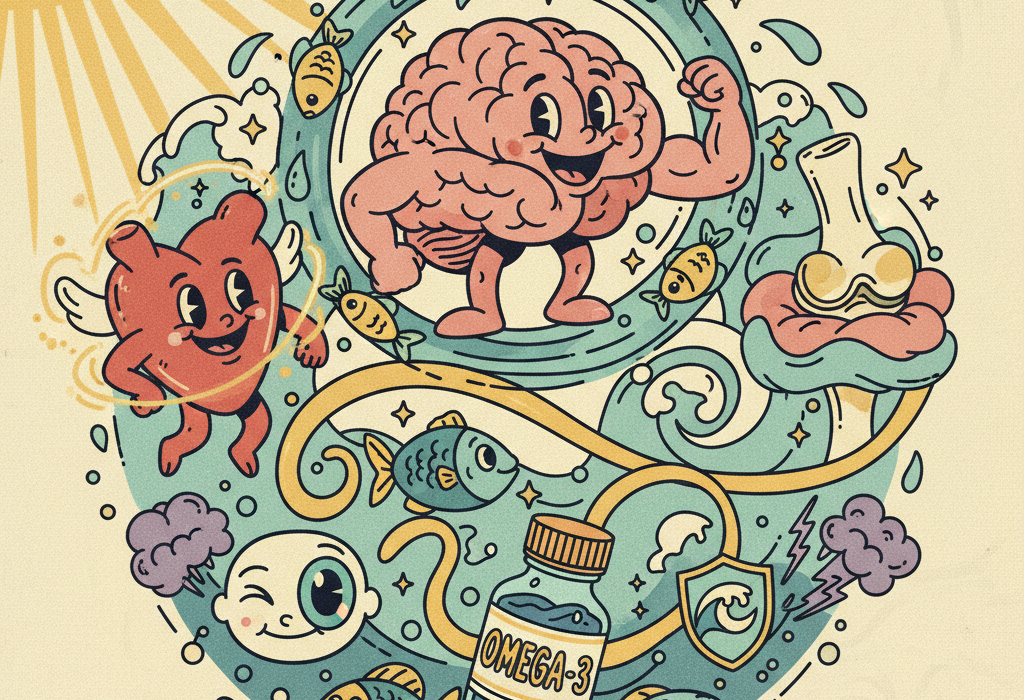
Omega-3 fatty acids are some of the most popular nutritional supplements in the world. You have likely heard that eating fish or taking fish oil capsules can protect your heart, sharpen your brain, and keep your joints healthy. But in the world of nutrition science, popular claims often outpace the actual evidence.
So, what does the research actually prove?
To understand omega-3s, it helps to think of your body’s cells like tiny houses. Every house needs a flexible, sturdy outer wall to let nutrients in and keep waste out. Omega-3 fatty acids are literally built into these outer walls, known as cell membranes. When you have enough omega-3s in your system, these cellular walls stay flexible and function smoothly. When you do not have enough, the walls can become stiff, making it harder for cells to communicate and triggering inflammation.

This article synthesizes recent peer-reviewed research to explain how omega-3s affect your heart, brain, eyes, and muscles, and helps clarify who actually benefits from taking them.
Understanding the Three Types of Omega-3s
Before looking at the health benefits, it is important to know that “omega-3” is a broad category. There are three main types you get from food:

- Eicosapentaenoic acid (eye-koh-suh-pen-tuh-NO-ic acid), or EPA: Found mostly in marine life like fatty fish and algae. It is heavily involved in reducing inflammation.
- Docosahexaenoic acid (doh-kossa-hex-uh-NO-ic acid), or DHA: Also found in marine life. It is a major structural building block of your brain and the retinas in your eyes.
- Alpha-linolenic acid (al-fuh-lin-oh-LEN-ic acid), or ALA: Found in plants like flaxseeds, walnuts, and chia seeds. Your body uses it for energy and can convert a very small amount of it into EPA and DHA.
Because the body is not very good at converting plant-based ALA into the more active EPA and DHA forms, most clinical research focuses on the benefits of marine-based omega-3s.
What the Research Shows About Heart Health
The most established medical use for omega-3s is protecting the cardiovascular system. For decades, observational studies noted that populations eating a lot of fish had fewer heart attacks. Today, randomized clinical trials give us a much clearer picture of how this works.
Lowering Blood Pressure
Omega-3s have a measurable impact on blood pressure. A 2022 review in the Journal of the American Heart Association analyzed 71 clinical trials to find the optimal dose for blood pressure control.
Researchers discovered a “J-shaped” curve. The most significant blood pressure reductions occurred at a moderate dose of 2 to 3 grams of combined EPA and DHA per day. At this dose, systolic blood pressure dropped by an average of 2.6 mm Hg. Taking massive doses above 3 grams a day did not provide additional blood pressure benefits for the average person. However, the study noted that people who already had high blood pressure or high cholesterol saw the strongest, most consistent improvements.
Reducing Heart Attacks and Surgeries
Beyond blood pressure, omega-3s help prevent severe cardiovascular events. A massive 2024 meta-analysis in the European Journal of Preventive Cardiology looked at over 134,000 participants. The researchers found that omega-3 supplementation significantly reduced the risk of myocardial infarction (heart attacks) and cardiovascular death.
Interestingly, the study found a strong reduction in the need for coronary revascularization (procedures like stents or bypass surgeries to open blocked arteries). The data also showed that taking EPA alone produced slightly greater cardiovascular benefits than taking a combination of EPA and DHA.
Related: The Science of Managing Cholesterol: What Research Actually Shows
Does Fish Oil Improve Brain Health and Memory?
Because your brain is highly enriched with DHA, scientists have long studied whether omega-3s can prevent cognitive decline or improve mood. The results here are mixed and depend heavily on the age and health status of the person taking them.
Cognitive Decline and Aging
A 2023 review in Current Opinion in Lipidology examined how omega-3s affect dementia and cognitive aging. The research shows a clear pattern: timing matters.
Supplementing with DHA appears to help people who are in the very early stages of memory loss, often called mild cognitive impairment. In one study of cognitively healthy older adults with coronary artery disease, taking 3.36 grams of EPA and DHA daily slowed cognitive aging by 2.5 years compared to a control group.
However, once a person has developed advanced Alzheimer’s disease, omega-3 supplements do not reverse the condition or significantly slow its progression. The researchers also noted that people carrying the APOE4 gene (a genetic risk factor for Alzheimer’s) may benefit the most from DHA supplementation, provided they start taking it before cognitive decline begins.
Related: Can We Prevent Age-Related Cognitive Decline? What Science Actually Shows
Menopause and Brain Fog
During the transition into menopause, many women experience “brain fog,” mood changes, and hot flashes due to fluctuating estrogen levels. A 2025 review in Post Reproductive Health explored whether omega-3s could help.
Estrogen normally helps the body synthesize DHA. As estrogen drops during menopause, the brain’s supply of DHA can decrease. While the research is still in early stages, some trials show that EPA and DHA supplementation during the menopausal transition can improve working memory and ease depressive symptoms. The effect on hot flashes is currently mixed, with some studies showing relief and others showing no difference compared to a placebo.
Depression and Mood
While some smaller studies suggest omega-3s help with depression, large-scale rigorous trials have been disappointing. The VITAL-DEP trial, published in The Journal of Clinical Psychiatry in 2023, tested whether vitamin D3 or omega-3s (1 gram per day) could prevent late-life depression in older adults at high risk for the condition.
Over a two-year period, the omega-3 supplements performed no better than a placebo. They did not prevent major depressive disorder, nor did they significantly improve general mood scores. While omega-3s are crucial for overall brain structure, taking a standard fish oil pill does not appear to act as a reliable preventive treatment for clinical depression in older adults.
Omega-3 Benefits for Dry Eyes and Skin
One of the most noticeable day-to-day benefits of omega-3s involves the body’s mucous membranes and skin barrier.
Screen Time and Dry Eye Relief
If you stare at a computer or phone all day, you may experience dry, gritty, or burning eyes. A 2023 clinical trial in the Indian Journal of Ophthalmology tested omega-3s on 470 visual display terminal (screen) users with dry eye symptoms.
Half the group took a placebo, while the other half took 2,400 mg of combined EPA and DHA daily for six months. The omega-3 group saw significant improvements. Their eyes produced more tears, the tears evaporated less quickly, and their overall discomfort dropped significantly. A blood test confirmed that patients who started with the lowest omega-3 levels in their blood saw the most dramatic relief.
Dermatology and Skin Health
Omega-3s also play a role in managing inflammatory skin conditions. A 2020 review in the Journal of Cutaneous Medicine and Surgery evaluated 38 studies on omega-3s and dermatology.
The review found that omega-3 supplementation provides measurable benefits as an add-on treatment for psoriasis, atopic dermatitis (eczema), and acne. By reducing the production of inflammatory chemicals in the body, EPA and DHA help calm the immune responses that trigger skin flare-ups. The fats also offer a mild level of systemic protection against UV damage from the sun.
Related: Protecting Skin From UV Damage: What the Latest Science Says
Sports Performance and Muscle Recovery
Athletes frequently use fish oil to help their joints and muscles recover. But does it actually work?
A 2020 review in Nutrients compared the effects of EPA and DHA on elite athletes versus amateur exercisers. The researchers found an interesting split in the data: amateurs often see more noticeable benefits than highly trained professionals.
For everyday active people, taking 1.8 grams or more of EPA/DHA daily consistently reduced delayed onset muscle soreness (DOMS) after heavy workouts. It also slightly improved oxygen uptake during endurance exercise.
For elite athletes, the benefits were harder to prove. Highly trained athletes already have optimized metabolic systems, making it difficult for a single supplement to move the needle. However, across both groups, omega-3s demonstrated a consistent ability to reduce exercise-induced inflammation and protect muscle cell membranes during intense physical stress.
Plant Sources vs. Marine Sources
If you do not eat fish, can you get enough omega-3s from plants?
Plant foods like walnuts, chia seeds, and flaxseeds are rich in ALA. A 2022 review in Advances in Nutrition looked specifically at ALA and cardiovascular disease. They found that higher intakes of dietary ALA are associated with a 10% lower risk of total cardiovascular disease and a 20% reduced risk of fatal coronary heart disease. ALA helps lower total cholesterol and triglycerides.
However, plant sources have a major limitation when it comes to brain and eye health. A 2022 review in Critical Reviews in Food Science and Nutrition confirmed that the human body is highly inefficient at converting ALA into EPA and DHA. Usually, less than 5% of the ALA you eat becomes EPA, and less than 1% becomes DHA.

Therefore, while walnuts and flaxseeds are excellent for heart health and general nutrition, vegetarians and vegans may need an algae-based EPA/DHA supplement to get the specific brain and eye benefits associated with marine omega-3s.
Who Benefits Most From Omega-3s?
| Population | Potential Benefit | Strength of Evidence |
|---|---|---|
| People with High Blood Pressure | Modest reduction in systolic pressure (at 2-3g/day) | Strong |
| People with High Triglycerides | Significant reduction in blood lipid levels | Strong |
| Office Workers / Screen Users | Relief from dry, irritated eyes | Strong |
| Amateur Athletes | Reduced muscle soreness after new or intense exercise | Moderate |
| Older Adults (Early Memory Loss) | May slow cognitive aging if started early | Moderate |
| Older Adults (Depression) | Does not reliably prevent late-life depression | Weak / Disproven |
The Bottom Line / Takeaways
Omega-3 fatty acids are essential structural components of your cells and play a vital role in managing inflammation.
What we know works:
Taking 2 to 3 grams of EPA and DHA daily is highly effective for lowering blood pressure, reducing the risk of heart attacks, and easing dry eye symptoms. It is also helpful for reducing muscle soreness in everyday athletes and calming inflammatory skin conditions.
What remains uncertain:
While DHA is critical for brain structure, taking fish oil pills will not cure Alzheimer’s disease or reliably prevent clinical depression. However, starting supplementation early in life or during the first signs of mild cognitive impairment may help protect memory.
Food vs. Supplements:
Eating fatty fish twice a week provides an excellent mix of EPA, DHA, and other nutrients. If you use a supplement, check the nutrition label. You want to look at the specific amounts of “EPA” and “DHA” listed on the back, not just the total “Fish Oil” listed on the front.
Quick Reference: Key Studies
| Study Focus | Key Finding | Source |
|---|---|---|
| Blood Pressure | 2-3g/day of EPA+DHA provides optimal blood pressure lowering. | PMID 35647665 |
| Heart Disease | Omega-3s significantly reduce the risk of heart attacks and coronary surgeries. | PMID 38869144 |
| Brain Health | DHA supplementation slows cognitive decline in early stages, especially for APOE4 carriers. | PMID 36637075 |
| Dry Eyes | 2400mg of EPA+DHA daily significantly improved dry eye symptoms in screen users. | PMID 37026312 |
| Depression | 1g/day of omega-3s did not prevent late-life depression in older adults. | PMID 37378490 |
| Plant Omega-3s (ALA) | ALA from plants lowers heart disease risk but converts poorly to EPA/DHA. | PMID 35170723 |
| Sports Recovery | Amateurs see noticeable reductions in muscle soreness with EPA/DHA supplementation. | PMID 33266318 |
Last updated: June 2026
This article synthesizes findings from peer-reviewed research. It is for educational purposes only and does not constitute medical advice. Consult a healthcare provider before starting any new regimen.

Leave a Reply