
Chia seeds have become a staple in smoothies, puddings, and health foods over the last decade. Much of their popularity comes from their high omega-3 fat content. However, the type of omega-3 found in plants is different from the type found in fish. This leads to a common question: does the omega-3 in chia seeds actually provide the same health benefits as marine oils?
The short answer is that chia seeds offer unique and measurable benefits for your heart and metabolism, but they are not a direct replacement for fish oil. Research shows that chia seeds can help lower certain types of cholesterol and reduce specific markers of inflammation. However, your body has to work hard to process plant-based omega-3s, meaning the way you prepare and eat chia seeds makes a massive difference in how much nutrition you actually absorb.
Here is a breakdown of what the latest scientific research says about chia seed omega-3, how it affects your body, and the best ways to include it in your diet.
How This Might Work: The Plant Omega-3 Pathway
To understand chia seeds, it helps to understand how omega-3 fats work in the body. There are three main types of omega-3 fatty acids:
- ALA (Alpha-linolenic acid): Found in plants like chia, flaxseed, and walnuts.
- EPA (Eicosapentaenoic acid): Found mostly in fish and marine algae.
- DHA (Docosahexaenoic acid): Also found mostly in fish and marine algae.
Chia seeds are incredibly rich in ALA. In fact, about 60 percent of the oil in a chia seed is made up of ALA.
When you eat chia seeds, your body absorbs the ALA. However, your body primarily uses EPA and DHA for things like brain health and reducing inflammation. To get those benefits, your liver must convert the ALA from the chia seeds into EPA and DHA.
Think of ALA as raw lumber. Your body is the carpenter that must turn that lumber into finished furniture (EPA and DHA). The catch is that the human body is not very efficient at this conversion process. Only a small percentage of ALA is successfully converted into EPA, and an even smaller amount becomes DHA.

Related: What Science Actually Says About Omega-3 Fatty Acid Benefits
What the Research Shows
Scientists have studied chia seeds extensively to see if consuming them leads to real-world health improvements. The results show that chia seed consumption does alter body chemistry, particularly regarding fats and inflammation.
Chia Seeds and Your Lipid Profile
A lipid profile is a blood test that measures the amount of cholesterol and fats in your blood. A 2021 review in Food & Function analyzed ten different clinical trials to see how chia seed consumption affected the lipid profiles of adults.
The researchers found that eating chia seeds had a protective effect on heart health markers. Specifically, chia consumption lowered total cholesterol and reduced triglycerides (a type of fat in the blood). It also lowered LDL cholesterol, which is often called “bad” cholesterol.
When looking directly at omega-3 levels in the blood, the same review found that eating chia seeds successfully increased blood levels of ALA and EPA. However, it actually reduced levels of DHA. This supports the idea that while chia seeds boost certain omega-3s, they do not help the body accumulate DHA.
Related: What Science Actually Says About Managing Cholesterol: What Research Actually Shows
Chia Seeds and Inflammation
Inflammation is the body’s natural response to injury or stress, but chronic inflammation is linked to many diseases. Scientists measure inflammation by looking at specific proteins in the blood.
A 2024 meta-analysis in the Journal of Nutritional Science looked at how chia seed supplementation affected three major inflammatory markers. The researchers found that consuming chia seeds significantly reduced levels of C-reactive protein (see-ree-AK-tiv PRO-teen), or CRP. CRP is a general marker that goes up when there is inflammation anywhere in the body.
Interestingly, the chia seeds did not significantly change the levels of two other specific inflammatory markers called IL-6 and TNF-alpha. The researchers noted that CRP responds very quickly to dietary changes, while IL-6 and TNF-alpha are involved in long-term, chronic inflammation and might require longer dietary interventions to change.
To get the best results for lowering CRP, the review noted that participants needed to consume more than 35 grams of chia seeds per day (about 3 tablespoons) for at least 12 weeks.
Related: What Blood Tests for Inflammation Actually Tell Us About Your Health
Food Science: Protecting the Omega-3s
One of the biggest challenges with omega-3 fats is that they are highly unstable. When exposed to air, light, or heat, they oxidize (spoil) quickly, which can cause a rancid taste and reduce their health benefits.

Food scientists are actively researching ways to protect chia oil so it can be added to everyday foods. A 2024 study in the Journal of the Science of Food and Agriculture successfully created microcapsules of chia oil to fortify fruit smoothies. By wrapping the oil in tiny, invisible layers of proteins and chia mucilage (the gel-like substance chia produces in water), they protected the omega-3s from spoiling for over 30 days without changing the taste of the smoothie.
Similarly, a 2024 study in ACS Omega found that blending chia oil and fish oil inside spray-dried microcapsules allowed scientists to create an omega-3 enriched mayonnaise that remained stable and tasty for weeks.
Practical Guidance: How to Prepare Chia Seeds
If you want to get the most omega-3s from your chia seeds, you cannot simply eat them dry. Chia seeds have a tough outer shell that human digestion struggles to break down fully. If you eat them whole and dry, they may pass through your digestive tract without releasing their beneficial oils.
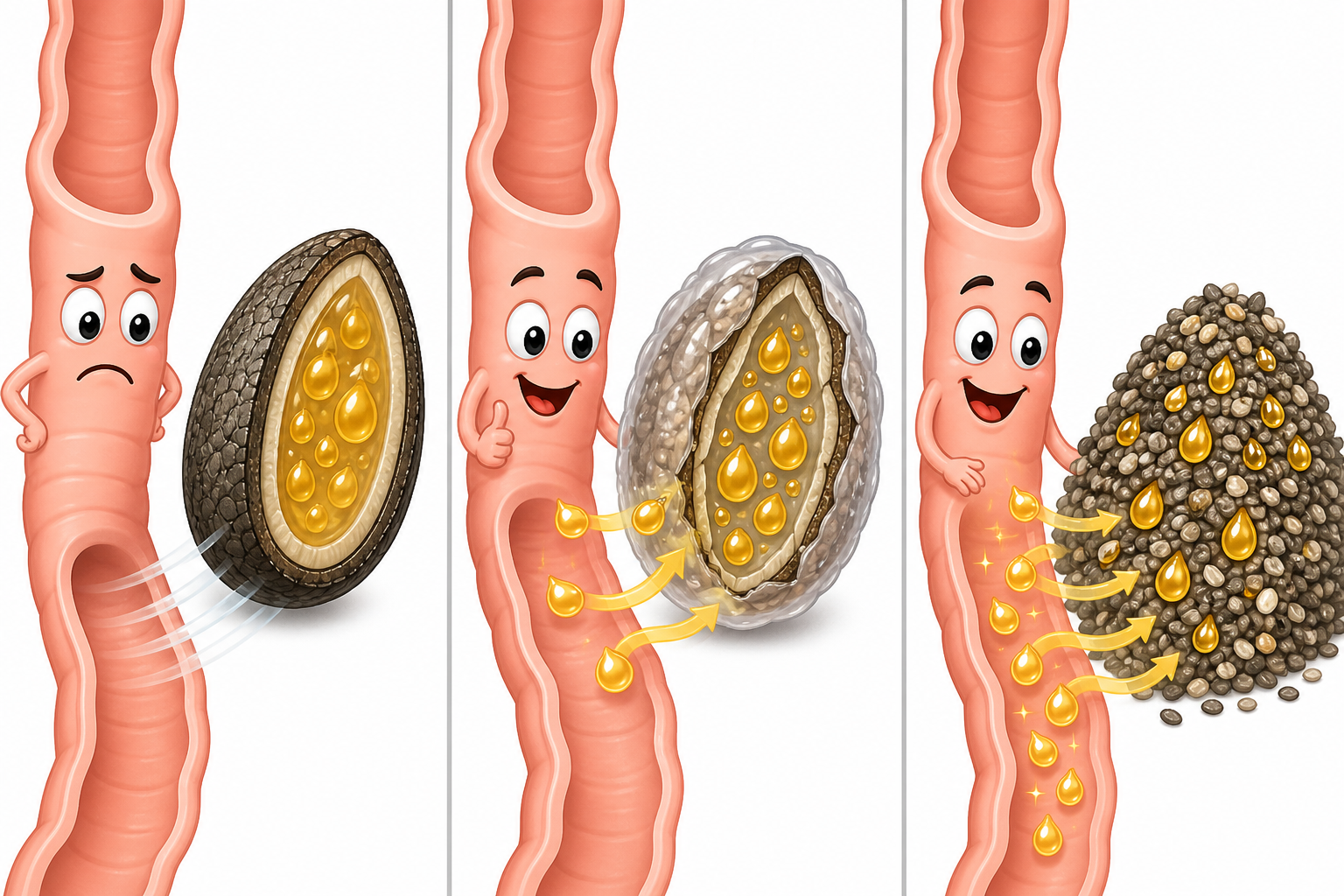
A 2019 study in Food Research International tested how different preparation methods affected the release of omega-3 fats from chia seeds. The researchers found that soaking chia seeds in water for 24 hours significantly improved the extractability of the omega-3 fats.
Soaking the seeds allows them to absorb water, which plasticizes (softens) the cells and weakens the cell walls. This makes it much easier for your digestive system to access the fats stored inside the seed.
Grinding or milling chia seeds also solves this problem. The clinical trials analyzed in the 2021 Food & Function review noted that participants who consumed ground chia seeds saw higher increases in blood ALA levels compared to those who ate whole seeds.
Chia Seed Preparation Comparison
| Preparation Method | Omega-3 Absorption | Why It Works |
|---|---|---|
| Dry, Whole Seeds | Low | The tough outer shell prevents the digestive system from accessing the oils inside. |
| Soaked in Water | High | Water softens and weakens the cell walls, releasing the fats for digestion. |
| Ground or Milled | High | Physically breaking the shell exposes the inner oils directly to the digestive tract. |
Where The Science Is Still Uncertain
While human studies clearly show chia seeds increase ALA and EPA, their effect on DHA remains complicated.
Some animal research suggests chia can help with DHA levels under specific conditions. A 2026 study in Prostaglandins, Leukotrienes, and Essential Fatty Acids tested pregnant rats on a high-fat, high-sugar diet. When researchers supplemented the rats’ diet with chia seeds, they found increased levels of DHA in the maternal liver, the placenta, and the fetal brain.
However, human clinical trials consistently show that chia seed consumption does not reliably increase DHA in the blood, and sometimes even reduces it. This highlights a common scientific reality: what happens in a rat’s metabolism during pregnancy does not always translate to everyday human digestion. Currently, the most reliable way for humans to increase DHA is still through marine sources like fish or algae oil.
Who Needs Caution
Because omega-3 fatty acids can influence how blood clots, very high doses can have a mild blood-thinning effect.
A 2023 animal study in The Yale Journal of Biology and Medicine looked at using chia seeds to protect rats from the toxic effects of a chemotherapy drug called cyclophosphamide. While the chia seeds did help protect the animals’ reproductive health from the drug’s toxicity, the researchers noted an unexpected side effect: several rats consuming the chia seeds experienced nasal bleeding.
The researchers suggested that the anti-platelet (blood-thinning) properties of the omega-3s in chia seeds may have interacted negatively with the chemotherapy drug, which already suppresses bone marrow. While this was an animal study using high doses alongside harsh medication, it serves as a reminder that natural supplements can interact with prescription drugs. Anyone taking blood thinners or undergoing chemotherapy should speak to their doctor before adding large amounts of chia seeds to their diet.
Common Questions About Chia Seed Omega-3
Can chia seeds replace fish oil supplements?
No. Chia seeds are an excellent source of ALA and can help boost EPA levels, but they do not provide DHA. Fish oil provides direct sources of both EPA and DHA. They offer different benefits and can both be part of a healthy diet.
Do chia-fed chickens produce better eggs?
Feeding chia seeds to chickens does increase the ALA omega-3 content of their eggs. However, a 2015 study in the Journal of Food Science found that feeding hens chia did not result in eggs containing EPA or DHA. Only hens fed fish oil produced eggs with EPA and DHA.
How much chia should I eat for health benefits?
Research suggests that to see significant changes in inflammation markers like CRP, a daily intake of about 35 grams (roughly 3 tablespoons) of milled or soaked chia seeds over several months is required.
The Bottom Line
Chia seeds are a highly nutritious food backed by solid science. The evidence confidently shows that they provide a dense source of ALA omega-3s, which can lower triglycerides, improve cholesterol profiles, and reduce general inflammation markers like CRP.
However, they are not a magic bullet. Your body struggles to convert the plant-based ALA in chia seeds into the DHA your brain and eyes need. Furthermore, to actually absorb the omega-3s locked inside a chia seed, you must either grind them up or soak them in liquid first.
Adding a few tablespoons of soaked or ground chia seeds to your daily routine is an excellent, evidence-based way to support your heart and metabolic health, provided you understand they work best alongside a balanced diet, not as a replacement for all other healthy fats.
Quick Reference: Key Studies
| Study Focus | Key Finding | Source |
|---|---|---|
| Lipid Profile | Chia consumption lowers total cholesterol, triglycerides, and LDL, while increasing ALA and EPA (but reducing DHA). | PMID 34378609 |
| Inflammation | Consuming chia seeds significantly reduces CRP (a marker of inflammation) but does not change IL-6 or TNF-alpha. | PMID 39703891 |
| Nutrient Absorption | Soaking chia seeds in water for 24 hours weakens cell walls and significantly improves the release of omega-3 fats. | PMID 31732052 |
| Drug Interactions | High doses of chia seeds combined with chemotherapy drugs caused bleeding in rats, highlighting potential anti-platelet effects. | PMID 38161578 |
| Food Fortification | Microencapsulation successfully protects chia oil from spoiling, allowing it to be added to smoothies and mayonnaise. | PMID 38105416 |
Last updated: October 2026
This article synthesizes findings from peer-reviewed research. It is for educational purposes only and does not constitute medical advice. Consult a healthcare provider before starting any new regimen.


Leave a Reply